Gutscheinbedingungen

**Gültig bis 17.08.2026 auf Schreibwaren & Office-Artikel online auf thalia.at, in der Thalia App und in teilnehmenden Thalia Buchhandlungen in Österreich mit Schulsortiment. In den Buchhandlungen nur gültig auf lagernde Ware. Einzelne Artikel können ausgeschlossen sein. Ausgenommen sind preisgebundene Artikel. Pro Einkauf einmal einlösbar. Nur gültig gegen Vorlage oder im Onlineshop hinterlegter Bonuscard. Infos zur Einlösung in der Buchhandlung sind auf der Bonuscard-Vorteilspreisseite zu finden. Click & Collect nur bei Onlinevorabzahlung möglich. Keine Einlösung bei Scan & Go-Bezahlung. Keine Barauszahlung. Nicht kombinierbar mit anderen Aktionen und Gutscheinen. Gutschein wird auf max. 500€ Bestellwert angerechnet. Nicht gültig für Geschenkkarten, Versandkosten und Services.

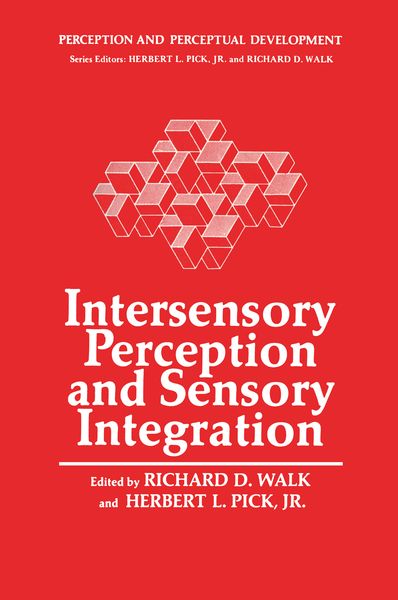
  • Produktbild: Intersensory Perception and Sensory Integration
  • Produktbild: Intersensory Perception and Sensory Integration
Band 2

Intersensory Perception and Sensory Integration

51,99 €

inkl. gesetzl. MwSt., Versandkostenfrei


Beschreibung

Produktdetails

Einband

Taschenbuch

Erscheinungsdatum

18.04.2012

Herausgeber

Richard D. Walk + weitere

Verlag

Springer Us

Seitenzahl

436

Maße (L/B/H)

22,9/15,2/2,4 cm

Gewicht

633 g

Auflage

Softcover reprint of the original 1st ed. 1981

Sprache

Englisch

ISBN

978-1-4615-9199-3

Beschreibung

Produktdetails

Einband

Taschenbuch

Erscheinungsdatum

18.04.2012

Herausgeber

Verlag

Springer Us

Seitenzahl

436

Maße (L/B/H)

22,9/15,2/2,4 cm

Gewicht

633 g

Auflage

Softcover reprint of the original 1st ed. 1981

Sprache

Englisch

ISBN

978-1-4615-9199-3

Herstelleradresse

Springer-Verlag KG
Sachsenplatz 4-6
1201 Wien
AT

Email: GPSR Kontakt

Noch keine Bewertungen vorhanden

Verfassen Sie die erste Bewertung zu diesem Artikel

Helfen Sie anderen Kundinnen und Kunden durch Ihre Meinung.

Kundinnen und Kunden meinen

Bewertungen (0)

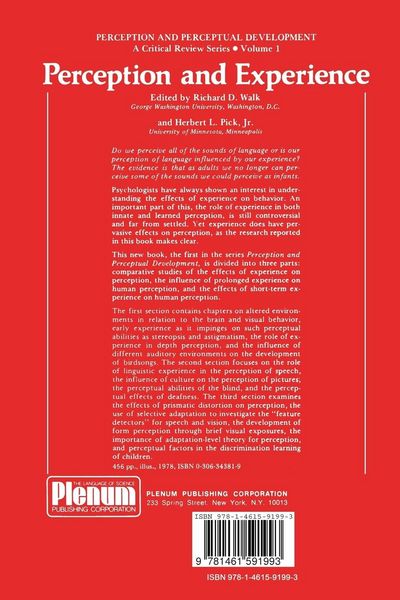
  • Produktbild: Intersensory Perception and Sensory Integration
  • Produktbild: Intersensory Perception and Sensory Integration
  • I Intersensory Perception and Sensory Integration in Children.- 1 The Ontogeny of Intermodal Relations: Vision and Touch in Infancy.- 1. Introduction.- 2. The Neonate.- 3. Equivalence of Location.- 4. Equivalence of Perceptual Features.- 5. Equivalence of “Actions”.- 6. Differentiation.- 7. Summary.- 8. References.- 2 The Origins of Auditory-Visual Perception and Visual Proprioception in Human Development.- 1. Introduction: The Genetic Method.- 2. Some Theoretical and Evolutionary Considerations.- 3. The Origins of Auditory-Visual Perception.- 3.1. Piaget’s Theory.- 3.2. Oculomotor Responses to Sound in the Neonate.- 3.3. The Primitive-Unity Hypothesis.- 3.4. Detection of Intermodal Equivalence.- 4. Summary and Conclusions: Auditory-Visual Coordination.- 5. Visual Proprioception.- 5.1. Theories of Visual-Motor Coordination.- 5.2. Reaching for Virtual Objects.- 5.3. Neonatal Responses to Looming.- 5.4. Visual Proprioception and Posture.- 6. General Conclusions.- 7. References.- 3 Integrating the Information from Eyes and Hands: A Developmental Account.- 1. Introduction.- 2. Undifferentiated Perception and the Unity of the Senses.- 3. Studies for Intersensory Coordination during Infancy.- 3.1. Looming.- 3.2. Haptic-Visual Transfer and Matching of Shape by Infants.- 3.3. Evidence from Early Imitation.- 4. Postinfancy Developmental Research.- 4.1. Processing Shape versus Length.- 5. Perceptual Activity and Exploration.- 5.1. Perceptual Activity When Perceiving Object Shape.- 5.2. Perceptual Activity When Perceiving Length.- 5.3. Perceptual Activity When Perceiving Complex Visual Displays.- 5.4. Summary.- 6. Conclusions.- 7. References.- 4 The Developmental Significance of Cross-Modal Matching.- 1. Introduction.- 2. Birch and Lefford’s Account of Cross-Modal Development..- 3. Visual-Tactual Cross-Modal Matching.- 3.1. Methodological Considerations.- 3.2. A Theory of Visual-Tactual Matching.- 3.3. Visual-Tactual Matching of Form.- 3.4. Cross-Modal Matching of Texture.- 4. Visual and Nonvisual Judgments of Length.- 5. Visual-Auditory Matching.- 6. Conclusions.- 7. References.- II Higher-Order Integration.- References.- 5 Some Aspects of Sensory-Motor Control and Adaptation in Man.- 1. Introduction.- 2. Adaptation to Sensory Rearrangement.- 3. Some Limitations on the Nature of Possible Compensatory Changes in Sensory-Motor Control.- 4. Conditions for Adaptation to Sensory Rearrangement.- 5. Factors Influencing the Form of Adaptation.- 5.1. Incremental Exposure to Sensory Rearrangement.- 5.2. Influence of Exposure Condition on Adaptation.- 5.3. Adaptational Specificity.- 5.4. Intersensory Factors and Adaptation: Constancies of Auditory and Visual Direction.- 5.5. Adaptation to Coriolis and Cross-Coupled Angular Accelerations.- 6. Intersensory Interactions.- 6.1. Z-Axis Recumbent Rotation: Importance of Touch and Pressure Cues.- 6.2. Skeletal Muscle Vibration: Illusory Postural and Visual Motion.- 7. Conclusions.- 8. References.- 6 Visual-Proprioceptive Interactions.- 1. Introduction.- 1.1. Scope of Chapter.- 1.2. Contents of Chapter.- 2. Classical Views of Proprioception.- 2.1. Proprioceptive and Exteroceptive Fields.- 2.2. Anatomical and Physiological Considerations.- 2.3. Cooperative Functioning of Proprioceptive and Visual Receptors.- 3. Modern Views of Proprioception.- 3.1. Historical Perspective.- 3.2. Contemporary Views.- 4. Mechanisms Subserving Visual Direction and Orientation.- 4.1. Background.- 4.2. Inflow Mechanisms.- 4.3. Outflow Mechanisms.- 4.4. Possible Hybrid Mechanisms.- 5. Experimental Modification of Visual-Proprioceptive Relationships.- 5.1. Methodological Considerations.- 5.2. Visual and Proprioceptive Illusions in Altered Gravitational-Inertial Fields.- 6. References.- 7 Multisensory Aspects of Rhythm.- 1. Introduction.- 1.1. Rhythm in Antiquity.- 1.2. Main Characteristics of Rhythms.- 2. Rhythms in the Different Sensory Modalities.- 2.1. Rhythm as Perception of the Succession.- 2.2. Rhythmic Groupings.- 2.3. The Spontaneous Tempo.- 2.4. The Ontogenesis of Rhythms.- 3. Auditory and Visual Rhythms.- 3.1. The Differences.- 3.2. Resemblances.- 4. The Sensory-Motor Aspect of Rhythms.- 4.1. Auditory-Motor Relations.- 4.2. Visuomotor Relations.- 4.3. Sensory Cues in Synchronization.- 4.4. The Role of the Nervous Centers.- 4.5. Rhythm and Affectivity.- 5. Rhythmic Cues in Poetry and Music.- 5.1. Music.- 5.2. Poetry.- 5.3. The Human Voice.- 5.4. The Principal Psychological Characteristics.- 6. Rhythms in Space.- 6.1. The Structures.- 6.2. Simultaneity and Succession.- 7. References.- 8 Gait Perception as an Example of How We May Perceive Events.- 1. Time, Movement, and Their Place in Event Structure.- 2. Gait Perception without Familiarity Cues.- 2.1. A Search for a Biomechanical Invariant.- 2.2. An Invariant Found: A Center of Moment.- 2.3. Gait Synthesis.- 3. Perceiving Centers of Moment in Other Events.- 3.1. Perceiving Centers of Moment in Wheel-Generated Motions.- 3.2. Perceiving Centers of Moment in Aging Faces.- 3.3. Perceiving Centers of Moment in Flowfields.- 3.4. Perceiving Centers of Moment in the Night Sky.- 4. Toward a Grammar for Perceptual Events.- 5. Summary.- 6. References.- III • Sensory Integration in Special Populations.- References.- 9 Cross-Modal and Intersensory Perception and the Blind.- 1. Introduction.- 1.1. Implications of Crossmodal Models for Blind Performance.- 1.2. Some Methodological Considerations in Assessing Blind Performance.- 2. Shape Recognition.- 2.1. Three-Dimensional Shapes in Touch and Vision.- 2.2. Touch and Naming.- 2.3. Names, Shapes, and Physical Features in Tactual Recognition.- 2.4. Tactual Coding and Information from Other Sources..- 2.5. Shapes, Names, and Familiarity: An Explanation.- 3. Spatial Judgments.- 3.1. Movement and Vision in Length Judgments.- 3.2. Spatial Location and Direction.- 3.3. Sound, Vision, and Movement in Large-Scale Space..- 4. Conclusions.- 5. References.- 10 Coding Strategies of Normal and Handicapped Children.- 1. Introduction.- 2. Modality-Specific Memory Systems and Sensory Integration.- 3. Temporal and Spatial Coordinates.- 4. Modality-Specific Processing.- 5. Representational Coding.- 6. Phonological Coding.- 7. Interpretation.- 8. References.- 11 Sensory-Motor and Perceptual-Motor Theories and Practices: An Overview and Evaluation.- 1. Introduction.- 2. Theoretical Issues and Child Development.- 3. Sensory- and Perceptual-Motor Programs and Changes in Movement Capacities.- 4. Perceptual-Motor Programs and Visual and Visual- Perceptual Changes.- 5. Sensory Integration and Neurological Organization.- 6. Summary.- 7. References.- 12 Individual Differences in the Interaction of Vision and Proprioception.- 1. Introduction.- 2. Developmental Changes in Modality Preference.- 3. Research with the Blind.- 3.1. Form Perception.- 3.2. Spatial Perception.- 4. Prism Adaptation and Visual Capture.- 4.1. Visual Capture.- 5. Rod-and-Frame Experiments.- 5.1. Visual Skills.- 5.2. Body Skills.- 5.3. Individual Differences and Sports.- 6. Artists and Athletes.- 7. Conclusion.- 8. References.- Author Index.