• Produktbild: Understanding Machine Learning
  • Produktbild: Understanding Machine Learning

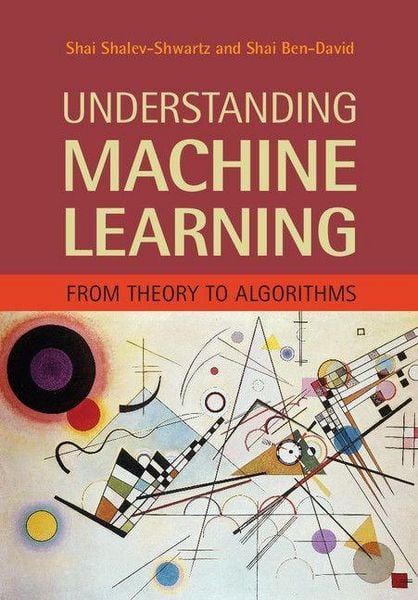
Understanding Machine Learning From Theory to Algorithms

62,99 €

inkl. gesetzl. MwSt., Versandkostenfrei


Beschreibung

Produktdetails

Einband

Gebundene Ausgabe

Erscheinungsdatum

06.03.2019

Verlag

Cambridge University Press

Seitenzahl

410

Maße (L/B/H)

26/18,3/2,7 cm

Gewicht

910 g

Sprache

Englisch

ISBN

978-1-107-05713-5

Beschreibung

Rezension

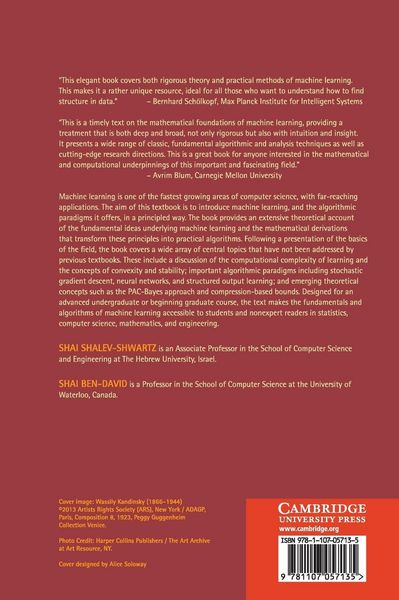
'This elegant book covers both rigorous theory and practical methods of machine learning. This makes it a rather unique resource, ideal for all those who want to understand how to find structure in data.' Bernhard Schölkopf, Max Planck Institute for Intelligent Systems, Germany

Produktdetails

Einband

Gebundene Ausgabe

Erscheinungsdatum

06.03.2019

Verlag

Cambridge University Press

Seitenzahl

410

Maße (L/B/H)

26/18,3/2,7 cm

Gewicht

910 g

Sprache

Englisch

ISBN

978-1-107-05713-5

Herstelleradresse

Libri GmbH
Europaallee 1
36244 Bad Hersfeld
DE

Email: gpsr@libri.de

Noch keine Bewertungen vorhanden

Verfassen Sie die erste Bewertung zu diesem Artikel

Helfen Sie anderen Kundinnen und Kunden durch Ihre Meinung.

Kundinnen und Kunden meinen

Bewertungen (0)

Die Leseprobe wird geladen.
  • Produktbild: Understanding Machine Learning
  • Produktbild: Understanding Machine Learning
  • 1. Introduction; Part I. Foundations: 2. A gentle start; 3. A formal learning model; 4. Learning via uniform convergence; 5. The bias-complexity trade-off; 6. The VC-dimension; 7. Non-uniform learnability; 8. The runtime of learning; Part II. From Theory to Algorithms: 9. Linear predictors; 10. Boosting; 11. Model selection and validation; 12. Convex learning problems; 13. Regularization and stability; 14. Stochastic gradient descent; 15. Support vector machines; 16. Kernel methods; 17. Multiclass, ranking, and complex prediction problems; 18. Decision trees; 19. Nearest neighbor; 20. Neural networks; Part III. Additional Learning Models: 21. Online learning; 22. Clustering; 23. Dimensionality reduction; 24. Generative models; 25. Feature selection and generation; Part IV. Advanced Theory: 26. Rademacher complexities; 27. Covering numbers; 28. Proof of the fundamental theorem of learning theory; 29. Multiclass learnability; 30. Compression bounds; 31. PAC-Bayes; Appendix A. Technical lemmas; Appendix B. Measure concentration; Appendix C. Linear algebra.