
Gutscheinbedingungen

**Gültig bis 14.09.2026 auf Spielzeug, Schreibwaren, Filme, Geschenke & Trends, Musik, tolino eReader & Zubehör, Hörbücher, nicht preisgebundene Bücher und Kalender in der Thalia App. Einzelne Artikel können ausgeschlossen sein. Aufgrund der Buchpreisbindung sind deutschsprachige Bücher und eBooks ausgenommen. Zusätzlich ausgenommen sind Abos & Flatrates, Games, Geschenkkarten/-boxen, Shelfies, Software, Zeitschriften sowie einzelne Artikel von tonies®. Pro Einkauf einmal einlösbar. Nur gültig mit im Onlineshop hinterlegter Bonuscard. Click & Collect nur bei Onlinevorabzahlung möglich. Keine Barauszahlung. Nicht kombinierbar mit anderen Aktionen und Gutscheinen. Gutschein wird auf max. 500€ Bestellwert angerechnet. Nicht gültig für Versandkosten und Services.

  • Produktbild: Human Choice and Computers
  • Produktbild: Human Choice and Computers
Band 98 - 12%

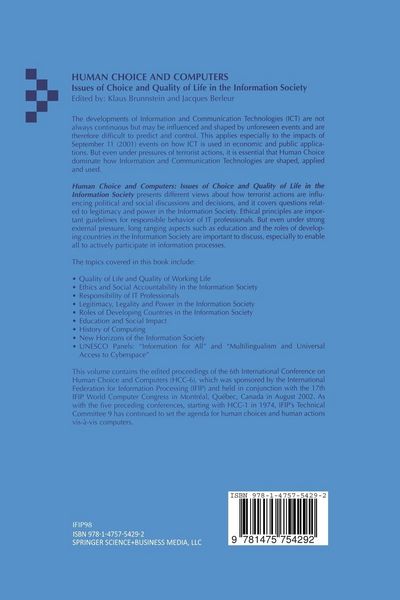
Human Choice and Computers Issues of Choice and Quality of Life in the Information Society

12% sparen

95,99 € UVP 109,99 €

inkl. gesetzl. MwSt., Versandkostenfrei


Beschreibung

Produktdetails

Einband

Taschenbuch

Erscheinungsdatum

05.03.2013

Abbildungen

XVI, 336 p.

Herausgeber

Klaus Brunnstein + weitere

Verlag

Springer Us

Seitenzahl

336

Maße (L/B/H)

23,5/15,5/1,9 cm

Gewicht

528 g

Auflage

Softcover reprint of the original 1st ed. 2002

Sprache

Englisch

ISBN

978-1-4757-5429-2

Beschreibung

Produktdetails

Einband

Taschenbuch

Erscheinungsdatum

05.03.2013

Abbildungen

XVI, 336 p.

Herausgeber

Verlag

Springer Us

Seitenzahl

336

Maße (L/B/H)

23,5/15,5/1,9 cm

Gewicht

528 g

Auflage

Softcover reprint of the original 1st ed. 2002

Sprache

Englisch

ISBN

978-1-4757-5429-2

Herstelleradresse

Springer-Verlag KG
Sachsenplatz 4-6
1201 Wien
AT

Email: ProductSafety@springernature.com

Noch keine Bewertungen vorhanden

Verfassen Sie die erste Bewertung zu diesem Artikel

Helfen Sie anderen Kundinnen und Kunden durch Ihre Meinung.

Kundinnen und Kunden meinen

Bewertungen (0)

  • Produktbild: Human Choice and Computers
  • Produktbild: Human Choice and Computers
  • Critical Professional Discourses About Information and Communications Technologies and Social Life in the U.S..- Does the Internet Promote Democracy?.- Theoretical Perspective on the Interplay Between ICT and Quality of Life.- Using Technology to Help the Citizen Enrollment.- Information and Communication Technology and the Home Environment.- Some Great Myths of the History of Computing.- Roots of Computing in Austria — Contributions of the IBM Vienna Laboratory and Changes of Paradigms and Priorities in Information Technology.- Self-regulation: Content, Legitimacy and Efficiency — Governance and Ethics.- Trust, Corruption, and Surveillance in the Electronic Workplace.- Ethics and Learning — From State Regulation towards Reflexive Self-Regulation of the Information Society.- Computer Augmented Research and Scientific Misconduct.- The Security Aspect of Information Society as a Global Biocultural System.- Choice and Responsibility: The Delegation of Decision Making to Intelligent Software Agents.- Responsibility and the Work of IT-Professionals: From Academia to Practice.- Is the Enemy Us? — New Threats to Privacy, Freedom of Information and Civil Liberties in the Age of Terrorism.- National Identification Schemes (Nids): A Remedy Against Terrorist Attack?.- A Classification of Biometric Applications Wanted by Politics: Passports, Person Tracking and Fight Against Terror.- Preventing Privacy Attacks and CyberCrime in the Mobile Internet?.- Towards a Framework for Sustainable Knowledge Management in Organisations in Developing Countries.- Adapting Global Practices Locally: A Perspective on IT Implementation in a Developing Country Context.- Technology and Learning Societies in the New Millennium (Indian Context): Content, Practice and Management.- Quality ofWorking Life, Knowledge-Intensive Work Processes and Creative Learning Organisations: Information Processing Paradigm versus Self-Organisation Theory.- Understanding the Process of Information Systems and ICT Curriculum Development. Three Models.- Cultural Differences of Female Enrollment in Tertiary Education in Computer Science.- A Radical Scandinavian (“ Øresundsk”) Approach to Inquiring Organizations — A Critique of ICT in Knowledge Management Martina.- Sustainable Development and the Information Society.- “Information for All” Programme.- Draft Recommendations “Concerning the Promotion and Use of Multilingualism and Universal Access to Cyberspace”.