• Produktbild: Theoretical Methods for Strongly Correlated Electrons
  • Produktbild: Theoretical Methods for Strongly Correlated Electrons
  • Produktbild: Theoretical Methods for Strongly Correlated Electrons
- 12%

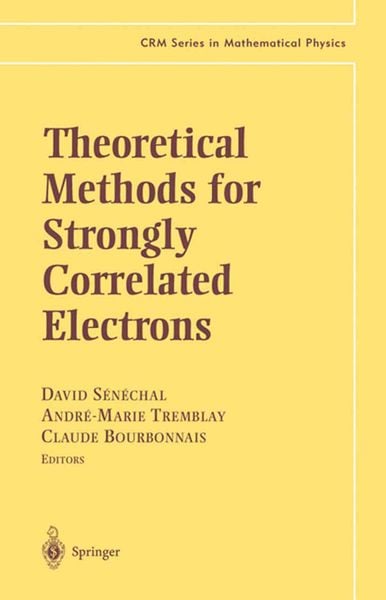
Theoretical Methods for Strongly Correlated Electrons

12% sparen

144,99 € UVP 164,99 €

inkl. gesetzl. MwSt., Versandkostenfrei


Portrait

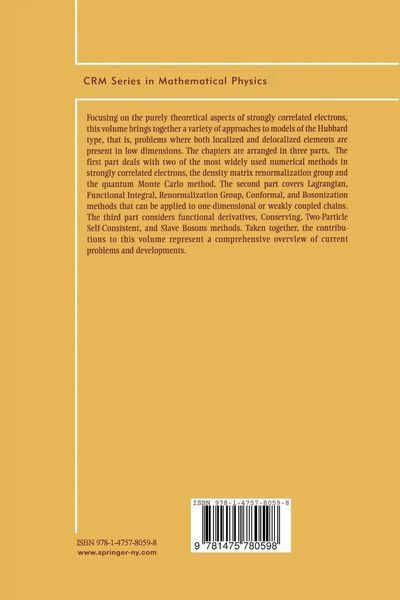
Focusing on the purely theoretical aspects of strongly correlated
electrons, this volume includes thorough pedagogical reviews as well
as overviews of current problems and developments.

Produktdetails

Einband

Taschenbuch

Erscheinungsdatum

21.04.2013

Herausgeber

David Sénéchal + weitere

Verlag

Springer Us

Seitenzahl

362

Maße (L/B/H)

23,5/15,5/2,1 cm

Gewicht

581 g

Auflage

Softcover reprint of the original 1st edition 2004

Sprache

Englisch

ISBN

978-1-4757-8059-8

Portrait

Produktdetails

Einband

Taschenbuch

Erscheinungsdatum

21.04.2013

Herausgeber

Verlag

Springer Us

Seitenzahl

362

Maße (L/B/H)

23,5/15,5/2,1 cm

Gewicht

581 g

Auflage

Softcover reprint of the original 1st edition 2004

Sprache

Englisch

ISBN

978-1-4757-8059-8

Herstelleradresse

Springer-Verlag KG
Sachsenplatz 4-6
1201 Wien
AT

Email: GPSR Kontakt

Noch keine Bewertungen vorhanden

Verfassen Sie die erste Bewertung zu diesem Artikel

Helfen Sie anderen Kundinnen und Kunden durch Ihre Meinung.

Kundinnen und Kunden meinen

Bewertungen (0)

  • Produktbild: Theoretical Methods for Strongly Correlated Electrons
  • Produktbild: Theoretical Methods for Strongly Correlated Electrons
  • Produktbild: Theoretical Methods for Strongly Correlated Electrons
  • Contents
    Series Preface
    Preface
    C. Bourbonnais, D. Senechal, A. Ruckenstein, and A.-M.S. Tremblay I Numerical Methods
    1 Density Matrix Renormalization
    Karen Hallberg
    1 Introduction 2 The Method 3 Applications 4 Other Extensions to DMRG
    4.1 Classical Systems
    4.2 Finite-Temperature DMRG
    4.3 Phonons, Bosons and Disorder
    4.4 Molecules and Quantum Chemistry 5 Dynamical Correlation Functions
    5.1 Lanczos and Correction Vector Techniques
    5.2 Moment Expansion
    5.3 Finite Temperature Dynamics 6 Conclusions 7 References 2 Quantum Monte Carlo Methods for Strongly Correlated Electron Systems
    Shiwei Zhang
    1 Introduction
    2 Preliminaries
    2.1 Starting Point of Quantum Monte Carlo (QMC)
    2.2 Basics of Monte Carlo Techniques
    2.3 Slater Determinant Space
    2.4 Hubbard-Stratonovich Transformation 3 Standard Auxiliary-Field Quantum Monte Carlo
    3.1 Ground-State Method
    3.2 Finite-Temperature Method 4 Constrained Path Monte Carlo Methods-Ground-State and Finite-Temperature
    4.1 Why and How Does the Sign Problem Occur?
    4.2 The Constrained-Path Approximation
    4.3 Ground-State Constrained Path Monte Carlo (CPMC) Method
    4.4 Finite-Temperature Method
    4.5 Additional Technical Issues 5 Illustrative Results 6 Summary 7 References A Brief Review of Con.guration-Space Methods
    A.1 Variational Monte Carlo
    A.2 Green's Function Monte Carlo (GFMC) II Lagrangian, Functional Integral,
    Renormalization Group, Conformal and Bosonization Methods
    Renormalization Group Technique for Quasi-One-Dimensional Interacting Fermion Systems at Finite Temperature
    C. Bourbonnais, B. Guay and R. Wortis
    1 Introduction
    2 Scaling Ansatz for Fermions
    2.1 One Dimension
    2.2 Anisotropic Scaling and Crossover Phenomena 3 Free Fermion Limit
    3.1 One Dimension
    3.2 Interchain Coupling 4 The Kadano.-Wilson Renormalization Group
    4.1 One-Dimensional Case
    4.2 One-Loop Results
    4.3 Two-Loop Results
    4.4 Response Functions 5 Interchain Coupling: One-Particle Hopping
    5.1 Interchain Pair Hopping and Long-Range Order
    5.2 Long-Range Order in the Decon.ned Region 6 Kohn-Luttinger Mechanism in Quasi-One-Dimensional Metals
    6.1 Generation of Interchain Pairing Channels
    6.2 Possibility of Long-Range Order in the Interchain Pairing Channels 7 Summary and Concluding Remarks 8 References A One-Particle Self-Energy at the Two-Loop Level
    A.1 Backward and Forward Scattering Contributions
    A.2 Umklapp contribution 4 An Introduction to Bosonization
    D. Senechal
    1 Quantum Field Theory in Condensed Matter 2 A Word on Conformal Symmetry
    2.1 Scale and Conformal Invariance
    2.2 Conformal Transformations
    2.3 E.ect of Perturbations
    2.4 The Central Charge 3 Interacting Electrons in One Dimension
    3.1 Continuum Fields and Densities
    3.2 Interactions 4 Bosonization: A Heuristic View
    4.1 Why Is One-Dimension Special?
    4.2 The Simple Boson
    4.3 Bose Representation of the Fermion Field 5 Details of the Bosonization Procedure
    5.1 Left and Right Boson Modes
    5.2 Proof of the Bosonization Formulas: Vertex Operators
    5.3 Bosonization of the Free-Electron Hamiltonian
    5.4 Spectral Equivalence of Boson and Fermion
    5.5 Case of Many Fermion Species: Klein Factors
    5.6 Bosonization of Interactions 6 Exact Solution of the Tomonaga-Luttinger Model
    6.1 Field and Velocity Renormalization
    6.2 Left-Right Mixing
    6.3 Correlation Functions
    6.4 Spin or Charge Gap 7 Non-Abelian Bosonization
    7.1 Symmetry Currents
    7.2 Application to the Perturbed Tomonaga-Luttinger Model 8 Other Applications of Bosonization
    8.1 The Spin- 12 Heisenberg Chain
    8.2 Edge States in Quantum Hall Systems
    8.3 And More