Gutscheinbedingungen

**Gültig bis 04.08.2026 ab einem Mindestbestellwert von 30€ auf Spielzeug, Schreibwaren, Filme, Geschenke & Trends, Musik, tolino eReader & Zubehör, Hörbücher und Hörbuch-Downloads (außer Abo), nicht preisgebundene Bücher und Kalender online auf thalia.at und in der Thalia App. Einzelne Artikel können ausgeschlossen sein. Aufgrund der Buchpreisbindung sind deutschsprachige Bücher und eBooks ausgenommen. Zusätzlich ausgenommen sind preisgebundene Artikel, Abos & Flatrates, eBooks, Games, Geschenkkarten/-boxen, Shelfies, Software, Zeitschriften sowie einzelne Artikel von tonies®. Pro Einkauf einmal einlösbar. Click & Collect nur bei Onlinevorabzahlung möglich. Keine Barauszahlung. Nicht kombinierbar mit anderen Aktionen und Gutscheinen. Gutschein wird auf max. 500€ Bestellwert angerechnet. Nicht gültig für Versandkosten und Services. Preisgebundene Artikel sind vom Mindestbestellwert ausgeschlossen.

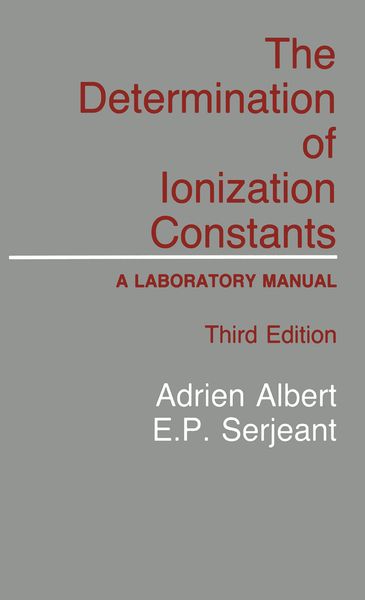
  • Produktbild: The Determination of Ionization Constants
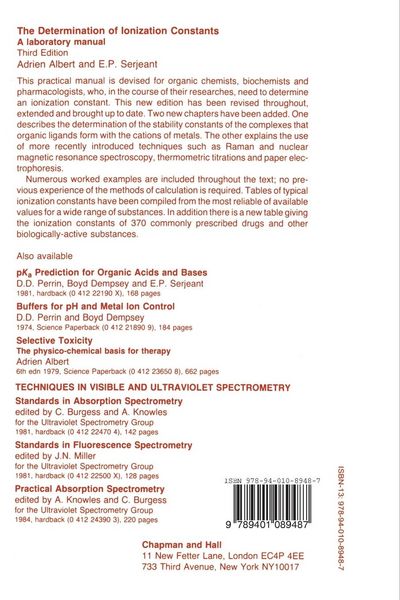
  • Produktbild: The Determination of Ionization Constants

The Determination of Ionization Constants A Laboratory Manual

49,99 €

inkl. gesetzl. MwSt., Versandkostenfrei


Beschreibung

Produktdetails

Einband

Taschenbuch

Erscheinungsdatum

05.10.2011

Verlag

Springer Netherland

Seitenzahl

218

Maße (L/B/H)

23,5/15,5/1,3 cm

Gewicht

359 g

Auflage

Third Edition 1984

Sprache

Englisch

ISBN

978-94-010-8948-7

Beschreibung

Produktdetails

Einband

Taschenbuch

Erscheinungsdatum

05.10.2011

Verlag

Springer Netherland

Seitenzahl

218

Maße (L/B/H)

23,5/15,5/1,3 cm

Gewicht

359 g

Auflage

Third Edition 1984

Sprache

Englisch

ISBN

978-94-010-8948-7

Herstelleradresse

Springer-Verlag KG
Sachsenplatz 4-6
1201 Wien
AT

Email: GPSR Kontakt

Noch keine Bewertungen vorhanden

Verfassen Sie die erste Bewertung zu diesem Artikel

Helfen Sie anderen Kundinnen und Kunden durch Ihre Meinung.

Kundinnen und Kunden meinen

Bewertungen (0)

  • Produktbild: The Determination of Ionization Constants
  • Produktbild: The Determination of Ionization Constants
  • 1 Introduction.- 1.1 What is meant by ‘ionization constants’?.- 1.2 Why do we determine ionization constants?.- 1.3 Brief summary of the chemistry of ionization.- 1.4 The nature of pKa values.- 1.5 The shape of a titration curve.- 1.6 Methods commonly used for determining ionization constants.- 1.7 What degree of precision is required?.- 1.8 The effect of temperature on ionization constants.- 1.9 Molality and molarity.- 2 Determination of Ionization Constants by Potentiometrie Titration using a Glass Electrode.- 2.1 Apparatus for general use.- 2.2 Preparation of solutions.- 2.3 Choice of concentration for the titration.- 2.4 Details of the titration method.- 2.5 Derivation and choice of equations for calculating pKa.- 2.6 Some typical titrations (worked examples).- 2.7 Precision and accuracy. Checking the precision obtained.- 2.8 Common sources of error, and their elimination.- 2.9False constants.- 2.10 Partly aqueous solvents.- 3 Refinements of Potentiometrie Titration: Apparatus and
    Calculations.- A Apparatus.- 3.1 Semi-micro titrations.- 3.2 Micro titrations.- 3.3 The rapid-flow method.- 3.4 The hydrogen electrode.- B Calculations.- 3.5 Monofunctional acids and bases.- 3.6 Method of calculation.- 3.7 Diacidic bases, dibasic acids and ampholytes.- 3.8 Overlapping ionization processes.- 3.9 Polyelectrolytes.- 3.10 Accuracy of the potentiometric method.- 3.11 Non-aqueous solvents.- 4 Determination of Ionization Constants by Spectrophotometry.- 4.1 Introduction.- 4.2 Apparatus.- 4.3 Buffers.- 4.4 Acidity functions.- 4.5 Preparation of the stock solution of the unknown.- 4.6 The search for the spectra of two pure ionic species.- 4.7 The choice of an
    analytical wavelength.- 4.8 Preliminary search for an approximate value of pKa.- 4.9 Exact determination of pKa.- 4.10 Worked examples.- 4.11 Activity corrections.- 4.12 Extensions of the spectrometric method.- (a)The pKa of a very weak acid (graphical treatment).- (b)Overlapping pKa values.- (c)Computer program for overlapping values.- 4.13 Errors, precision and accuracy.- 4.14 Common sources of error.- 4.15 Spectrophotometric determination of the pKa of a substance
    that lacks an absorption spectrum.- 4.16 A rapid method for the approximate measurement of pKa.- 5 Relations between Ionization and Solubility. Determination of Ionization Constants by Phase Equilibria.- 5.1 Ionization constants in preparative work.- 5.2 Prediction of solubility from ionization constants.- 5.3 Determination of ionization constants from solubilities.- 5.4 Determination of ionization constants from vapour pressure, by partitioning between a pair of solvents, or by other phase equilibria.- 6 Determination of Ionization Constants by Conductimetry.- 6.1 Scope of the method.- 6.2 Apparatus.- 6.3 Procedure.- 6.4 Refinements of calculation.- 7 Some Other Methods for the Determination of Ionization Constants.- 7.1 Raman spectrometry.- 7.2 Proton nuclear magnetic resonance.- 7.3 Nuclear magnetic resonance using other atoms.- 7.4 Thermometric methods.- 8 Zwitterions (Dipolar Ions).- 8.1 Zwitterions compared to ordinary amphoteric substances.- 8.2 How to distinguish zwitterions from ordinary ampholytes.- 8.3 Zwitterionic equilibria: macroscopic and microscopic constants.- 9 The Ionization Constants of Typical Acids and Bases.- A Organic Section.- 9.1 The oxygen acids (monobasic).- (a) Aliphatic carboxylic acids.- (b) Aromatic carboxylic acids.- (c) Aliphatic hydroxylie acids.- (d) Aromatic hydroxylie acids (phenols).- (e) Other oxygen acids.- 9.2 The oxygen acids (dibasic).- 9.3 Sulphur acids, nitrogen acids and carbon acids.- (a) Mercaptans.- (b) Nitrogen acids.- (c) Carbon acids.- 9.4 The nitrogen bases (monoacidic).- (a) Aliphatic bases.- (b) Aromatic and heteroaromatic bases.- 9.5 The nitrogen bases (diacidic).- 9.6 Carbinolamine bases.- 9.7 Oxygen bases and carbon bases.- 9.8 Amphoteric substances.- B Inorganic Section.- 9.9 Inorganic acids.- 9.10 Inorganic bases 164.- C Biologically-Active Substances.- 10 Chelation and the Stability Constants of Metal Complexes.- 10.1 The nature of chelation.- 10.2 Methods of calculation.- 10.3 Choice of ionic medium and the preparation of standard
    solutions.- 10.4 Measurement of pH and the calculation of pCH.- 10.5 Common difficulties and how they can be overcome.- 11 Appendices.- I An outline of the Brønsted-Lowry Theory.- II Comparison of classical and thermodynamic quantities.- III Calculations of hydrogen ion activity and concentration: also of hydroxyl ion activity and concentration.- IV Some effects of temperature on ionization constants.- V How percentage ionized may be calculated, given pKa and pH.- VI An outline of the theory of pH.- References.