KI-Beratung Beta

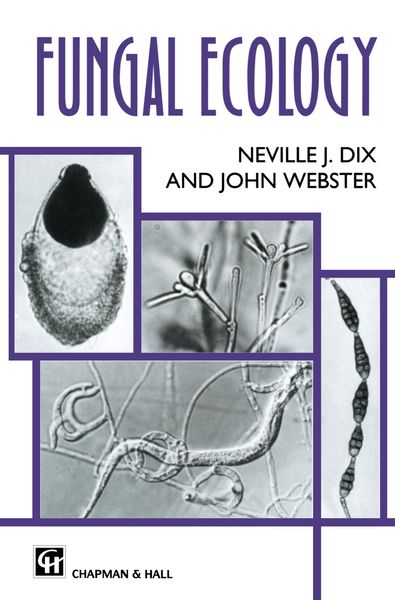
  • Produktbild: Fungal Ecology
  • Produktbild: Fungal Ecology
- 12%

Fungal Ecology

12% sparen

105,99 € UVP 120,99 €

inkl. gesetzl. MwSt., Versandkostenfrei


Beschreibung

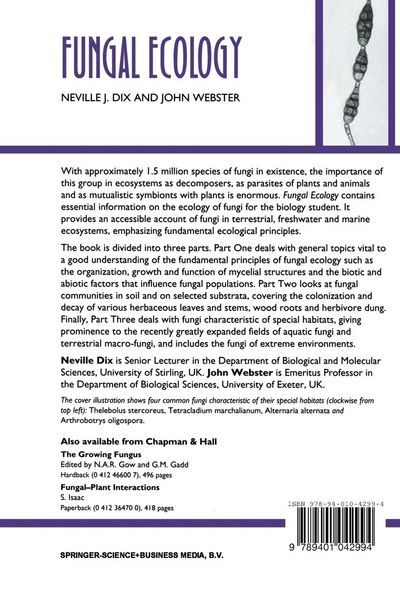
Fungi play vital roles in all ecosystems, as decomposers, symbionts of animals and plants and as parasites. Thus their ecology is of great interest. It has been estimated that there may be as many as 1. 5 million species of fungi, many of which are still undescribed. These interact in various ways with...

Beschreibung

Fungi play vital roles in all ecosystems, as decomposers, symbionts of animals and plants and as parasites. Thus their ecology is of great interest. It has been estimated that there may be as many as 1. 5 million species of fungi, many of which are still undescribed. These interact in various ways with their hosts, with their substrates, with their competitors (including other fungi) and with abiotic variables of their environment. They show great variation in morphology, reproduction, life cycles and modes of dispersal. They grow in almost every conceivable habitat where organic carbon is available: on rock surfaces, in soil, the sea and in fresh water, at extremes of high and low temperature, on dry substrata and in concen trated solutions. Fungal ecology is therefore an enormous subject and its literature is voluminous. In view of this we have had to be selective in the material we have included in this book. We have chosen to concentrate on subjects in which we have some personal experience through either research or teaching. We preferred to tackle a few subjects in depth instead of attempting to cover a wider range of topics superficially. We are conscious of the extensive gaps in coverage: for example on the ecology of lichens, of fungal plant pathogens and of the complex interactions between fungi and animals. It is some justification that book-length treatments of these subjects are available elsewhere.

Produktdetails

Einband

Taschenbuch

Erscheinungsdatum

03.10.2013

Herausgeber Neville J. Dix
Verlag Springer Netherland

Produktdetails

Einband

Taschenbuch

Erscheinungsdatum

03.10.2013

Herausgeber Neville J. Dix
Verlag Springer Netherland
Seitenzahl

549

Maße (L/B/H)

23,5/15,5/3 cm

Auflage

1995

Sprache

Englisch

ISBN

978-94-010-4299-4

Herstelleradresse

Springer-Verlag GmbH
Tiergartenstr. 17
69121 Heidelberg
DE

Email: ProductSafety@springernature.com

Noch keine Bewertungen vorhanden

Verfassen Sie die erste Bewertung zu diesem Artikel

Helfen Sie anderen Kundinnen und Kunden durch Ihre Meinung.

Kundinnen und Kunden meinen

Bewertungen (0)

  • Produktbild: Fungal Ecology
  • Produktbild: Fungal Ecology
  • 1 Introduction.- 1.1 Life strategies of fungi.- 2 The mycelium and substrates for growth.- 2.1 The mycelium.- 2.2 Spores and other mycelial-derived structures.- 2.3 Substrata and substrates for saprotrophs.- 3 Structure of fungal communities.- 3.1 Introduction.- 3.2 Development of fungal communities.- 3.3 Successions.- 4 Colonization and decomposition of leaves.- 4.1 Deposition.- 4.2 Colonization of living leaves.- 4.3 Factors affecting the development of fungal communities on leaf surfaces.- 4.4 Fungal successions in leaf litter.- 4.5 Decomposition of leaf litter.- 5 Development of fungal communities on herbaceous stems and grasses.- 5.1 Distribution of fungal populations on Dactylis glomerata.- 5.2 Interpretation of distribution patterns.- 5.3 Distribution patterns on other plants.- 6 Colonization and decay of wood.- 6.1 Wood as a resource.- 6.2 Colonization of woody tissues.- 6.3 Types of wood rot.- 6.4 Water relations.- 7 Fungi of soil and rhizosphere.- 7.1 Techniques for studying fungi of soil and roots.- 7.2 Fungal distribution in soil.- 7.3 Fungal activity in soil.- 7.4 The rhizosphere and root colonization.- 8 Coprophilous fungi.- 8.1 Succession of coprophilous fungi.- 8.2 Comparison of the fungal flora of different animal dungs.- 8.3 Autecological studies.- 9 Aquatic fungi.- 9.1 Introduction.- 9.2 Freshwater fungi.- 9.3 Marine fungi.- 10 Nematophagous fungi.- 10.1 Techniques for studying nematophagous fungi.- 10.2 Distribution and abundance.- 10.3 Ecological characteristics.- 10.4 Biological control of pathogenic nematodes.- 11 Phoenicoid fungi.- 11.1 Chemical, physical and biological changes in soil after burning.- 11.2 Ecological characteristics and phenology.- 11.3 Experimental studies.- 11.4 Fruiting of phoenicoid fungi following volcanic eruptions.- 12 Fungi of extreme environments.- 12.1 Thermotolerant and psychrotolerant fungi.- 12.2 Xerotolerant and osmotolerant fungi.- 13 Terrestrial macrofungi.- 13.1 Introduction.- 13.2 Wood-decay macrofungi.- 13.3 Litter decomposers.- 13.4 Mycorrhizal macrofungi.- References.