KI-Beratung Beta

Gutscheinbedingungen

**Gültig bis 18.11.2026 auf englischsprachige Klassiker (klassiker-32728) online auf thalia.at und in der Thalia App. Einzelne Artikel können ausgeschlossen sein. Ausgenommen sind preisgebundene Artikel & eBooks. Pro Einkauf einmal einlösbar. Click & Collect nur bei Onlinevorabzahlung möglich. Keine Barauszahlung. Nicht kombinierbar mit anderen Aktionen und Gutscheinen. Gutschein wird auf max. 500€ Bestellwert angerechnet. Nicht gültig für Geschenkkarten, Versandkosten und Services.

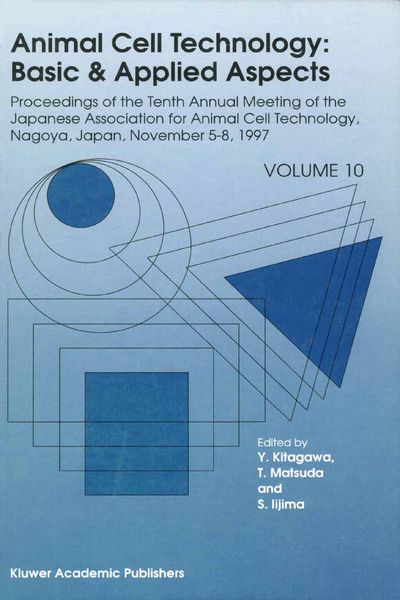
  • Produktbild: Animal Cell Technology: Basic & Applied Aspects
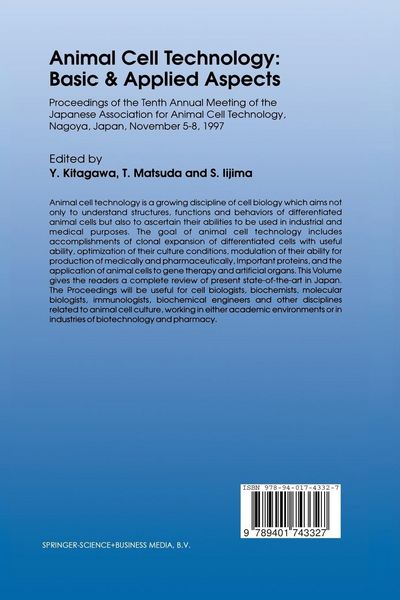
  • Produktbild: Animal Cell Technology: Basic & Applied Aspects
Band 1 - 13%

Animal Cell Technology: Basic & Applied Aspects Proceedings of the Tenth Annual Meeting of the Japanese Association for Animal Cell Technology, Nagoya, November 5–8, 1997

13% sparen

189,99 € UVP 219,99 €

inkl. gesetzl. MwSt., Versandkostenfrei


Beschreibung

Animal cell technology is a growing discipline of cell biology which aims not only to understand structures, functions and behaviors of differentiated animal cells but also to ascertain their abilities to be used for industrial and medical purposes. The goal of animal cell technology includes accomplishments...

Beschreibung

Animal cell technology is a growing discipline of cell biology which aims not only to understand structures, functions and behaviors of differentiated animal cells but also to ascertain their abilities to be used for industrial and medical purposes. The goal of animal cell technology includes accomplishments of clonal expansion of differentiated cells with useful ability, optimization of their culture conditions, modulation of their ability for production of medically and pharmaceutically important proteins, and the application of animal cells to gene therapy and artificial organs. This Volume gives the readers a complete review of the present state of the art in Japan. The Proceedings will be useful for cell biologists, biochemists, molecular biologists, immunologists, biochemical engineers and other disciplines related to animal cell culture, working either in academic environments or in industries of biotechnology and pharmacy.

Produktdetails

Einband

Taschenbuch

Erscheinungsdatum

03.10.2013

Abbildungen

XIV, 392 p.

Herausgeber Y. Kitagawa + weitere

Produktdetails

Einband

Taschenbuch

Erscheinungsdatum

03.10.2013

Abbildungen

XIV, 392 p.

Herausgeber
Verlag Springer Netherland
Seitenzahl

392

Maße (L/B/H)

23,5/15,5/2,3 cm

Gewicht

622 g

Auflage

1999 edition

Sprache

Englisch

ISBN

978-94-017-4332-7

Herstelleradresse

Libri GmbH
Europaallee 1
36244 Bad Hersfeld
DE

Email: gpsr@libri.de

Noch keine Bewertungen vorhanden

Verfassen Sie die erste Bewertung zu diesem Artikel

Helfen Sie anderen Kundinnen und Kunden durch Ihre Meinung.

Kundinnen und Kunden meinen

Bewertungen (0)

  • Produktbild: Animal Cell Technology: Basic & Applied Aspects
  • Produktbild: Animal Cell Technology: Basic & Applied Aspects
  • Role of Heparan Sulfate Proteoglycan in Cell Growth and Differentiation.- Glycoengineering.- Artificial Organ and Cell Therapy.- Immunological Manipulation.- DT40 Cells as a System of Homologous Gene Recombination.- Transgenic Livestock.- Transgenic Fish: Standardization of Technology in the Model System and Aquaculture.- Growth, Immortality and Death of Cells in Culture: Present and Future Impact for the Development of Health Care Products.- Gene Transfer to Cells and Tissues of Living Animals: Applica- tion to Production and Therapeutics.- Cell Culture for Assessment of Physiologically Functional Substances.- Expression of Recombinant Animal Genes in Cultured Animal Cells.- Cell Culture Engineering.- Cost Performance for Producing Biochemicals.- Establishment of Functional Cell Lines for Production of Biologicals.- Application of Human Monoclonal Antibody.- Cell Characterization and Validation.- Cell Culture Engineering.- Expression of Recombinant Animal Genes in Cultured Animal Cells.- Cell Characterization and Validation.- Transplantation and Artificial Organs.- Transgenic Technology.- Antibody Technology.- Cytokines and Signal Transduction.- Cell Culture for Assessment of Physiologically Functional Substances.