Gutscheinbedingungen

**Gültig am 28.09.2026 auf fremdsprachige Bücher online auf thalia.at und in der Thalia App. Einzelne Artikel können ausgeschlossen sein. Ausgenommen sind preisgebundene Artikel & eBooks. Pro Einkauf einmal einlösbar. Click & Collect nur bei Onlinevorabzahlung möglich. Keine Barauszahlung. Nicht kombinierbar mit anderen Aktionen und Gutscheinen. Gutschein wird auf max. 500€ Bestellwert angerechnet. Nicht gültig für Geschenkkarten, Versandkosten und Services.

  • Produktbild: The Nuclear Equation of State
  • Produktbild: The Nuclear Equation of State
Band 216

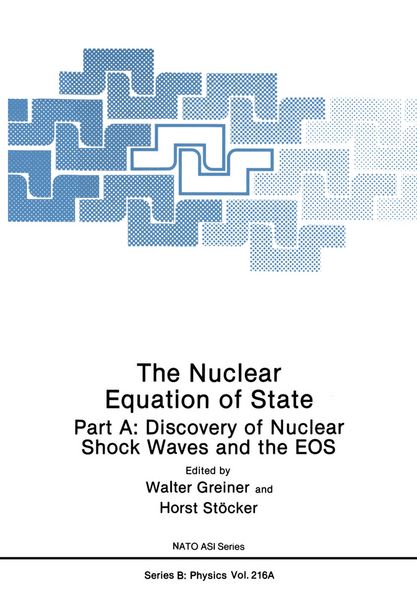
The Nuclear Equation of State Part A: Discovery of Nuclear Shock Waves and the EOS

Aus der Reihe NATO Science Series B:

51,99 €

inkl. gesetzl. MwSt., Versandkostenfrei


Beschreibung

Produktdetails

Einband

Taschenbuch

Erscheinungsdatum

26.04.2013

Abbildungen

XIII, 802 p.

Herausgeber

Walter Greiner + weitere

Verlag

Springer Us

Seitenzahl

802

Maße (L/B/H)

24,4/17/4,4 cm

Gewicht

1386 g

Auflage

1989

Sprache

Englisch

ISBN

978-1-4612-7877-1

Beschreibung

Portrait

Prof. Dr. Horst Stöcker studierte in Frankfurt am Main Physik, Mathematik, Chemie und Philosophie. Nach der Promotion 1979 war er als Gastwissenschaftler an verschiedenen renommierten Instituten tätig, bevor er 1985 eine Professur für Theoretische Physik an der an der Johann Wolfgang Goethe-Universität in Frankfurt am Main erhielt.
Schwerpunkte seiner Forschung sind die Schwerionenphysik, die Physik der Kernmaterie und Elementarteilchen sowie die Vielteilchentheorie.
Prof. Dr. rer. nat. Dr. h. c. mult. Walter Greiner, geb. Oktober 1935 im Thüringer Wald, Promotion 1961 in Freiburg im Breisgau, 1962-64 Assistent Professor an der University of Maryland, seit 1964/65 ordentlicher Professor für Theoretische Physik der Johann Wolfgang Goethe-Universität Frankfurt am Main und Direktor des Instituts für Theoretische Physik. Gastprofessuren unter anderem an der Florida State University, University of Virginia, Los Alamos Scientific Laboratory, University of California Berkeley, Oak Ridge National Laboratory, University of Melbourne, Yale University, Vanderbilt University, University of Arizona. Hauptarbeitsgebiete sind die Struktur und Dynamik der elementaren Materie (Quarks, Gluonen, Mesonen, Baryonen, Atomkerne), Schwerionenphysik, Feldtheorie (Quantenelektrodynamik, Eichtheorie der schwachen Wechselwirkung, Quantenchromodynamik, Theorie der Gravitation), Atomphysik.
974 Empfänger des Max-Born-Preises und der Max-Born-Medaille des Institute of Physics (London) und der Deutsche Physikalische Gesellschaft, 1982 des Otto-Hahn-Preises der Stadt Frankfurt am Main, 1998 der Alexander von Humboldt-Medaille, 1999 Officier dans l'Ordre des Palmes Academiques.
Inhaber zahlreicher Ehrendoktorwürden (unter anderem der University of Witwatersrand, Johannesburg, der Universite Louis Pasteur Strasbourg, der UNAM Mexico, der Universitäten Bucharest, Tel Aviv, Nantes, St. Petersburg, Moskau, Debrecen, Dubna und anderen) sowie Ehrenprofessuren (University of Bejing, China, und Jilin University Changchun, China) und Ehrenmitglied vieler Akademien.
Produktdetails

Einband

Taschenbuch

Erscheinungsdatum

26.04.2013

Abbildungen

XIII, 802 p.

Herausgeber

Verlag

Springer Us

Seitenzahl

802

Maße (L/B/H)

24,4/17/4,4 cm

Gewicht

1386 g

Auflage

1989

Sprache

Englisch

ISBN

978-1-4612-7877-1

Herstelleradresse

Springer-Verlag KG
Sachsenplatz 4-6
1201 Wien
AT

Email: ProductSafety@springernature.com

Noch keine Bewertungen vorhanden

Verfassen Sie die erste Bewertung zu diesem Artikel

Helfen Sie anderen Kundinnen und Kunden durch Ihre Meinung.

Kundinnen und Kunden meinen

Bewertungen (0)

  • Produktbild: The Nuclear Equation of State
  • Produktbild: The Nuclear Equation of State
  • Opening Remarks.- Experimental Observation Of Collective Flow And Particle Production In High Energy Heavy Ion Collisions.- Collective Flow Measured with the Plastic Ball.- Relativistic Heavy Ion Collisions Studied with the Streamer Chamber at the BEVALAC.- Fragment Flow and Squeeze-Out of Hot Dense Nuclear Matter.- Stopping Power and the Equation of State at Intermediate Energy.- Collective Flow Measurements in Asymmetric Nuclear Collisions.- 4? Fragment Measurements at MSU and the Nuclear Equation of State.- Collective Flow of Charged Fragments and Neutrons from Bevalac Experiment 848H.- Pion and Proton Emission in Intermediate Energy Heavy Ion Collisions.- Hard Photons and Subthreshold Mesons from Nucleus-Nucleus Collisions.- Hard Photons from Intermediate Energy Heavy Ion Collisions.- Production of Lepton Pairs at the LBL Bevalac.- Intermediate Mass Fragment Emission in the Reacitons Nb+Au and Fe+Au at 50 to 100 MeV/A.- The HISS TPC.- THEORETICAL MODELS FOR COMPRESSION PHENOMENA AND PARTICLE PRODUCTION.- The Equations of State and Viscocity in the Hydrodynamic Model.- Transport Theory, Viscosity, and Kaon Production.- Study of Observables from Heavy Ion Data using VUU and QMD Calculations.- Medium Effects and Nuclear Transport Theory.- Many Body Modes of Excitation in Heavy Ion Collisions.- How to Extract the Nuclear Equation of State from Heavy Ion Data.- Transverse Momentum Generation and Dilepton Emission in High Energy Heavy Ion Collisions.- Relativistic Vlasov-Uehling-Uhlenbeck Model for High-Energy Heavy-Ion Collisions.- The relativistic BUU Approach - Analysis of Retardation Effects and Thermal Properties.- High Energy Photons and Pions in Intermediate Energy Heavy Ion Reactions.- Photon and Pion Production in Heavy Ion Collisions.- Dilepton Production inHeavy Ion Collisions.- On the Derivation of the Quantum Molecular Dynamics Approach.- Fermionic Molecular Dynamics.- Mean Field and Collisions in Hot Nuclei.- Nuclear Multifragmentation and the Equation of State.- Medium Energy Collisions and Multifragmentation.- DISTINGUISHED LECTURES ON: THE HISTORY AND FUTURE OF NUCLEAR SHOCK WAVES.- Introductory Remarks to the lectures of E. Schopper and A.M. Poskanzer.- Early History of Shock Waves in Heavy Ion Collisions.- A History of Central Collisions at the Bevalac.- The SIS/ES R-Project at GSI-Present and Future.- High Energy Heavy Ion Collisions and the RHIC project at Brookhaven.- HIGH T SUPERCONDUCTIVITY.- Adaptation of the Theory of Superconductivity to the Behavior of Oxides.- SPECIAL TOPICS.- High Pressure Equation of State in Various Areas of Physics - Overview.- Scale Transformations, the Energy-Momentum Tensor, and the Equation of State.- Density Functional Theory at Finite Temperatures.- The Collective Spin of Nuclear Surface Vibrations.- Review of the Current Status of Cold Fusion.- Coulomb Assisted Cold Fusion.- Cold Confusion.- COMPRESSIBILITY OF NUCLEAR MATTER AND FINITE NUCLEI.- The Nuclear Matter Saturation Problem.- Variational Theory of Nuclear and Neutron Matter.- Exploring Many-Body Theories in Light Nuclei.- Spectral Functions and the Momentum Distribution of Nuclear Matter.- Meson and Quark Degrees of Freedom in Nuclear Matter and Finite Nuclei.- The Relativistic Mean-Field Model of Nuclear Structure and Dynamics.- The Giant Monopole Resonance and the Compressibility of Nuclear Matter.- The Nuclear Matter Compressibility from Breathing Mode: A Semi-Phenomenological Approach.- Nuclear Compression Modulus from Monopole Data.- THE NUCLEAR EQUATION OF STATE IN SUPERNOVAE AND NEUTRON STARS.- Constraints on the Nuclear Equation of State from Type II Supernovae and Newly Born Neutron Stars.- The Hadronic Equation of State and Supernovae.- Supernovae and Stellar Collapse.- Neutron Stars, Fast Pulsars, Supernovae, and the Equation of State of Dense Matter.- Constraints on the Equation of State for Neutron Stars from Fast Rotating Pulsars.- Neutron Star Calculations in the Relativistic Hartree and Hartree-Fock Approximation.- The Equation of State and Properties of Neutron Stars.