
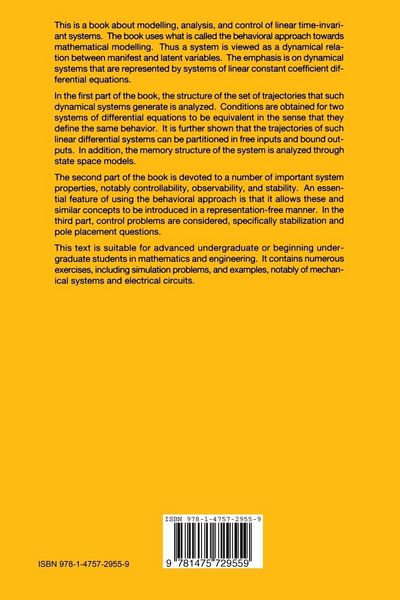
• Produktbild: Introduction to Mathematical Systems Theory
  • Produktbild: Introduction to Mathematical Systems Theory
Band 26 - 11%

Introduction to Mathematical Systems Theory A Behavioral Approach

11% sparen

82,99 € UVP 93,49 €

inkl. gesetzl. MwSt., Versandkostenfrei


Beschreibung

Produktdetails

Einband

Taschenbuch

Erscheinungsdatum

03.03.2013

Abbildungen

XXX, 424 p.

Verlag

Springer Us

Seitenzahl

424

Maße (L/B/H)

23,5/15,5/2,5 cm

Gewicht

686 g

Sprache

Englisch

ISBN

978-1-4757-2955-9

Beschreibung

Rezension

From the reviews:


INTERNATIONAL JOURNAL OF ROBUST AND NONLINEAR CONTROL


"The present book is a major original contribution to the literature and is of high quality. The most original chapters are the ‘strongly behavioural’ Chapters 1-6 and the historical preface. The introduction is carefully written and each chapter ends with a precise recapitulation of what has been done. It is well organized, technically well written, philosophically nice, and contains a wealth of examples and exercises. It is also well self-contained for its audience…scientific honesty dictates to congratulate the authors and to recommend this book as a textbook to a large public of systems and control students, and especially for those having already followed a first course on linear systems."

Produktdetails

Einband

Taschenbuch

Erscheinungsdatum

03.03.2013

Abbildungen

XXX, 424 p.

Verlag

Springer Us

Seitenzahl

424

Maße (L/B/H)

23,5/15,5/2,5 cm

Gewicht

686 g

Sprache

Englisch

ISBN

978-1-4757-2955-9

Herstelleradresse

Springer-Verlag KG
Sachsenplatz 4-6
1201 Wien
AT

Email: ProductSafety@springernature.com

Noch keine Bewertungen vorhanden

Verfassen Sie die erste Bewertung zu diesem Artikel

Helfen Sie anderen Kundinnen und Kunden durch Ihre Meinung.

Kundinnen und Kunden meinen

Bewertungen (0)

  • Produktbild: Introduction to Mathematical Systems Theory
  • Produktbild: Introduction to Mathematical Systems Theory
  • 1 Dynamical Systems.- 2 Systems Defined by Linear Differential Equations.- 3 Time Domain Description of Linear Systems.- 4 State Space Models.- 5 Controllability and Observability.- 6 Elimination of Latent Variables and State Space Representations.- 7 Stability Theory.- 8 Time- and Frequency-Domain Characteristics of Linear Time-Invariant Systems.- 9 Pole Placement by State Feedback.- 10 Observers and Dynamic Compensators.- A Simulation Exercises.- A.1 Stabilization of a Cart.- A.2 Temperature Control of a Container.- A.3 Autonomous Dynamics of Coupled Masses.- A.4 Satellite Dynamics.- A.4.1 Motivation.- A.4.2 Mathematical modeling.- A.4.3 Equilibrium Analysis.- A.4.4 Linearization.- A.4.5 Analysis of the model.- A.4.6 Simulation.- A.5 Dynamics of a Motorbike.- A.6 Stabilization of a Double Pendulum.- A.6.1 Modeling.- A.6.2 Linearization.- A.6.3 Analysis.- A.6.4 Stabilization.- A.7 Notes and References.- B Background Material.- B.1 Polynomial Matrices.- B.2 Partial Fraction Expansion.- B.3 Fourier and Laplace Transforms.- B.3.1 Fourier transform.- B.3.2 Laplace transform.- B.4 Notes and References.- B.5 Exercises.- Notation.- References.