Gutscheinbedingungen

**Gültig bis 06.07.2026 auf fremdsprachige Bücher online auf thalia.at, in der Thalia App ab einem Mindestbestellwert von 30€ und in allen Thalia Buchhandlungen in Österreich. In den Buchhandlungen nur gültig auf lagernde Ware. Einzelne Artikel können ausgeschlossen sein. Ausgenommen sind preisgebundene Artikel & eBooks. Pro Einkauf einmal einlösbar. Nur gültig gegen Vorlage oder im Onlineshop hinterlegter Bonuscard. Infos zur Einlösung in der Buchhandlung sind auf der Bonuscard-Vorteilspreisseite zu finden. Click & Collect nur bei Onlinevorabzahlung möglich. Keine Einlösung bei Scan & Go-Bezahlung. Keine Barauszahlung. Nicht kombinierbar mit anderen Aktionen und Gutscheinen. Gutschein wird auf max. 500€ Bestellwert angerechnet. Nicht gültig für Versandkosten und Services.

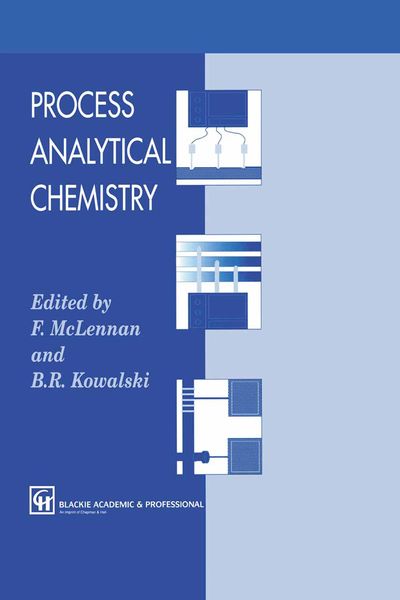
  • Produktbild: Process Analytical Chemistry
  • Produktbild: Process Analytical Chemistry

Process Analytical Chemistry

189,99 €

inkl. gesetzl. MwSt., Versandkostenfrei


Beschreibung

Produktdetails

Einband

Taschenbuch

Erscheinungsdatum

18.09.2012

Herausgeber

F. McLennan + weitere

Verlag

Springer Netherland

Seitenzahl

378

Maße (L/B/H)

23,5/15,5/2,2 cm

Auflage

Softcover reprint of the original 1st ed. 1995

Sprache

Englisch

ISBN

978-94-010-4262-8

Beschreibung

Rezension

`
This is an interesting book...students in analytical chemistry and chemical engineering will find it useful supplementary reading.
'

Analysis Europa

`
Each chapter is self-contained and can be read independently of the others, a useful feature given the scope of the book. Most of the chapters are purely descriptive and...contain many useful tips and much sound advice...This book will give hints and encouragement to those, all too few, technology champions who follow the trends and collaborate with the scientific and technical world outside their own group.
'

Analyst

`
This book is written in a readable style, and the information is presented in such a way as to be intelligible to the non-specialist.
'

Chemistry and Industry

Produktdetails

Einband

Taschenbuch

Erscheinungsdatum

18.09.2012

Herausgeber

Verlag

Springer Netherland

Seitenzahl

378

Maße (L/B/H)

23,5/15,5/2,2 cm

Auflage

Softcover reprint of the original 1st ed. 1995

Sprache

Englisch

ISBN

978-94-010-4262-8

Herstelleradresse

Springer-Verlag GmbH
Tiergartenstr. 17
69121 Heidelberg
DE

Email: ProductSafety@springernature.com

Noch keine Bewertungen vorhanden

Verfassen Sie die erste Bewertung zu diesem Artikel

Helfen Sie anderen Kundinnen und Kunden durch Ihre Meinung.

Kundinnen und Kunden meinen

Bewertungen (0)

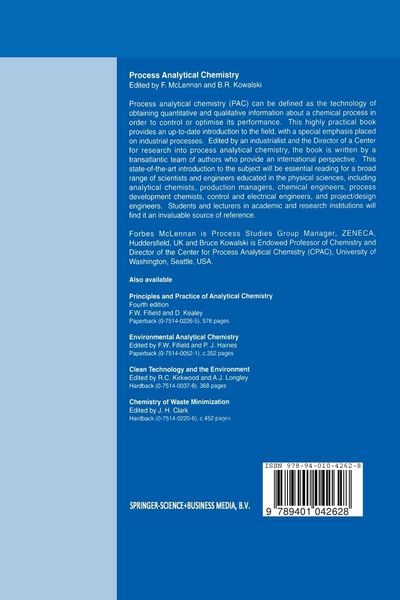
  • Produktbild: Process Analytical Chemistry
  • Produktbild: Process Analytical Chemistry
  • 1 Process analytical chemistry in perspectivel.- 1.1 Introduction.- 1.2 Terminology.- 1.3 An integrated approach.- 1.4 Technology and instrumentation.- 1.5 PAC maintenance and support.- 1.6 Safety.- 1.7 Information sources.- References.- 2 Sampling systems.- 2.1 Introduction.- 2.2 Sample points.- 2.3 Preconditioning system.- 2.4 Sample transport.- 2.5 Conditioning system.- 2.6 Stream selection.- 2.7 Sample disposal.- 3 Physical property analyzers.- 3.1 Introduction.- 3.2 Viscosity measurement.- 3.3 Boiling point measurement.- 3.4 Flash point measurement.- 3.5 Pour point, cloud point and associated measurements.- 3.6 Vapor pressure measurement.- 3.7 Density and specific gravity measurement.- 3.8 Heating value measurement.- 3.9 Measurement of octane number.- 3.10 Refractive index measurement.- 3.11 Thermal conductivity measurement.- Reference.- 4 Process chromatography.- 4.1 Historical perspective of process chromatography.- 4.2 A simple chromatography model.- 4.3 Process gas chromatography.- 4.4 Liquid chromatography.- 4.5 Process supercritical fluid chromatography.- 4.6 Ion chromatography.- 4.7 Programmer/controller/communication.- References.- 5 Flow injection analysis.- 5.1 Introduction.- 5.2 Fundamental principles.- 5.3 Instrumentation.- 5.4 FI methodologies.- 5.5 Process applications.- 5.6 Conclusions.- References.- 6 Molecular spectroscopy.- 6.1 Introduction.- 6.2 Optical spectroscopy.- 6.3 Process mass spectrometry.- References.- 7 Electrochemical methods.- 7.1 Introduction.- 7.2 Potentiometry.- 7.3 Amperometry.- 7.4 Conclusions.- References.- 8 Process chemometrics.- 8.1 Introduction.- 8.2 Definition.- 8.3 Process monitoring.- 8.4 Multivariate calibration.- 8.5 Non-linear calibration methods.- 8.6 Intrument standardization.- 8.7 Process modeling.- 8.8 Process control.- 8.9 The future.- Acknowledgment.- References.- 9 Environmental monitoring for a sustainable future: From pollution control to pollution prevention.- 9.1 Introduction.- 9.2 Environmental monitoring.- 9.3 Regulatory concerns.- 9.4 Environmental monitoring technology.- 9.5 The future.- References.- 10 Non-invasive techniques.- 10.1 Introduction.- 10.2 Benefits and drawbacks.- 10.3 Techniques.- 10.4 Conclusions.- References.- 11 Future developments of chemical sensor and analyzer systems.- 11.1 Introduction.- 11.2 The higher order approach to array sensing.- 11.3 Optical sensing.- 11.4 Silicon processing for sensor development.- 11.5 Acoustic sensing.- 11.6 Metal oxide semiconductor sensors.- 11.7 Ion selective electrodes.- 11.8 Conclusion.- References.