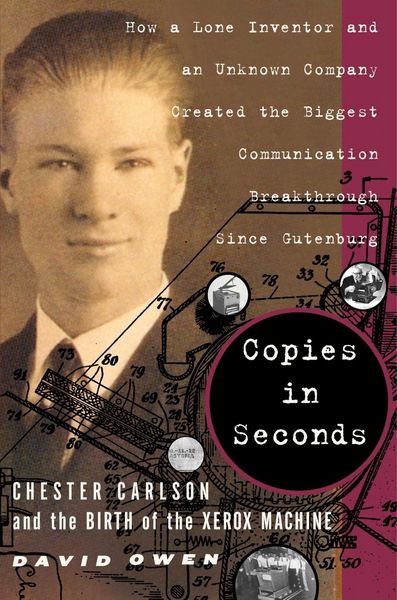
Copies in Seconds How a Lone Inventor and an Unknown Company Created the Biggest Communication Breakthrough Since Gutenberg--Chester Carlson and the Birth of the Xerox Machine
-
- Taschenbuch
- eBook ausgewählt
-
Form:Einzelkauf Download
-
Sprache:Englisch
16,26 €
inkl. gesetzl. MwSt.Beschreibung
Produktdetails
Format
ePUB
Kopierschutz
Ja
Family Sharing
Ja
Text-to-Speech
Ja
Erscheinungsdatum
30.06.2008
Verlag
Simon + Schuster LLCSeitenzahl
320 (Printausgabe)
Dateigröße
3347 KB
Sprache
Englisch
EAN
9781416598329
The first plain-paper office copier -- which was introduced in 1960 and has been called the most successful product ever marketed in America -- is unusual among major high-technology inventions in that its central process was conceived by a single person. David Owen's fascinating narrative tells the story of the machine nobody thought we needed but now we can't live without.
Chester Carlson grew up in unspeakable poverty, worked his way through junior college and the California Institute of Technology, and made his discovery in solitude in the depths of the Great Depression. He offered his big idea to two dozen major corporations -- among them IBM, RCA, and General Electric -- all of which turned him down. So persistent was this failure of capitalist vision that by the time the Xerox 914 was manufactured by an obscure photographic-supply company in Rochester, New York, Carlson's original patent had expired. Xerography was so unusual and nonintuitive that it conceivably could have been overlooked entirely. Scientists who visited the drafty warehouses where the first machines were built sometimes doubted that Carlson's invention was even theoretically feasible.
Drawing on interviews, Xerox company archives, and the private papers of the Carlson family, David Owen has woven together a fascinating and instructive story about persistence, courage, and technological innovation -- a story that has never before been fully told.
Chester Carlson grew up in unspeakable poverty, worked his way through junior college and the California Institute of Technology, and made his discovery in solitude in the depths of the Great Depression. He offered his big idea to two dozen major corporations -- among them IBM, RCA, and General Electric -- all of which turned him down. So persistent was this failure of capitalist vision that by the time the Xerox 914 was manufactured by an obscure photographic-supply company in Rochester, New York, Carlson's original patent had expired. Xerography was so unusual and nonintuitive that it conceivably could have been overlooked entirely. Scientists who visited the drafty warehouses where the first machines were built sometimes doubted that Carlson's invention was even theoretically feasible.
Drawing on interviews, Xerox company archives, and the private papers of the Carlson family, David Owen has woven together a fascinating and instructive story about persistence, courage, and technological innovation -- a story that has never before been fully told.
Noch keine Bewertungen vorhanden
Verfassen Sie die erste Bewertung zu diesem Artikel
Helfen Sie anderen Kundinnen und Kunden durch Ihre Meinung.
Kurze Frage zu unserer Seite
Vielen Dank für Ihr Feedback
Wir nutzen Ihr Feedback, um unsere Produktseiten zu verbessern. Bitte haben Sie Verständnis, dass wir Ihnen keine Rückmeldung geben können. Falls Sie Kontakt mit uns aufnehmen möchten, können Sie sich aber gerne an unseren Kund*innenservice wenden.
zum Kundenservice