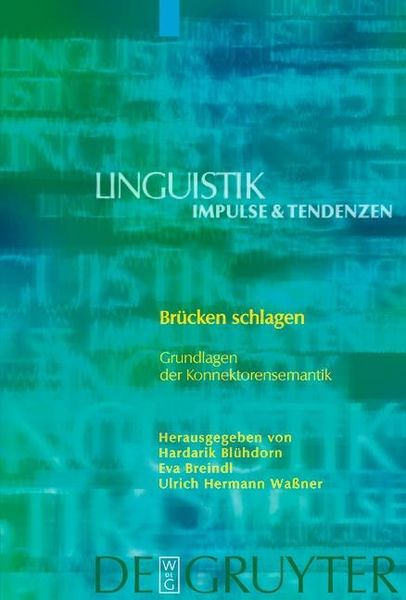
Brücken schlagen Grundlagen der Konnektorensemantik
-
- eBook ausgewählt
-
Form:Einzelkauf Download
-
Sprache:Deutsch
0,00 €
inkl. gesetzl. MwSt.Artikel erhalten
Beschreibung
Produktdetails
Format
Kopierschutz
Nein
Family Sharing
Nein
Text-to-Speech
Nein
Erscheinungsdatum
17.04.2012
Herausgeber
Hardarik Blühdorn + weitereVerlag
De Gruyter OldenbourgSeitenzahl
442 (Printausgabe)
Auflage
1. Auflage
Sprache
Deutsch
EAN
9783110890266
A systematic description of the semantics of connectives is a challenge that linguists have yet to answer. In order to define semantic classes such as "causal", "concessive", "temporal" according to objectivizable criteria, to classify them, and to describe their relationship to one another, it is important to consider the polysemy phenomena of connectives. The interaction with syntactic, information-structural and intonational structure must also be examined. It was the goal of a colloquium at the Institut für Deutsche Sprache [German Language Institute] in December 2002 to present itself with this challenge. Their results are presented collectively in this volume. The contributions all have in common the reference to the Handbuch der deutschen Konnektoren [Handbook of German Connectives], which, with its extensive description of the syntax of connectives, offers an up-to-date starting point for a survey of semantics.
The contributions, which interactively refer to one another, are divided into four chapters. In Chapter A, interfaces are described from a grammar-theoretical, syntactic and logical viewpoint and substantiated by way of examples. Chapter B is dedicated to the temporal connectives with a focus on ambiguities (i.e. of the German connectives während, bevor, nachdem) and the establishment of the paradigms that structure the temporal field. In Chapter C, "Contrast Connectives", adversative and concessive connectives and their differentiation from one another and from additive connectives are discussed. This chapter also presents suggestions for a minimalistic, semantic description of ways of reading German aber. Chapter D is dedicated to the causal connectives. In addition to a revision of the causality concept, this chapter mainly includes suggestions for the restructuring of the causal field, for instance, through the introduction of a class mainly based on the indication of inferences.
Noch keine Bewertungen vorhanden
Verfassen Sie die erste Bewertung zu diesem Artikel
Helfen Sie anderen Kundinnen und Kunden durch Ihre Meinung.
Kurze Frage zu unserer Seite
Vielen Dank für Ihr Feedback
Wir nutzen Ihr Feedback, um unsere Produktseiten zu verbessern. Bitte haben Sie Verständnis, dass wir Ihnen keine Rückmeldung geben können. Falls Sie Kontakt mit uns aufnehmen möchten, können Sie sich aber gerne an unseren Kund*innenservice wenden.
zum Kundenservice