KI-Beratung Beta

Gutscheinbedingungen

**Gültig am 25.11.2026 auf fremdsprachige Bücher online auf thalia.at und in der Thalia App. Einzelne Artikel können ausgeschlossen sein. Ausgenommen sind preisgebundene Artikel & eBooks. Pro Einkauf einmal einlösbar. Click & Collect nur bei Onlinevorabzahlung möglich. Keine Barauszahlung. Nicht kombinierbar mit anderen Aktionen und Gutscheinen. Gutschein wird auf max. 500€ Bestellwert angerechnet. Nicht gültig für Geschenkkarten, Versandkosten und Services.

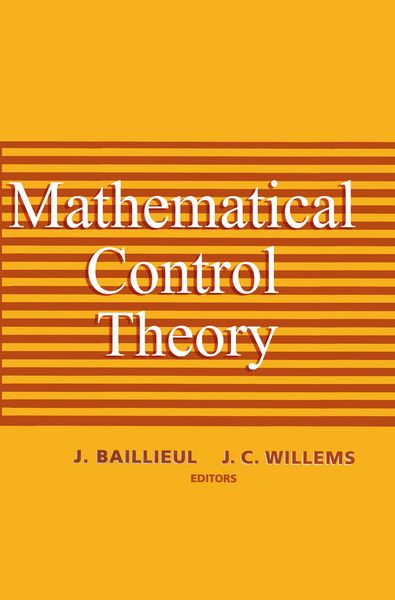
  • Produktbild: Mathematical Control Theory
  • Produktbild: Mathematical Control Theory

Mathematical Control Theory

49,99 €

inkl. gesetzl. MwSt., Versandkostenfrei


Beschreibung

This self-contained volume surveys three decades of mathematical control theory and at the same time describes how the work of Roger Brockett shaped and influenced its development. Nine survey articles written by leading experts in the field, who have also been closely associated with Roger Brockett...

Beschreibung

This self-contained volume surveys three decades of mathematical control theory and at the same time describes how the work of Roger Brockett shaped and influenced its development. Nine survey articles written by leading experts in the field, who have also been closely associated with Roger Brockett at various stages in his career, treat the subject cohesively and in depth. This volume will provide an important reference for graduate students and researchers, as well as for mathematicians, engineers and scientists whose work involves concepts and the language of control and systems theory.

Produktdetails

Einband

Taschenbuch

Erscheinungsdatum

23.10.2012

Abbildungen

XXXII, 360 p.

Herausgeber John B. Baillieul + weitere

Produktdetails

Einband

Taschenbuch

Erscheinungsdatum

23.10.2012

Abbildungen

XXXII, 360 p.

Herausgeber
Verlag Springer Us
Seitenzahl

360

Maße (L/B/H)

23,5/15,5/2,2 cm

Gewicht

598 g

Auflage

Softcover reprint of the original 1st ed. 1999

Sprache

Englisch

ISBN

978-1-4612-7136-9

Herstelleradresse

Springer-Verlag KG
Sachsenplatz 4-6
1201 Wien
AT

Email: ProductSafety@springernature.com

Noch keine Bewertungen vorhanden

Verfassen Sie die erste Bewertung zu diesem Artikel

Helfen Sie anderen Kundinnen und Kunden durch Ihre Meinung.

Kundinnen und Kunden meinen

Bewertungen (0)

  • Produktbild: Mathematical Control Theory
  • Produktbild: Mathematical Control Theory
  • 1 Path Integrals and Stability.- 1.1 Introduction.- 1.2 Path Independence.- 1.3 Positivity of Quadratic Differential Forms.- 1.4 Lyapunov Theory for High-Order Differential Equations.- 1.5 The Bezoutian.- 1.6 Dissipative Systems.- 1.7 Stability of Nonautonomous Systems.- 1.8 Conclusions.- 1.9 Appendixes.- 2 The Estimation Algebra of Nonlinear Filtering Systems.- 2.1 Introduction.- 2.2 The Filtering Model and Background.- 2.3 Starting from the Beginning.- 2.4 Early Results on the Homomorphism Principle.- 2.5 Automorphisms that Preserve Estimation Algebras.- 2.6 BM Estimation Algebra.- 2.7 Structure of Exact Estimation Algebra.- 2.8 Structure of BM Estimation Algebras.- 2.9 Connection with Metaplectic Groups.- 2.10 Wei-Norman Representation of Filters.- 2.11 Perturbation Algebra and Estimation Algebra.- 2.12 Lie-Algebraic Classification of Maximal Rank Estimation Algebras.- 2.13 Complete Characterization of Finite-Dimensional Estimation Algebras.- 2.14 Estimation Algebra of the Identification Problem.- 2.15 Solutions to the Riccati P.D.E.- 2.16 Filters with Non-Gaussian Initial Conditions.- 2.17 Back to the Beginning.- 2.18 Acknowledgement.- 3 Feedback Linearization.- 3.1 Introduction.- 3.2 Linearization of a Smooth Vector Field.- 3.3 Linearization of a Smooth Control System by Change-of-State Coordinates.- 3.4 Feedback Linearization.- 3.5 Input-Output Linearization.- 3.6 Approximate Feedback Linearization.- 3.7 Normal Forms of Control Systems.- 3.8 Observers with Linearizable Error Dynamics.- 3.9 Nonlinear Regulation and Model Matching.- 3.10 Backstepping.- 3.11 Feedback Linearization and System Inversion.- 3.12 Conclusion.- 4 On the Global Analysis of Linear Systems.- 4.1 Introduction.- 4.2 The Geometry of Rational Functions.- 4.3 Group Actions and the Geometry of Linear Systems.- 4.4 The Geometry of Inverse Eigenvalue Problems.- 4.5 Nonlinear Optimization on Spaces of Systems.- 5 Geometry and Optimal Control.- 5.1 Introduction.- 5.2 From Queen Dido to the Maximum Principle.- 5.3 Invariance, Covariance, and Lie Brackets.- 5.4 The Maximum Principle.- 5.5 The Maximum Principle as a Necessary Condition for Set Separation.- 5.6 Weakly Approximating Cones and Transversality.- 5.7 A Streamlined Version of the Classical Maximum Principle.- 5.8 Clarke’s Nonsmooth Version and the ?ojasiewicz Improvement.- 5.9 Multidifferentials, Flows, and a General Version of the Maximum Principle.- 5.10 Three Ways to Make the Maximum Principle Intrinsic on Manifolds.- 5.11 Conclusion.- 6 Languages, Behaviors, Hybrid Architectures, and Motion Control.- 6.1 Introduction.- 6.2 MDLe: A Language for Motion Control.- 6.3 Hybrid Architecture.- 6.4 Application of MDLe to Path Planning with Nonholonomic Robots.- 6.5 PNMR: Path Planner for Nonholonomic Mobile Robots.- 6.6 Conclusions.- 7 Optimal Control, Geometry, and Mechanics.- 7.1 Introduction.- 7.2 Variational Problems with Constraints and Optimal Control.- 7.3 Invariant Optimal Problems on Lie Groups.- 7.4 Sub-Riemannian Spheres—The Contact Case.- 7.5 Sub-Riemannian Systems on Lie Groups.- 7.6 Heavy Top and the Elastic Problem.- 7.7 Conclusion.- 8 Optimal Control, Optimization, and Analytical Mechanics.- 8.1 Introduction.- 8.2 Modeling Variational Problems in Mechanics and Control.- 8.3 Optimization.- 8.4 Optimal Control Problems and Integrable Systems.- 9 The Geometry of Controlled Mechanical Systems.- 9.1 Introduction.- 9.2 Second-Order Generalized Control Systems.- 9.3 Flat Systems and Systems with Flat Inputs.- 9.4 Averaging Lagrangian and Hamiltonian Systems with Oscillatory Inputs.- 9.5 Stability and Flatness in Mechanical Systems with Oscillatory Inputs.- 9.6 Concluding Remarks.