Gutscheinbedingungen

**Gültig bis 14.09.2026 auf Spielzeug, Schreibwaren, Filme, Geschenke & Trends, Musik, tolino eReader & Zubehör, Hörbücher, nicht preisgebundene Bücher und Kalender in der Thalia App. Einzelne Artikel können ausgeschlossen sein. Aufgrund der Buchpreisbindung sind deutschsprachige Bücher und eBooks ausgenommen. Zusätzlich ausgenommen sind Abos & Flatrates, Games, Geschenkkarten/-boxen, Shelfies, Software, Zeitschriften sowie einzelne Artikel von tonies®. Pro Einkauf einmal einlösbar. Nur gültig mit im Onlineshop hinterlegter Bonuscard. Click & Collect nur bei Onlinevorabzahlung möglich. Keine Barauszahlung. Nicht kombinierbar mit anderen Aktionen und Gutscheinen. Gutschein wird auf max. 500€ Bestellwert angerechnet. Nicht gültig für Versandkosten und Services.

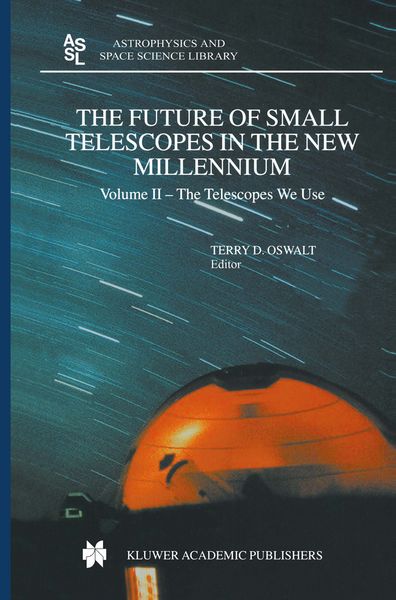
  • Produktbild: The Future of Small Telescopes in the New Millennium
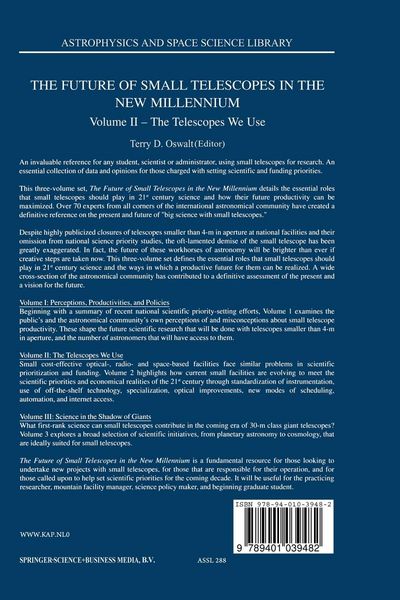
  • Produktbild: The Future of Small Telescopes in the New Millennium
- 12%

The Future of Small Telescopes in the New Millennium Volume I – Perceptions, Productivities, and Policies Volume II – The Telescopes We Use Volume III – Science in the Shadows of Giants

12% sparen

289,99 € UVP 329,99 €

inkl. gesetzl. MwSt., Versandkostenfrei


Beschreibung

Produktdetails

Einband

Taschenbuch

Erscheinungsdatum

21.10.2012

Herausgeber

Terry D. Oswalt

Verlag

Springer Netherland

Seitenzahl

1031

Maße (L/B/H)

23,5/15,5/2 cm

Gewicht

546 g

Auflage

1. Auflage

Sprache

Englisch

ISBN

978-94-010-3948-2

Beschreibung

Rezension

From the reviews:


"…The contributed papers cover a wide range of astronomical topics and form a superb case for the regeneration of small-telescope observational research. For astronomers at all levels. Summing Up: Highly recommended. Upper-division undergraduates through professionals. (A. R. Upgren,
Choice
, June 2004)

Portrait

Dr. Terry D. Oswalt, an astronomer, is Head of the Department of Physics and Space Sciences and Associate Provost for Research at Florida Institute of Technology. He has also served the U.S. National Science Foundation as program officer for Stellar Astronomy and Astrophysics. He earned his Ph.D. in Astronomy at The Ohio State University specializing in photoelectric and spectroscopic studies of binary star systems, late stages of stellar evolution, minor planets, and comets.
Since coming to Florida Tech in 1982, Dr. Oswalt has taught astronomy and physics, while continuing his primary research interest in studies of collapsed stars called white dwarfs. Because such objects are very faint, this work often takes him to Kitt Peak National Observatory in Arizona, Cerro Tololo Inter-American Observatory in Chile, and Mauna Kea Observatory in Hawaii, where telescopes as large as 10-meters are available on a competitive basis to scientists.
Oswalt is the founding Chairman of the Southeast Association for Research in Astronomy, a consortium of 10 universities which operates an automated 1-meter telescope at Kitt Peak National Observatory near Tucson, Arizona. In 2007 SARA will assume operations of a similar telescope at Cerro Tololo Interamerican Observatory in Chile. Oswalt also has been director of the SARA summer internship program, which brings undergraduate students from around the U.S. to the SARA facility at Kitt Peak each summer to do research in astronomy. Dr. Oswalt has written over 100 scientific articles and edits the I.A.P.P.P. Communications, an international journal for advanced amateurs, students, teachers and professionals who collaborate on research and educational projects in astronomy. He is also the editor for a three-volume set of Springer books, 'The Future of Small Telescopes in the New Millennium'.

Zitat

From the reviews:
"...The contributed papers cover a wide range of astronomical topics and form a superb case for the regeneration of small-telescope observational research. For astronomers at all levels. Summing Up: Highly recommended. Upper-division undergraduates through professionals. (A. R. Upgren, Choice, June 2004)

Produktdetails

Einband

Taschenbuch

Erscheinungsdatum

21.10.2012

Herausgeber

Terry D. Oswalt

Verlag

Springer Netherland

Seitenzahl

1031

Maße (L/B/H)

23,5/15,5/2 cm

Gewicht

546 g

Auflage

1. Auflage

Sprache

Englisch

ISBN

978-94-010-3948-2

Herstelleradresse

Springer-Verlag GmbH
Tiergartenstr. 17
69121 Heidelberg
DE

Email: ProductSafety@springernature.com

Noch keine Bewertungen vorhanden

Verfassen Sie die erste Bewertung zu diesem Artikel

Helfen Sie anderen Kundinnen und Kunden durch Ihre Meinung.

Kundinnen und Kunden meinen

Bewertungen (0)

  • Produktbild: The Future of Small Telescopes in the New Millennium
  • Produktbild: The Future of Small Telescopes in the New Millennium
  • 1. Small is as Small Does.- 2. The Future of Small, Inexpensive, Continuously Operating, Wide Field Cameras.- 3. The All Sky Automated Survey.- 4. The Carlsberg Meridian Telescope.- 5. Astrometric Projects at the Bordeaux CCD Meridian Circle.- 6. The USNO CCD Astrograph Catalog (UCAC) Project and Beyond.- 7. The Future of Automated Telescopes and the Bradford Robotic Telescopes.- 8. The Liverpool and Faulkes Telescopes.- 9. The Dutch Open Telescope.- 10. Building a Global Education and Science System Based on Modest-Aperture Telescopes: The Hands On Universe System.- 11. The OTHER Keck Observatories.- 12. The Sun from Big Bear.- 13. The Four-College Consortium and the Future of APT’s.- 14. The National Undergraduate Research Observatory.- 15. Advantages of Automated Observing with Small Telescopes.- 16. Astronomy Back East: The Future of the University Telescope.- 17. Research in a Virtual Astronomy Department: The Southeastern Association for Research in Astronomy (SARA) and the Future of Small Telescopes.- 18. The CHARA Visible/IR Array on Mt. Wilson: Small Telescopes with Large Baselines.- 19. A Dedicated 1-Meter Telescope for High Precision Astrometric Sky Mapping of Faint Stars.- 20. AST/RO: A Small Submillimeter Telescope at the South Pole.- 21. The APO 3.5-m Remote Observing Program — Present and Future.- 22. Scientific Priorities and Scheduling of the UK Infrared Telescope in the Eight-Meter Era.- 23. Small Radio Interferometer Arrays in Solar Physics.- 24. The Educational Role of Small Telescopes in Radio Astronomy.