• Produktbild: HACCP in Meat, Poultry, and Fish Processing
  • Produktbild: HACCP in Meat, Poultry, and Fish Processing
Band 10

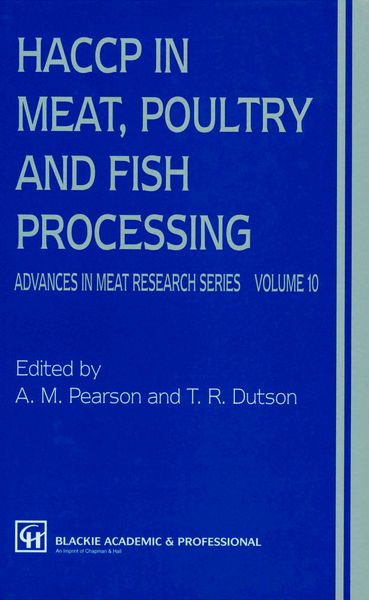
HACCP in Meat, Poultry, and Fish Processing

89,99 €

inkl. gesetzl. MwSt., Versandkostenfrei


Beschreibung

Produktdetails

Einband

Taschenbuch

Erscheinungsdatum

11.03.2013

Verlag

Springer Us

Seitenzahl

393

Maße (L/B/H)

23,5/15,5/2,3 cm

Gewicht

622 g

Auflage

Softcover reprint of the original 1st ed. 1995

Sprache

Englisch

ISBN

978-1-4613-5898-5

Beschreibung

Produktdetails

Einband

Taschenbuch

Erscheinungsdatum

11.03.2013

Verlag

Springer Us

Seitenzahl

393

Maße (L/B/H)

23,5/15,5/2,3 cm

Gewicht

622 g

Auflage

Softcover reprint of the original 1st ed. 1995

Sprache

Englisch

ISBN

978-1-4613-5898-5

Herstelleradresse

Springer-Verlag KG
Sachsenplatz 4-6
1201 Wien
AT

Email: GPSR Kontakt

Noch keine Bewertungen vorhanden

Verfassen Sie die erste Bewertung zu diesem Artikel

Helfen Sie anderen Kundinnen und Kunden durch Ihre Meinung.

Kundinnen und Kunden meinen

Bewertungen (0)

  • Produktbild: HACCP in Meat, Poultry, and Fish Processing
  • Produktbild: HACCP in Meat, Poultry, and Fish Processing
  • 1 The origin and concept of HACCP.- 1.1 Introduction.- 1.2 Development of the HACCP concept.- 1.2.1 HACCP — A new approach.- 1.2.2 HACCP — A preventative system.- 1.3 Acceptance of HACCP by the food industry.- 1.3.1 Establishment of HACCP by other companies.- 1.3.2 Role of various agencies.- 1.4 Summary.- References.- 2 The HACCP system and how it fits into FSIS programs.- 2.1 Introduction.- 2.1.1 FSIS background.- 2.1.2 Industrial responsibility and HACCP.- 2.1.3 FSIS and HACCP.- 2.2 HACCP study.- 2.2.1 Background.- 2.2.2 Consultations and public hearings.- 2.2.3 Workshops.- 2.3 Critical control points for various models.- 2.3.1 Refrigerated foods (cooked and assembled) critical control points.- 2.3.2 Raw beef pattie critical control points.- 2.3.3 Whole young chickens critical control points.- 2.3.4 Cooked sausage critical control points.- 2.3.5 Pork slaughter market hogs critical control points.- 2.4 In-plant testing of HACCP models.- 2.4.1 Background.- 2.4.2 Plant specific plan.- 2.4.3 Inspection during phases II and III.- 2.4.4 Phase II: Implementation.- 2.4.5 Phase III: Operational.- 2.5 Evaluation.- 2.5.1 Background.- 2.5.2 Limitations.- 2.5.3 HACCP model checklist.- 2.5.4 National profiles.- 2.5.5 Quantitative plant data.- 2.5.6 Qualitative plant data.- 2.5.7 Inspector and plant personnel survey.- 2.5.8 Workshop evaluation.- 2.5.9 Training.- 2.5.10 In-plant changes.- 2.6 Current HACCP issues.- 2.6.1 Voluntary/mandatory.- 2.6.2 Review of HACCP plans.- 2.6.3 Transition period.- 2.6.4 Plan approval.- 2.6.5 Critical limits.- 2.6.6 Generic models.- 2.6.7 Training.- 2.6.8 Plan failure.- 2.6.9 Safety/economic.- 2.6.10 Other quality systems.- 2.6.11 Scientific validity.- 2.7 Quadrilateral discussions on food safety.- 2.7.1 Introduction.- 2.7.2 HACCP working group.- 2.7.3 HACCP working group report.- 2.8 Summary.- References.- 3 Implementation of HACCP program on farms and ranches.- 3.1 Introduction.- 3.2 Livestock quality assurance programs.- 3.3 Implementing HACCP on livestock units.- 3.3.1 Initiating on-farm HACCP preventive medicine programs.- 3.3.2 Hazard identification.- 3.3.3 Flow diagrams.- 3.4 Conclusion.- References.- 4 Implementation of the HACCP program by meat and poultry slaughterers.- 4.1 Introduction.- 4.2 Purpose of HACCP.- 4.2.1 Selection of team members.- 4.2.2 Training of HACCP team.- 4.3 Development of the HACCP program.- 4.3.1 Selection of the HACCP team coordinator.- 4.3.2 Development of the master HACCP program.- 4.4 Implementation of the HACCP program.- 4.4.1 Support of management.- 4.4.2 Fitting HACCP plan into operations.- 4.4.3 Focusing attention on hazards.- 4.4.4 Product specific HACCP programs.- 4.5 Summary.- References.- 5 The use of HACCP for producing and distributing processed meat and poultry products.- 5.1 Introduction.- 5.2 Reasons for using HACCP.- 5.3 Developing HACCP plans.- 5.4 Hazard analysis and risk assessment.- 5.4.1 Product recalls.- 5.4.2 Epidemiological data.- 5.4.3 Chemical hazards.- 5.4.4 Physical hazards.- 5.4.5 Biological hazards.- 5.5 Critical control points and critical limits.- 5.5.1 Formulating.- 5.5.2 Cooking.- 5.5.3 Cooling.- 5.5.4 Holding.- 5.5.5 Packaging.- 5.5.6 Preventing recontamination.- 5.5.7 Storing and distributing.- 5.6 Monitoring.- 5.7 Corrective action.- 5.8 Record keeping.- 5.9 Verification.- 5.10 Should HACCP be mandatory?.- 5.11 Summary.- References.- Addendum — Guideline for writing operating instructions/HACCP plans for processed meat and poultry products.- A.1 Headings.- A.2 Critical Control Point (CCP).- A.3 Control Point (CP).- 6 Implementation of the HACCP program by the fresh and processed seafood industry.- 6.1 Introduction.- 6.2 Significance of the seafood industry.- 6.2.1 Resources.- 6.2.2 Fishery habitats.- 6.2.3 US imports of fishery products.- 6.2.4 US exports of fishery products.- 6.2.5 Challenges facing the US seafood industry.- 6.2.6 Food safety in the US fishery system.- 6.3 HACCP in the seafood industry.- 6.3.1 Background.- 6.3.2 Benefits of HACCP.- 6.3.3 History of HACCP in the seafood industry.- 6.4 HACCP and seafood safety.- 6.4.1 CDC seafood safety data.- 6.5 Seafood industry workshops.- 6.5.1 Purpose of workshops.- 6.5.2 Outcome of workshops.- 6.6 NMFS HACCP program.- 6.6.1 Program components.- 6.6.2 Substantial and low risk products.- 6.6.3 Difference between NMFS and FDA programs.- 6.7 FDA’s HACCP program.- 6.7.1 HACCP-based system.- 6.7.2 Seven or five principles?.- 6.7.3 Mandatory training.- 6.7.4 Records access.- 6.7.5 Obligations of importers.- 6.7.6 General sanitation control procedures.- 6.8 Impact of FDA’s proposed HACCP regulation — an example.- 6.9 Summary.- References.- 7 Risk analysis, HACCP and microbial criteria in meat and poultry systems.- 7.1 Introduction.- 7.2 Risk analysis.- 7.2.1 Risk assessment.- 7.2.2 Risk management.- 7.2.3 Risk communication.- 7.3 How risk analysis and HACCP contribute to food safety.- 7.3.1 Interventions are required to reduce risk.- 7.3.2 Appropriate use of interventions.- 7.4 HACCP versus end-product microbial testing.- 7.5 The role of microbiological criteria.- 7.5.1 Microbiological standards.- 7.5.2 Microbiological guidelines.- 7.5.3 Microbiological specifications.- 7.5.4 Microbiological criteria and safety.- 7.5.5 Sampling procedures.- 7.5.6 Disposition of product.- 7.5.7 Establishment and implementation.- 7.5.8 Cost of implementation.- 7.5.9 Application to raw meat and poultry.- 7.5.10 Application to cooked meat and poultry.- 7.6 Statistical process control.- 7.6.1 Statistical process control measures critical control points.- 7.6.2 Control charts.- 7.6.3 Types of control charts.- 7.6.4 Capability.- 7.7 Summary.- Acknowledgements.- References.- 8 Relationship of the HACCP system to Total Quality Management.- 8.1 The importance of quality.- 8.1.1 What do we mean by quality?.- 8.1.2 The need for a culture change.- 8.2 Total Quality Management (TQM): the key to continuous quality improvement.- 8.2.1 TQM defined.- 8.2.2 TQM as a vehicle for corporate quality innovation.- 8.3 The Hazard Analysis Critical Control Point (HACCP) system.- 8.4 Modern quality management: striving for continuous quality improvement.- 8.4.1 Steps for successful transition: philosophies of quality management leaders.- 8.4.2 Quality leadership for the future.- 8.5 The economics of quality.- 8.5.1 The impact of quality on company finances.- 8.5.2 Quality audits.- 8.6 Implementation of TQM and HACCP.- 8.6.1 Phases of TQM implementation.- 8.6.2 Crosby’s Quality Improvement Process (QIP).- 8.6.3 Quality circles.- 8.6.4 HACCP implementation in a TQM company.- 8.6.5 Application of a HACCP system in a TQM meat processing company.- 8.7 ISO 9000.- 8.8 The National Quality Award.- 8.9 Summary.- Acknowledgements.- References.- 9 HACCP for delicatessens and meat, poultry and seafood retailers.- 9.1 Introduction.- 9.2 Potential hazards.- 9.2.1 Raw materials and ingredients.- 9.2.2 Handling and storage practices.- 9.3 Hazard controls.- 9.3.1 Food sources.- 9.3.2 Specifications for receiving.- 9.3.3 Controls at receiving.- 9.3.4 Controls for storage.- 9.3.5 Controls for food preparation.- 9.3.6 Controls for thawing frozen foods.- 9.3.7 Controls for cooking.- 9.3.8 Controls for cooling.- 9.3.9 Controls for reheating.- 9.3.10 Controls for display.- 9.3.11 Controls for sanitation.- 9.4 Monitoring.- 9.5 Corrective actions.- 9.6 Records.- 9.7 Verification.- 9.8 A deli HACCP plan.- 9.8.1 Recipe review.- 9.8.2 Flowcharts.- 9.8.3 Hazard analysis.- 9.8.4 Receiving.- 9.8.5 Preparation, storage and display.- 9.9 Example HACCP plans.- 9.10 Summary.- References.- 10 HACCP-TQM for retail and food service operations.- 10.1 Introduction.- 10.2 What is quality?.- 10.2.1 The safety assurance component of quality.- 10.3 HACCP principles for food production.- 10.4 Food science HACCP principles.- 10.4.1 The unit as a food process system.- 10.5 The HACCP-based TQM process.- 10.5.1 The system for HACCP-based food safety TQM.- 10.5.2 Hazards in the food system.- 10.5.3 Risk clientele.- 10.5.4 What constitutes a hazard?.- 10.5.5 Government microbiological standards for raw and pasteurized food.- 10.5.6 Foodborne illness: Annual estimated cases and deaths in the USA.- 10.6 Food operations hazard analysis.- 10.6.1 Pasteurized—chilled food process hazard control flow diagram.- 10.6.2 The seven recipe processes.- 10.6.3 Recipe flow charting.- 10.6.4 Quality-assured HACCP recipe procedures, the critical hazard control document.- 10.6.5 Components of an effective HACCP program.- 10.6.6 Food safety through Quality Assurance: policies, procedures and standards manual.- 10.7 Summary.- References.- 11 The HACCP program and the consumer.- 11.1 Introduction.- 11.2 The HACCP program.- 11.2.1 The Hazard Analysis Critical Control Point (HACCP) system.- 11.2.2 The goal of HACCP.- 11.2.3 Application of HACCP principles by consumers.- 11.3 HACCP and consumers.- 11.3.1 Defining the elusive customer.- 11.3.2 Target populations for HACCP application.- 11.4 HACCP incorporation into everyday life.- 11.4.1 Education and training of consumers in HACCP.- 11.4.2 Effective modes of communication and training.- 11.4.3 Base line knowledge of consumers on food safety.- 11.5 Application of HACCP principles for consumers.- 11.5.1 HACCP implementation.- 11.5.2 Pilot community.- 11.5.3 Consumer practices.- 11.5.4 HACCP principles applied by the consumer.- 11.5.5 Formation of a HACCP plan for households.- 11.6 Conclusions.- References.- 12 Organization and management of HACCP programs.- 12.1 Introduction.- 12.2 Documentation of HACCP systems.- 12.3 Phases of HACCP system implementation and management requirements.- 12.3.1 Design and introduction.- 12.3.2 Integrating the HACCP system into total operation.- 12.3.3 Operations of the HACCP program.- 12.4 Producing the framework/structure to ensure that the HACCP program is a success.- 12.4.1 Role of personnel to success of HACCP programs.- 12.4.2 A few painful lessons and helpful hints.- 12.5 Summary.- References.- 13 Predictive microbiology and HACCP.- 13.1 Introduction.- 13.2 Predictive microbiology.- 13.2.1 Relationship of predictive modelling to HACCP.- 13.2.2 History of predictive microbiology.- 13.2.3 Modelling approaches.- 13.2.4 Quantitative microbiology?.- 13.3 Predictive modelling and and HACCP.- 13.3.1 Sources of models.- 13.3.2 Principle 1. Risk and hazard assessment.- 13.3.3 Principle 2. Determination of CCPs.- 13.3.4 Principle 3. Establishing critical limits.- 13.3.5 Principle 5. Corrective action specification.- 13.4 Examples of the application of predictive models in HACCP systems.- 13.4.1 Use of the HACCP approach.- 13.4.2 Variability of responses.- 13.5 Conclusions.- References.- 14 National and international cooperation on governmental regulations for meat, poultry and fish inspection.- 14.1 Overview.- 14.2 Agencies and functions.- 14.2.1 Main agencies.- 14.2.2 Other agencies.- 14.3 Domestic interests and cooperation.- 14.3.1 Common interests, philosophies and mechanisms.- 14.3.2 Rulemaking.- 14.3.3 FSIS and FDA inspection techniques.- 14.3.4 Use of Hazard Analysis and Critical Control Point system by the federal agencies.- 14.3.5 Cooperation in developing policies and regulations.- 14.4 International interests and cooperation.- 14.4.1 Bilateral agreements with an individual country, or multilateral with a small group of countries.- 14.4.2 International agreements.- 14.4.3 Codex Alimentarius Commission (CAC).- 14.5 Opportunities to increase cooperation.- 14.5.1 Domestic.- 14.5.2 International.- 14.6 Summary.- References.