
• Produktbild: Fossils, Phylogeny, and Form
  • Produktbild: Fossils, Phylogeny, and Form
Band 19 - 12%

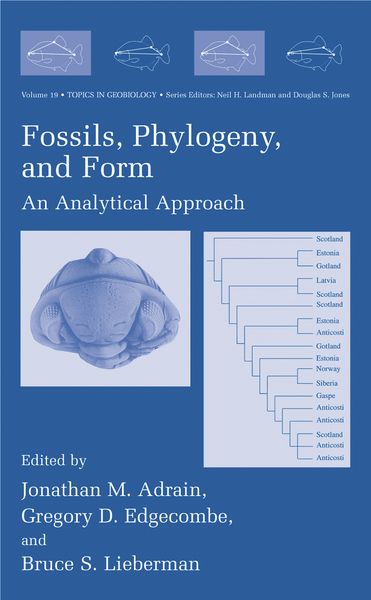
Fossils, Phylogeny, and Form An Analytical Approach

Aus der Reihe Topics in Geobiology
12% sparen

144,99 € UVP 164,99 €

inkl. gesetzl. MwSt., Versandkostenfrei


Beschreibung

Produktdetails

Einband

Taschenbuch

Erscheinungsdatum

03.10.2012

Abbildungen

XIV, 402 p.

Herausgeber

Jonathan M. Adrain + weitere

Verlag

Springer Us

Seitenzahl

402

Maße (L/B/H)

25,4/17,8/2,3 cm

Gewicht

786 g

Auflage

2001

Sprache

Englisch

ISBN

978-1-4613-5137-5

Beschreibung

Produktdetails

Einband

Taschenbuch

Erscheinungsdatum

03.10.2012

Abbildungen

XIV, 402 p.

Herausgeber

Verlag

Springer Us

Seitenzahl

402

Maße (L/B/H)

25,4/17,8/2,3 cm

Gewicht

786 g

Auflage

2001

Sprache

Englisch

ISBN

978-1-4613-5137-5

Herstelleradresse

Springer-Verlag KG
Sachsenplatz 4-6
1201 Wien
AT

Email: ProductSafety@springernature.com

Noch keine Bewertungen vorhanden

Verfassen Sie die erste Bewertung zu diesem Artikel

Helfen Sie anderen Kundinnen und Kunden durch Ihre Meinung.

Kundinnen und Kunden meinen

Bewertungen (0)

  • Produktbild: Fossils, Phylogeny, and Form
  • Produktbild: Fossils, Phylogeny, and Form
  • 1 • Paleobiology: An Empirical Historical Science.- A Historical Perspective.- Phylogeny and Form.- References.- 2 • Phylogenetic Systematics: Five Steps to Enlightenment.- The Terminology.- The Method.- Summary.- Acknowledgments.- References.- 3 • Morphometry and Phylogeny in the Resolution of Paleobiological Problems—Unlocking the Evolutionary Significance of an Assemblage of Silurian Trilobites.- Paleontology’s Contribution to Understanding Evolution.- Research Questions.- Locality.- Study Sample.- Analysis.- Discussion.- Summary.- Acknowledgments.- References.- 4 • Morphological Disparity: A Primer.- Cladistic Concepts.- Phenetic Concepts.- Phenetic Indices of Disparity.- Disparity and Major Body Plans.- Other Factors Variously Related to Disparity.- The Continuity of Morphospace Occupation.- Patterns of Disparity Through Time.- Morphological Constraints.- Disparity and Extant Biodiversity.- Conclusions.- Acknowledgments.- References.- 5 • Homology, Characters, and Morphometric Data.- Homology.- Homology and Classes of Morphometric Variables.- Conclusions.- Acknowledgments.- References.- 6 • Landmarks, Localization, and the Use of Morphometrics in Phylogenetic Analysis.- The Geometric Basis of Morphometric Observations.- The Biological Basis of Morphometric Observations.- Materials and Methods.- Results.- Discussion.- Summary.- Acknowledgments.- References.- 7 • Cladistic Biogeography: Component-Based Methods and Paleontological Application.- Geographic Congruence.- The Role of Fossils.- Optimality.- Area Definition.- Taxon-Area Cladograms, Areagrams and General Areagrams.- Analytical Problems and Assumptions.- Current Component-Based Approaches.- Sources of Ambiguity.- Node Interpretation.- Cladograms and Trees Revisited.- Acknowledgments.-Notes.- Glossary of Terms.- References.- 8 • Stratigraphy, Phylogeny, and Species Sampling in Time and Space.- Reconstructing Phylogeny With and Without Temporal “Data”.- Time as “Data”.- Utility of Strato-Phylogenies.- Strato-Methods and Sampling.- Trilobite Species Sampling in the Laurentian Sunwaptan.- Phylogeny of the Euptychaspidinae and Macronodinae.- Phylogeny Versus Sampling.- Conclusions.- Acknowledgments.- References.- Appendix 1. Character List for Analysis of Euptychaspidinae and Macronodinae.- 9 • Analyzing Speciation Rates in Macroevolutionary Studies.- The Rates of Evolution Most Relevant to Paleontological Studies of Macroevolution.- Approaches to Analyzing Rates of Speciation.- Conclusions.- Acknowledgments.- References.- 10 • The Nature and Origin of Supraspecific Taxa Revisited—With Special Reference to Trilobita.- The Sloshing Bucket.- Trilobites: How Do the Predictions of the Sloshing Bucket Fare?.- Acknowledgments.- Notes.- References.- 11 • The Role and Design of Databases in Paleontology.- Databases Today.- Kinds of Databases.- Security, Access, and the Value of Information.- The Electronic Relational Database.- Databases in Paleontology.- The Future of Databases in Paleontology.- Conclusions.- Acknowledgments.- References.