KI-Beratung Beta

Gutscheinbedingungen

**Gültig bis 30.11.2026 auf Spielzeug, Schreibwaren, Filme, Geschenke & Trends, Musik, tolino eReader & Zubehör, Hörbücher und Hörbuch-Downloads, nicht preisgebundene Bücher und Kalender online auf thalia.at und in der Thalia App. Einzelne Artikel können ausgeschlossen sein. Aufgrund der Buchpreisbindung sind deutschsprachige Bücher und eBooks ausgenommen. Zusätzlich ausgenommen sind Abos & Flatrates, Games, Geschenkkarten/-boxen, Shelfies, Software, Zeitschriften sowie einzelne Artikel von tonies®. Pro Einkauf einmal einlösbar. Nur gültig mit im Onlineshop hinterlegter Bonuscard. Click & Collect nur bei Onlinevorabzahlung möglich. Keine Barauszahlung. Nicht kombinierbar mit anderen Aktionen und Gutscheinen. Gutschein wird auf max. 500€ Bestellwert angerechnet. Nicht gültig für Versandkosten und Services.

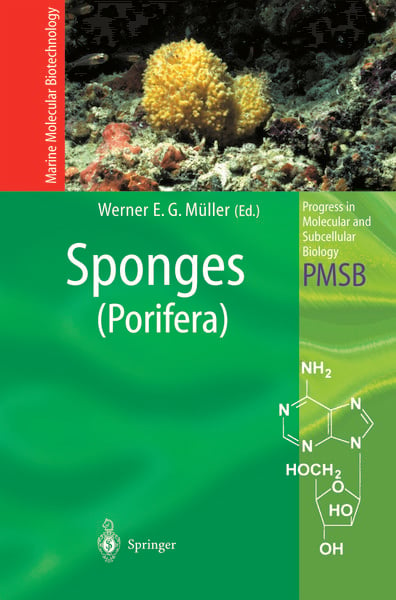
  • Produktbild: Sponges (Porifera)
  • Produktbild: Sponges (Porifera)
Band 37

Sponges (Porifera)

52,99 €

inkl. gesetzl. MwSt., Versandkostenfrei


Beschreibung

Sponges (phylum Porifera) are known to be very rich sources for bioactive compounds, mainly secondary metabolites. Main efforts are devoted to cell- and mariculture of sponges to assure a sustainable exploitation of bioactive compounds from biological starting material. These activities are flanked by...

Beschreibung

Sponges (phylum Porifera) are known to be very rich sources for bioactive compounds, mainly secondary metabolites. Main efforts are devoted to cell- and mariculture of sponges to assure a sustainable exploitation of bioactive compounds from biological starting material. These activities are flanked by improved technologies to cultivate bacteria and fungi which are associated with the sponges. It is the hope that by elucidating the strategies of interaction between microorganisms and their host (sponge), by modern cell and molecular biological methods, a more comprehensive cultivation of the symbiotic organisms will be possible. The next step in the transfer of knowledge to biotechnological applications is the isolation, characterization and structural determination of the bioactive compounds by sophisticated chemical approaches.

Produktdetails

Einband

Taschenbuch

Erscheinungsdatum

21.10.2012

Abbildungen

XVIII, 258 p.

Herausgeber Werner E. G. Müller

Produktdetails

Einband

Taschenbuch

Erscheinungsdatum

21.10.2012

Abbildungen

XVIII, 258 p.

Herausgeber Werner E. G. Müller
Verlag Springer Berlin
Seitenzahl

258

Maße (L/B/H)

23,5/15,5/1,6 cm

Gewicht

429 g

Auflage

Softcover reprint of the original 1st edition 2003

Sprache

Englisch

ISBN

978-3-642-62471-1

Herstelleradresse

Springer-Verlag KG
Sachsenplatz 4-6
1201 Wien
AT

Email: ProductSafety@springernature.com

Noch keine Bewertungen vorhanden

Verfassen Sie die erste Bewertung zu diesem Artikel

Helfen Sie anderen Kundinnen und Kunden durch Ihre Meinung.

Kundinnen und Kunden meinen

Bewertungen (0)

  • Produktbild: Sponges (Porifera)
  • Produktbild: Sponges (Porifera)
  • Analysis of the Sponge [Porifera] Gene Repertoire: Implications for the Evolution of the Metazoan Body Plan.- 1 Introduction.- 2 Sponges.- 3 Adhesion Between Cells.- 4 Growth and Differentiation.- 5 Migration of Cells — Contraction in Cell Layers.- 6 Elements of a Neuronal Network.- 7 Secretion of Skeletal Elements.- 8 Morphogens.- 9 Apoptosis.- 10 Conclusion: Contribution to the Origin of the Metazoan Body Plan.- References.- Sponge-Associated Bacteria: General Overview and Special Aspects of Bacteria Associated with Halichondria panicea.- 1 Introduction.- 2 General Considerations.- 3 Bacteria Associated with Halichondria panicea.- 4 Conclusions.- References.- Microbial Diversity of Marine Sponges.- 1 Introduction.- 2 Sponge—Microbe Associations.- 3 Tools of Molecular Microbial Ecology.- 4 A Uniform Microbial Community in Sponges from Different Oceans.- 5 Biotechnological Potential of Sponge-Associated Microorganisms.- 6 Conclusions and Future Directions.- References.- Full Absolute Stereo structures of Natural Products Directly from Crude Extracts: the HPLC-MS/MS-NMR-CD ‘Triad’.- 1 Introduction.- 2 Exemplarily for Naphthylisoquinoline Alkaloids: Constitutions and Relative Configurations by LC-MS/MS-NMR.- 3 Complemented by the LC-CD Option for the Online Assignment of Absolute Configurations: the Triad Is Complete!.- 4 Application of the Triad to the Online Structural Elucidation of New Naphthylisoquinoline Alkaloids and Related Compounds.- 5 An Application to Natural Phenylanthraquinones — Including Quantum Chemical CD Calculations and Total Synthesis.- 6 Stereochemistry of Axially Chiral Biscarbazoles in Plant Extracts, by LC-CD Coupling and CD Calculations.- 7 Without (True) Stereogenic Axes or Centers, but Chiral: a Bis-Bibenzyl Macrocycle.- 8 First Timein Marine Natural Products Analysis: the Analytical Triad HPLC-MS/MS-NMR-CD.- 9 Conclusions.- References.- Bioactive Natural Products from Marine Invertebrates and Associated Fungi.- 1 Introduction: Some Current Issues of Marine Natural Products Research.- 2 Ecological Functions of Sponge Alkaloids.- 3 Pharmacologically Active Constituents from Marine Invertebrates.- 4 Sponge-Associated Fungi as a New Source for Bioactive Metabolites.- 5 Conclusions.- References.- Sustainable Use of Marine Resources: Cultivation of Sponges.- 1 Introduction.- 2 In Situ Cultivation of Bath Sponges.- 3 Sponge Farming.- 4 Ex Situ Maintenance of Sponges in Aquaria.- 5 In Vitro Cultivation of Sponges.- 6 Conclusions and Future Directions.- References.- Sustainable Production of Bioactive Compounds from Sponges: Primmorphs as Bioreactors.- 1 Introduction.- 2 Origin of Biologically Active Compounds from Sponges.- 3 Biologically Active Compounds from S. domuncula.- 4 The Primmorph System.- 5 Production of Bioactive Compounds in the Primmorph System.- 6 Future Directions.- 7 Conclusions.- References.- Approaches for a Sustainable Use of the Bioactive Potential in Sponges: Analysis of Gene Clusters, Differential Display of mRNA and DNA Chips.- 1 Introduction.- 2 Genome of Porifera.- 3 Nonrandom Distribution of Dinucleotide Repeats.- 4 Burst of Gene Duplication.- 5 Approaches to Identify Genes Involved in the Synthesis of Bioactive Compounds.- 6 Conclusions.- References.- Sorbicillactone A: a Structurally Unprecedented Bioactive Novel-Type Alkaloid from a Sponge-Derived Fungus.- 1 Introduction.- 2 Isolation and Cultivation of the Fungus.- 3 Online Analysis of the Extract by the Triad LC-MS/MS-NMR-CD: Hints at a Novel Structural Type.- 4 Isolation of the New Compound and Completion of the Structural Elucidation.- 5 Sorbicillactone A: a Unique, Novel-Type Structure and Its Presumable Biosynthetic Origin.- 6 Sorbicillactone A: a Natural Product with Strong — and Selective — Bioactivities.- 7 Summary and Future Perspectives.- References.