Gutscheinbedingungen

**Gültig bis 25.06.2026 auf fremdsprachige Bücher online auf thalia.at und in der Thalia App. Einzelne Artikel können ausgeschlossen sein. Ausgenommen sind preisgebundene Artikel & eBooks. Pro Einkauf einmal einlösbar. Click & Collect nur bei Onlinevorabzahlung möglich. Keine Barauszahlung. Nicht kombinierbar mit anderen Aktionen und Gutscheinen. Gutschein wird auf max. 500€ Bestellwert angerechnet. Nicht gültig für Geschenkkarten, Versandkosten und Services.

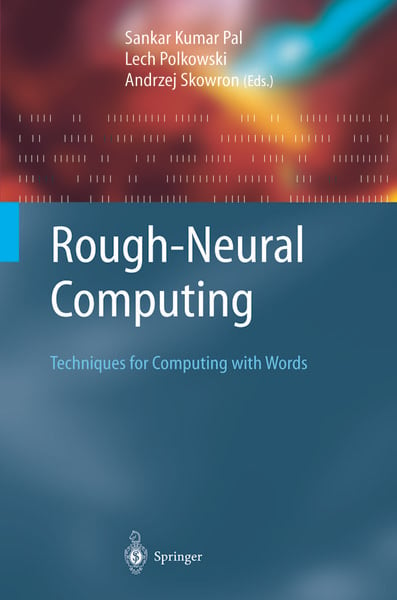
Produktbild: Rough-Neural Computing

Rough-Neural Computing Techniques for Computing with Words

Aus der Reihe Cognitive Technologies

148,99 €

inkl. gesetzl. MwSt., Versandkostenfrei


Beschreibung

Produktdetails

Einband

Taschenbuch

Erscheinungsdatum

23.10.2012

Herausgeber

Sankar Kumar Pal + weitere

Verlag

Springer Berlin

Seitenzahl

736

Maße (L/B/H)

23,5/15,5/4,1 cm

Auflage

Softcover reprint of the original 1st ed. 2004

Sprache

Englisch

ISBN

978-3-642-62328-8

Beschreibung

Rezension

From the reviews:


"This book (actually edited volume) presents recent advances in the area of rough neural computer from a wide konge (sic) of perspectives. … The book contains a few introductory articles suitable to understand what the field of rough several computing is about." (Jan Friso Groote, Zentralblatt MATH, Vol. 1040(9), 2004)

Produktdetails

Einband

Taschenbuch

Erscheinungsdatum

23.10.2012

Herausgeber

Verlag

Springer Berlin

Seitenzahl

736

Maße (L/B/H)

23,5/15,5/4,1 cm

Auflage

Softcover reprint of the original 1st ed. 2004

Sprache

Englisch

ISBN

978-3-642-62328-8

Herstelleradresse

Springer-Verlag GmbH
Tiergartenstr. 17
69121 Heidelberg
DE

Email: ProductSafety@springernature.com

Kundinnen und Kunden meinen

0 Bewertungen

Informationen zu Bewertungen

Zur Abgabe einer Bewertung ist eine Anmeldung im Konto notwendig. Die Authentizität der Bewertungen wird von uns nicht überprüft. Wir behalten uns vor, Bewertungstexte, die unseren Richtlinien widersprechen, entsprechend zu kürzen oder zu löschen.

Die Bewertungen sind nach Format, Anzahl Sterne und Datum sortiert.

Verfassen Sie die erste Bewertung zu diesem Artikel

Helfen Sie anderen Kund*innen durch Ihre Meinung

Kundinnen und Kunden meinen

0 Bewertungen filtern

  • Produktbild: Rough-Neural Computing
  • 1 Elementary Rough Set Granules: Toward a Rough Set Processor.- 2 Rough-Neural Computing: An Introduction.- 3 Information Granules and Rough-Neural Computing.- 4 A Rough-Neural Computation Model Based on Rough Mereology.- 5 Knowledge-Based Networking in Granular Worlds.- 6 Adaptive Aspects of Combining Approximation Spaces.- 7 Algebras from Rough Sets.- 8 Approximation Transducers and Trees: A Technique for Combining Rough and Crisp Knowledge.- 9 Using Contextually Closed Queries for Local Closed-World Reasoning in Rough Knowledge Databases.- 10 On Model Evaluation, Indexes of Importance, and Interaction Values in Rough Set Analysis.- 11 New Fuzzy Rough Sets Based on Certainty Qualification.- 12 Toward Rough Datalog: Embedding Rough Sets in Prolog.- 13 On Exploring Soft Discretization of Continuous Attributes.- 14 Rough-SOM with Fuzzy Discretization.- 15 Biomedical Inference: A Semantic Model.- 16 Fundamental Mathematical Notions of the Theory of Socially Embedded Games: A Granular Computing Perspective.- 17 Fuzzy Games and Equilibria: The Perspective of the General Theory of Games on Nash and Normative Equilibria.- 18 Rough Neurons: Petri Net Models and Applications.- 19 Information Granulation in a Decision-Theoretical Model of Rough Sets.- 20 Intelligent Acquisition of Audio Signals Employing Neural Networks and Rough Set Algorithms.- 21 An Approach to Imbalanced Data Sets Based on Changing Rule Strength.- 22 Rough-Neural Approach to Testing the Influence of Visual Cues on Surround Sound Perception.- 23 Handwritten Digit Recognition Using Adaptive Classifier Construction Techniques.- 24 From Rough through Fuzzy to Crisp Concepts: Case Study on Image Color Temperature Description.- 25 Information Granulation and Pattern Recognition.- 26 Computational Analysis of Acquired Dyslexia of Kanji Characters Based on Conventional and Rough Neural Networks.- 27 WaRS: A Method for Signal Classification.- 28 A Hybrid Model for Rule Discovery in Data.- Author Index.