KI-Beratung Beta

Gutscheinbedingungen

**Gültig bis 18.11.2026 auf englischsprachige Klassiker (klassiker-32728) online auf thalia.at und in der Thalia App. Einzelne Artikel können ausgeschlossen sein. Ausgenommen sind preisgebundene Artikel & eBooks. Pro Einkauf einmal einlösbar. Click & Collect nur bei Onlinevorabzahlung möglich. Keine Barauszahlung. Nicht kombinierbar mit anderen Aktionen und Gutscheinen. Gutschein wird auf max. 500€ Bestellwert angerechnet. Nicht gültig für Geschenkkarten, Versandkosten und Services.

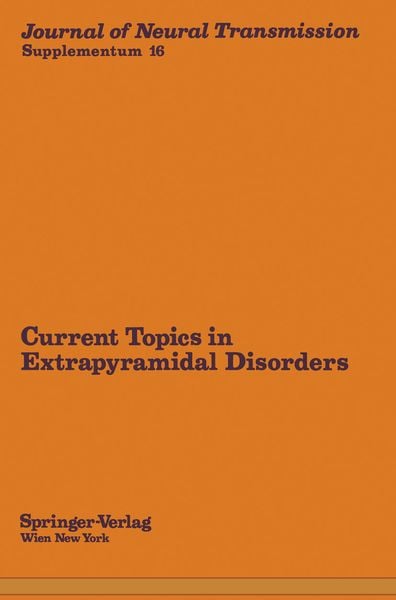
Produktbild: Current Topics in Extrapyramidal Disorders
Band 16

Current Topics in Extrapyramidal Disorders

51,99 €

inkl. gesetzl. MwSt., Versandkostenfrei


Beschreibung

The scientific work of Walther Birkmayer is grounded on his ability to turn what was often a mass of clinical details into the basis for a hypothesis for a new therapeutic approach toward solving the problems of a patient's illness. Birkmayer first became known when, during the Second World War, he built...

Beschreibung

The scientific work of Walther Birkmayer is grounded on his ability to turn what was often a mass of clinical details into the basis for a hypothesis for a new therapeutic approach toward solving the problems of a patient's illness. Birkmayer first became known when, during the Second World War, he built up a clinic for brain injuries in Vienna, in which over 3000 patients were treated. The study of changes in the autonomic functions of the nervous system in these patients as well as the problems of rehabilitation were published in a monograph, "Hirn verletzungen". Consequently, this was his major scientific interest during the post-war years. His book, "Klinik und Therapie der vegetativen Funktionsstorungen" published with W. Winkler, brought Birkmayer recognition in the German-speaking world. In 1954 he took over the Neurological Department of the Geriatric Hospital of Vienna in Lainz, where he remained until his retirement in 1975. International acclaim followed his breakthrough with the clinical application of L-DOPA in Parkinson's disease. Birkmayer, as a strong adherent to the scientific interpretation of neurological and psychiatric disease, has encouraged multidisciplinary research. This is reflected in his establishment of the former Ludwig Boltzmann Institute of Neurochemistry, in which pharmacological, biochemical and histopathological research into neuropsychiatric diseases was performed under one roof. Further to his initial work on L-DOPA, Birkmayer has been in the forefront of supplementary parkinsonian therapy using enzyme inhibitors: benserazide in 1967, unselective monoamine oxidase inhibitors in 1962 and deprenyl in 1975.

Produktdetails

Einband

Taschenbuch

Erscheinungsdatum

31.12.2011

Abbildungen

X, 241 p.

Herausgeber A. Carlsson + weitere

Produktdetails

Einband

Taschenbuch

Erscheinungsdatum

31.12.2011

Abbildungen

X, 241 p.

Herausgeber
Verlag Springer Wien
Seitenzahl

241

Maße (L/B/H)

22,9/15,2/1,4 cm

Gewicht

371 g

Auflage

Softcover reprint of the original 1st ed. 1980

Sprache

Englisch

ISBN

978-3-7091-8584-1

Herstelleradresse

Springer-Verlag KG
Sachsenplatz 4-6
1201 Wien
AT

Email: ProductSafety@springernature.com

Noch keine Bewertungen vorhanden

Verfassen Sie die erste Bewertung zu diesem Artikel

Helfen Sie anderen Kundinnen und Kunden durch Ihre Meinung.

Kundinnen und Kunden meinen

Bewertungen (0)

  • Produktbild: Current Topics in Extrapyramidal Disorders
  • Parkinson’s Disease: Unanswered Questions.- Blood Platelets as Models for Neurons: Uses and Limitations.- Changing Concepts of Nigral Dopamine System Function Within the Basal Ganglia: Relevance to Extrapyramidal Disorders.- An Autoradiographic Study of the Striatofugal Fibers in the Monkey.- Kinetics of L-DOPA Metabolism in the Caudate Nucleus of Cats with Ventrotegmental Lesions.- Spiro- peridol Binding in the Human Caudate Nucleus.- Quantitative Dissection of Human Brain Areas: Relevance to Transmitter Analyses.- On the Mechanism of the Antiparkinsonian Action of 1-DOPA and Bromocriptine: A Theoretical and Experimental Analysis of Dopamine Receptor Sub- and Super- sensitivity.- Contributions of ?- Adrenoreceptor Blockade to Extrapyramidal Effects of Neuroleptic Drugs.- The Decarboxylation of DOPA in the Parkinsonian Brain: In vivo Studies on an Animal Model.- Metabolic Alterations in an Animal Model of Huntington’s Disease Using the 14C- Deoxyglucose Method.- Progressive Supranuclear Palsy: Clinico-Pathological and Biochemical Studies.- Clinical Analysis of Akinesia.- Akinetic Freezing and Trick Movements in Parkinson’s Disease.- Distribution and Metabolism of the Potential Anti-Parkinson Drug Memantine in the Human.- Long-Term Responses of Parkinson’s Disease to Levodopa Therapy.- Monoamine Oxidase Inhibitors as Anti-Depressant Drugs and as Adjunct to L-Dopa Therapy of Parkinson’s Disease.- Dopamine Oxidation and Its Inhibition by (—)-Deprenyl in Man.- Dopamine Metabolism in Human Brain: Effects of Monoamine Oxidase Inhibition in vitro by (—)Deprenyl and (+) and (—)Tranylcypromine.- Unilateral Parkinson’s Disease and Contralateral Tardive Dyskinesia: A Unique Case with Successful Therapy That May Explain the Pathophysiology of These TwoDisorders.- Lecithin in Parkinson’s Disease.- Is the Neurosurgical Treatment of Parkinson’s Disease Still Indicated?.- Benign and Malignant Types of Parkinson’s Disease: Clinical and Patho-Physiological Characterization.- Theoretical and Clinical Aspects of the Tourette Syndrome (Chronic Multiple Tic).- The Neuropathology of GABA Neurons in Extrapyramidal Disorders.- The Potential of GABA Mimetics in the Therapy of Extrapyramidal Disorders.