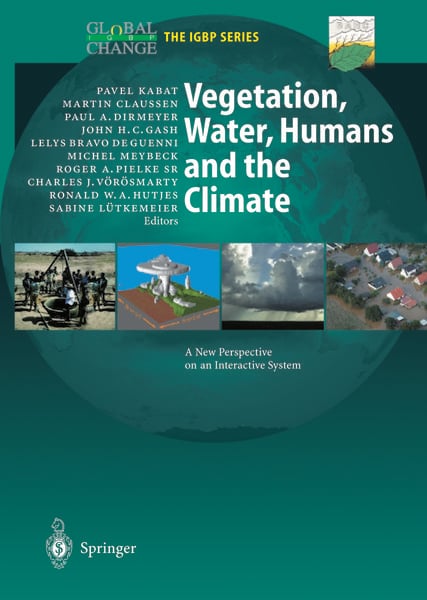
Vegetation, Water, Humans and the Climate A New Perspective on an Interactive System
-
- Englisch ausgewählt
99,99 €
inkl. gesetzl. MwSt.,
Beschreibung
Produktdetails
Einband
Taschenbuch
Erscheinungsdatum
21.10.2012
Herausgeber
Pavel Kabat + weitereVerlag
Springer BerlinSeitenzahl
566
Maße (L/B/H)
27/19,3/3,2 cm
Gewicht
1265 g
Auflage
Softcover reprint of the original 1st ed. 2004
Sprache
Englisch
ISBN
978-3-642-62373-8
A state-of-the-art overview of the influence of terrestrial vegetation and soils within the Earth system. The text deals especially with interactions between the terrestrial biosphere and the atmosphere via the hydrological cycle and their interlinkage with anthropogenic activities. Measurements gathered in integrated field experiments in the Sahel, the Amazon, North America and South-east Asia confirm the importance of these interactions. Observations are complemented by modelling studies, including regional models that simulate flows and transport in river catchments, coupled land-cover and regional climate systems, and Earth-system and global circulation models. Water, nutrient and sediment fluxes in river basins are also discussed and are shown to be highly impacted and regulated by humans through land use, pollution and river engineering. Finally, the book discusses environmental vulnerability and methodologies for assessing the risks associated with regional and global climatic and environmental variability and change.
The results reported in this book are based on the research work of many individual scientists and teams around the world associated with the objectives of the IGBP-BAHC and WCRP-GEWEX international research programmes.
Noch keine Bewertungen vorhanden
Verfassen Sie die erste Bewertung zu diesem Artikel
Helfen Sie anderen Kundinnen und Kunden durch Ihre Meinung.
Kurze Frage zu unserer Seite
Vielen Dank für Ihr Feedback
Wir nutzen Ihr Feedback, um unsere Produktseiten zu verbessern. Bitte haben Sie Verständnis, dass wir Ihnen keine Rückmeldung geben können. Falls Sie Kontakt mit uns aufnehmen möchten, können Sie sich aber gerne an unseren Kund*innenservice wenden.
zum Kundenservice