• Produktbild: Computer Algebra in Scientific Computing CASC’99
  • Produktbild: Computer Algebra in Scientific Computing CASC’99

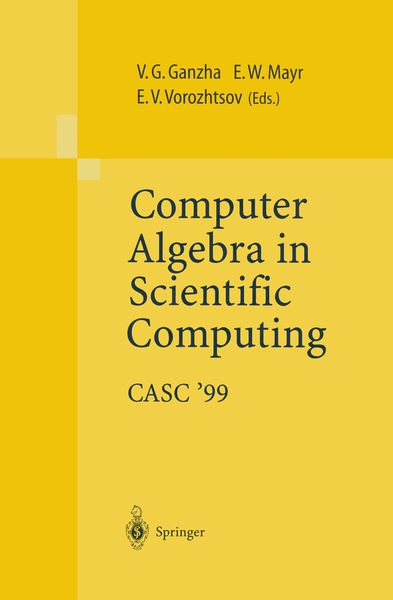
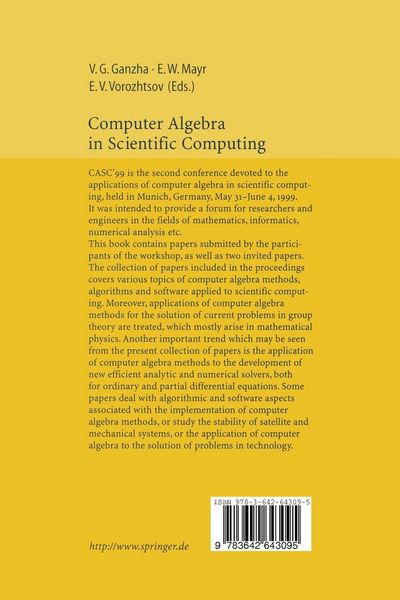
Computer Algebra in Scientific Computing CASC’99 Proceedings of the Second Workshop on Computer Algebra in Scientific Computing, Munich, May 31 – June 4, 1999

52,99 €

inkl. gesetzl. MwSt., Versandkostenfrei


Beschreibung

Produktdetails

Einband

Taschenbuch

Erscheinungsdatum

16.09.2011

Herausgeber

Victor G. Ganzha + weitere

Verlag

Springer Berlin

Seitenzahl

511

Maße (L/B/H)

23,5/15,5/2,9 cm

Gewicht

785 g

Auflage

Softcover reprint of the original 1st ed. 1999

Sprache

Englisch

ISBN

978-3-642-64309-5

Beschreibung

Portrait

Prof. Dr. Victor Ganzha lehrt am Fachbereich Mathematik/Informatik der Universität-GH Kassel. Er beschäftigt sich mit symbolisch-numerischen Methoden.

Produktdetails

Einband

Taschenbuch

Erscheinungsdatum

16.09.2011

Herausgeber

Verlag

Springer Berlin

Seitenzahl

511

Maße (L/B/H)

23,5/15,5/2,9 cm

Gewicht

785 g

Auflage

Softcover reprint of the original 1st ed. 1999

Sprache

Englisch

ISBN

978-3-642-64309-5

Herstelleradresse

Springer-Verlag KG
Sachsenplatz 4-6
1201 Wien
AT

Email: GPSR Kontakt

Noch keine Bewertungen vorhanden

Verfassen Sie die erste Bewertung zu diesem Artikel

Helfen Sie anderen Kundinnen und Kunden durch Ihre Meinung.

Kundinnen und Kunden meinen

Bewertungen (0)

  • Produktbild: Computer Algebra in Scientific Computing CASC’99
  • Produktbild: Computer Algebra in Scientific Computing CASC’99
  • Solution of Ordinary Differential Equations with MathLie.- Analysis of Stability of Rational Approximations through Computer Algebra.- An Automatic Symbolic-Numeric Taylor Series ODE Solver.- About Normal Form Method.- Computer Algebra Investigation of Equivalence in 4-node Plane Stress/Strain Finite Elements.- Symmetry Theorems for the Newtonian 4- and 5-body Problems with Equal Masses.- Symbolic Derivation of Different Class of High-order Compact Schemes for Partial Differential Equations.- Implementation of Aerodynamic Computations with Mathematica.- Completion of Linear Differential Systems to Involution.- Constrained Hamiltonian Systems and Gröbner Bases.- Construction of Involutive Monomial Sets for Different Involutive Divisions.- Partial Inverse Heuristic for the Approximate Solution of Non-linear Equations.- Computing Cocycles on Simplicial Complexes.- Bifurcations of Maps in the Software Package CONTENT.- Extending a Java Based Framework for Scientific Software-Components.- Symbolic-numeric Investigations for Stability Analysis of Satellite Systems.- Quantization by Presentation: The Nambu-Goto String in 1+3 Dimensions.- One Algorithm of Finding Solutions for the Systems with First Integrals.- Cohomology of Lie Superalgebras of Hamiltonian Vector Fields: Computer Analysis.- Computer Algebra Tools in Construction of Renormgroup Symmetries 251.- Where Numerics Can Benefit from Computer Algebra in Finite Difference Modelling of Fluid Flows.- Effectively Computation of Some Radicals of Submodules of Free Modules.- Computations on Character Tables of Association Schemes.- Investigation of Subgroup Embeddings by the Computer Algebra Package GAP.- An Investigation into Stability of Conservative Mechanical Systems Using Analytic Calculations.- Superfast Computations with Singular Structured Matrices over Abstract Fields.- From Modeling to Simulation with Symbolic Computation: An Application to Design and Performance Analysis of Complex Optical Devices.- A Symbolic Numeric Environment for Analyzing Measurement Data in Multi-Model Settings (Extended Abstract).- Geometric Interpretation of Strong Inconsistency in Knowledge Based Systems.- Indices and Solvability for General Systems of Differential Equations.- Decomposing Systems of Polynomial Equations.- Polynomials with Coefficients of Limited Accuracy.- Localization of Roots of a Polynomial not Represented in Canonical Form.- On Normalization of a Class of Polynomial Hamiltonians: From Ordinary and Inverse Points of View.- On Multivariate Polynomial Decomposition.- Complexity of Monomial Evaluations and Duality.- On the Simplification of Nonlinear DAE Systems in Analog Circuit Design.- Symbolic Analysis of Computational Algorithms with SYDNA.