Gutscheinbedingungen

**Gültig am 28.06.2026 auf Spielzeug, Schreibwaren, Filme, Geschenke & Trends, Musik, tolino eReader & Zubehör, Hörbücher und Hörbuch-Downloads (außer Abo), nicht preisgebundene Bücher und Kalender online auf thalia.at und in der Thalia App. Einzelne Artikel können ausgeschlossen sein. Aufgrund der Buchpreisbindung sind deutschsprachige Bücher und eBooks ausgenommen. Zusätzlich ausgenommen sind preisgebundene Artikel, Abos & Flatrates, eBooks, Games, Geschenkkarten/-boxen, Shelfies, Software, Zeitschriften sowie einzelne Artikel von tonies®. Pro Einkauf einmal einlösbar. Click & Collect nur bei Onlinevorabzahlung möglich. Keine Barauszahlung. Nicht kombinierbar mit anderen Aktionen und Gutscheinen. Gutschein wird auf max. 500€ Bestellwert angerechnet. Nicht gültig für Versandkosten und Services.

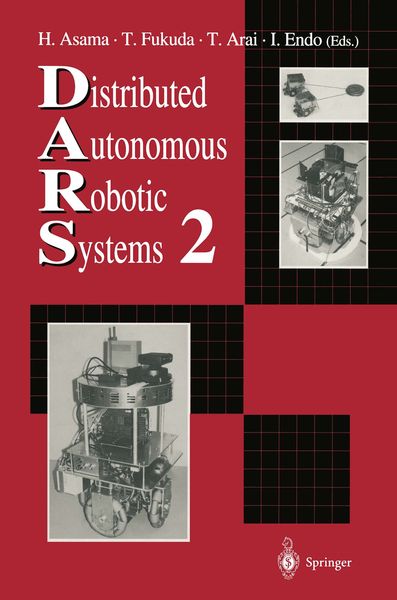
  • Produktbild: Distributed Autonomous Robotic Systems 2
  • Produktbild: Distributed Autonomous Robotic Systems 2
- 11%

Distributed Autonomous Robotic Systems 2

11% sparen

96,99 € UVP 109,99 €

inkl. gesetzl. MwSt., Versandkostenfrei


Beschreibung

Produktdetails

Einband

Taschenbuch

Erscheinungsdatum

03.10.2013

Herausgeber

Hajime Asama + weitere

Verlag

Springer Tokyo

Seitenzahl

441

Maße (L/B/H)

23,5/15,5/2,5 cm

Gewicht

686 g

Auflage

Softcover reprint of the original 1st ed. 1996

Sprache

Englisch

ISBN

978-4-431-66944-9

Beschreibung

Produktdetails

Einband

Taschenbuch

Erscheinungsdatum

03.10.2013

Herausgeber

Verlag

Springer Tokyo

Seitenzahl

441

Maße (L/B/H)

23,5/15,5/2,5 cm

Gewicht

686 g

Auflage

Softcover reprint of the original 1st ed. 1996

Sprache

Englisch

ISBN

978-4-431-66944-9

Herstelleradresse

Springer-Verlag KG
Sachsenplatz 4-6
1201 Wien
AT

Email: GPSR Kontakt

Kundinnen und Kunden meinen

0 Bewertungen

Informationen zu Bewertungen

Zur Abgabe einer Bewertung ist eine Anmeldung im Konto notwendig. Die Authentizität der Bewertungen wird von uns nicht überprüft. Wir behalten uns vor, Bewertungstexte, die unseren Richtlinien widersprechen, entsprechend zu kürzen oder zu löschen.

Die Bewertungen sind nach Format, Anzahl Sterne und Datum sortiert.

Verfassen Sie die erste Bewertung zu diesem Artikel

Helfen Sie anderen Kund*innen durch Ihre Meinung

Kundinnen und Kunden meinen

0 Bewertungen filtern

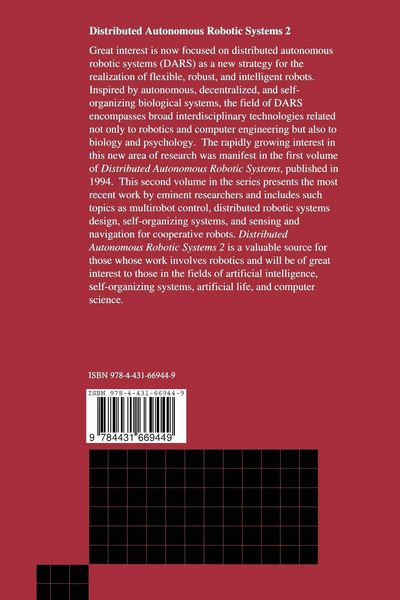
  • Produktbild: Distributed Autonomous Robotic Systems 2
  • Produktbild: Distributed Autonomous Robotic Systems 2
  • Trends and Perspective of Researches on Control System Theory.- Collective Intelligence in Natural and Artificial Systems.- Reconfiguration Method for a Distributed Mechanical System.- Shock Absorbers and Shock Transformers: Comparing the Collision Behavior of a Mobile Robot Equipped with Different Bumper Types.- Towards a Generic Computer Simulation Platform for Distributed Robotic System Development and Experiments.- Cooperation between a Human Operator and Multiple Robots for Maintenance Tasks at a Distance.- Fast 3D Simulation of Snake Robot Motion.- GMD-Snake: A Semi-Autonomous Snake-like Robot.- Development of a Snake-like Robot-Design Concept and Simulation of a Planar Movement Mode.- Multi-Robot Team Design for Real-World Applications.- An Application Concept of an Underwater Robot Society.- The Modeling of the Team Strategy of Robotic Soccer as a Multi-Agent Robot System.- A Model of Group Choice for Artificial Society.- Distributed Autonomous Formation Control of Mobile Robot Groups by Swarm-Based Pattern Generation.- Affordance in Autonomous Robot; Grounding Mechanism of Sensory Inputs.- Iterative Transportation Planning of Multiple Objects by Cooperative Mobile Robots.- Experimental Characteristics of Multiple-Robots Behaviors in Communication Network Expansion and Object-Fetching.- Managing Different Types of Interactions among Robots.- Amoeba Like Grouping Behavior for Autonomous Robots Using Vibrating Potential Field (Obstacle Avoidance on Uneven Road).- Dissipative Structure Network for Collective Autonomy: Spatial Decomposition of Robotic Group.- Cooperative Acceleration of Task Performance: Foraging Behavior of Interacting Multi-Robots System.- Asynchronous and Synchronous Cooperation; Demonstrated by Deadlock Resolution in a Distributed Robot System.- Cooperative Sweeping in Environments with Movable Obstacles.- Integration of Distributed Sensing Information in DARS based on Evidential Reasoning.- Implementing an Automated Reasoning System for Multi-Robot Cooperation.- Distributed Fail-Safe Structure for Collaborations of Multiple Manipulators.- Multi-Legged Vehicle Based on Mimic-Reactive Architecture.- Adaptability of a Decentralized Kinematic Control Algorithm to Reactive Motion under Microgravity.- Interactive Human-Robot Pole Balancing Utilizing Multiple Viìtual Fuzzy Agents.- Cooperative Operation of Two Mobile Robots.- A New Approach to Multiple Robots’ Behavior Design for Cooperative Object Manipulation.- Robot Behavior and Information System for Multiple Object Handling Robots.- Cooperative Strategy for Multiple Position-controlled Mobile Robots.- Cooperative Navigation among Multiple Mobile Robots.- Self-Localization of Autonomous Mobile Robots Using Intelligent Data Carriers.- Fusion of Range Images and Intensity Images Measured from Multiple View Points.- A Robot Duo for Cooperative Autonomous Navigation.- Appendix Related Research Topics.- Granularity and Scaling in Modularity Design for Manipulator Systems.- Shared Experience Learning on a pair of Autonomous Mobile Robots.- Autonomous Navigation of Mobile Robot by Using Hierarchical Fuzzy Inference and Multi-Sensor Fusion.- Genetic Approach for Autonomous Learning and Structural Evolution.- A Field Communication System for Distributed Autonomous Robots; Investigation of Cooperative Behavior on Messenger Robots Problem.- Power Grasping by Distributed Autonomous Control.- Acquiring Co-operation without Communication by Reinforcement Learning and Dynamics Identification.- BUGS: An Autonomous “Basic UXO Gathering System” Approach in Minefield Countermeasure & UXO Clearance II.- Consideration on Conceptual Design of Inter Robot Communications Network for Mobile Robot System; Concept of Implicit Communication and how to realize with current technology.