KI-Beratung Beta

Gutscheinbedingungen

**Gültig bis 11.11.2026 auf Spielzeug, Schreibwaren, Filme, Geschenke & Trends, Musik, tolino eReader & Zubehör, Hörbücher und Hörbuch-Downloads, nicht preisgebundene Bücher und Kalender online auf thalia.at und in der Thalia App. Einzelne Artikel können ausgeschlossen sein. Aufgrund der Buchpreisbindung sind deutschsprachige Bücher und eBooks ausgenommen. Zusätzlich ausgenommen sind Abos & Flatrates, Games, Geschenkkarten/-boxen, Shelfies, Software, Zeitschriften sowie einzelne Artikel von tonies®. Pro Einkauf einmal einlösbar. Click & Collect nur bei Onlinevorabzahlung möglich. Keine Barauszahlung. Nicht kombinierbar mit anderen Aktionen und Gutscheinen. Gutschein wird auf max. 500€ Bestellwert angerechnet. Nicht gültig für Versandkosten und Services.

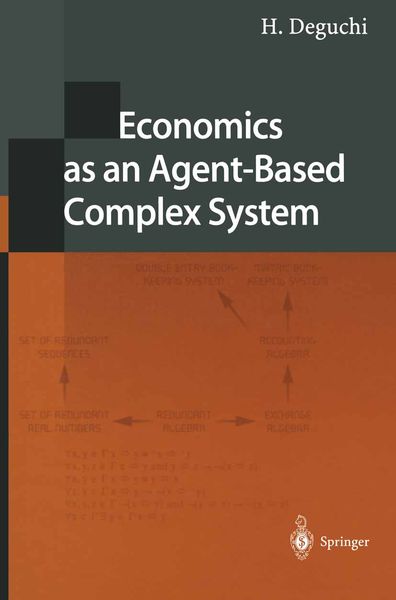
Produktbild: Economics as an Agent-Based Complex System

Economics as an Agent-Based Complex System Toward Agent-Based Social Systems Sciences

99,99 €

inkl. gesetzl. MwSt., Versandkostenfrei


Beschreibung

Produktdetails

Einband

Taschenbuch

Erscheinungsdatum

03.10.2013

Abbildungen

XIII, 261 p.

Verlag

Springer Tokyo

Seitenzahl

261

Maße (L/B/H)

23,5/15,5/1,6 cm

Gewicht

423 g

Auflage

1. Auflage

Sprache

Englisch

ISBN

978-4-431-67965-3

Beschreibung

Produktdetails

Einband

Taschenbuch

Erscheinungsdatum

03.10.2013

Abbildungen

XIII, 261 p.

Verlag

Springer Tokyo

Seitenzahl

261

Maße (L/B/H)

23,5/15,5/1,6 cm

Gewicht

423 g

Auflage

1. Auflage

Sprache

Englisch

ISBN

978-4-431-67965-3

Herstelleradresse

Springer-Verlag KG
Sachsenplatz 4-6
1201 Wien
AT

Email: ProductSafety@springernature.com

Noch keine Bewertungen vorhanden

Verfassen Sie die erste Bewertung zu diesem Artikel

Helfen Sie anderen Kundinnen und Kunden durch Ihre Meinung.

Kundinnen und Kunden meinen

Bewertungen (0)

  • Produktbild: Economics as an Agent-Based Complex System
  • Preface.- 1 Systems Description and Models in Economics.- Purpose of This Chapter.- 1.1 A Systems Description of Economics Systems.- 1.2 Paradigm Shift.- 1.3 Conception of This Book.- 1.4 Methodological Issue.- 1.5 Three Types of Realities.- 1.6 Beyond the Systems View of Natural Science.- 1.7 An Epistemological Framework for a Poly Agent System.- 2 Mathematical Research of Evolution and Structural Change.- -Social Learning Dynamics and Its Bifurcation-.- Aim of This Chapter.- 2.1 Structural Change and Bifurcation in Social Sciences.- 2.2 Game Theory and Evolutionary Games.- 2.3 Social Learning Dynamics.- 2.4 Asymmetrical Social Learning Dynamics.- 3 A Social and Organizational Learning Model of Decision Making.- -Application of SLD and Agent Based Simulation-.- Purpose of This Chapter.- 3.1 Indirect Control.- 3.2 Norm Formation, Mutual Commitment and Structural Change.- 3.3 Social Learning Dynamics of the Norm Game.- 3.4 Centralized and Hierarchical Commitment and Support.- 3.5 The Historical Change of Social Commitment Structure.- 3.6 Commitment and Learning Rationality.- 4 The Tragedy of the Commons and Its Agent Based and Gaming Modeling.- Aim of This Chapter.- 4.1 Gaming Simulation and ABM.- 4.2 Environment Management Gaming.- 4.3 How to Play Environment Management Gaming.- 4.4 The Facilitator's Guide of Environment Management Gaming.- 4.5 Human Gaming Simulation of the Commons.- 4.6 Agent Based Simulation and Classifier.- 4.7 Agent Based Simulation of the Commons.- 4.8 Agent Based Simulation of the Commons.- 5 State Space Complexity and Exchange Algebra.- Purpose of This Chapter.- 5.1 Introduction.- 5.2 Axiomatic Foundation of Economic Exchange.- 5.3 Exchange Algebra.- 5.4 Concluding Remarks.- 6 The National Economic Field and Algebraic Reconstruction of SNA.- Aimof This Chapter.- 6.1 The Virtual Economy.- 6.2 The Structure of Economic Field and SNA.- 6.3 Classification of Transactions.- 6.4 National Economic Field: Aggregation.- 6.5 National Economic Field and Bottom Up Reconstruction of SNA.- 6.6 Integrated National Economic Field.- 6.7 Conclusion.- 7 Gaming Simulation and the Dynamics of a Virtual Economy.- Aim of This Chapter.- 7.1 Introduction.- 7.2 Assumption of Virtual Economy Gaming.- 7.3 Three Types of Gaming Simulation for a Virtual Economy.- 7.4 Multi Player's Gaming Model.- 7.5 The Failure and Success of Economic Growth by Gaming.- 7.6 A Multiplier Analysis of a Virtual Economy.- 7.7 Agent Based Simulation of Bird's Eye View Model.- 7.8 Long Term Growth Path.- 7.9 Conclusion.- 8 Network Oriented Industrial Structures.- Aim of This Chapter.- 8.1 What Is a Network?.- 8.2 Industrial Networks in the Software Industry.- 8.3 Networks of Medium and Small Enterprises.- 8.4 The Merits of a Network and Networks of Medium and Small Companies.- Notes.- 9 Learning Dynamics in Platform Externality.- 9.1 Platform Concept.- 9.2 Platform Externality.- 9.3 Model of Platform Externality and Lock In.- 9.4 Bifurcation Analysis of Social Learning Dynamics.- 9.5 Platform Goods and Technological Innovation.- 9.6 Cultural Platforms.- References.