Gutscheinbedingungen

**Gültig bis 25.06.2026 auf fremdsprachige Bücher online auf thalia.at und in der Thalia App. Einzelne Artikel können ausgeschlossen sein. Ausgenommen sind preisgebundene Artikel & eBooks. Pro Einkauf einmal einlösbar. Click & Collect nur bei Onlinevorabzahlung möglich. Keine Barauszahlung. Nicht kombinierbar mit anderen Aktionen und Gutscheinen. Gutschein wird auf max. 500€ Bestellwert angerechnet. Nicht gültig für Geschenkkarten, Versandkosten und Services.

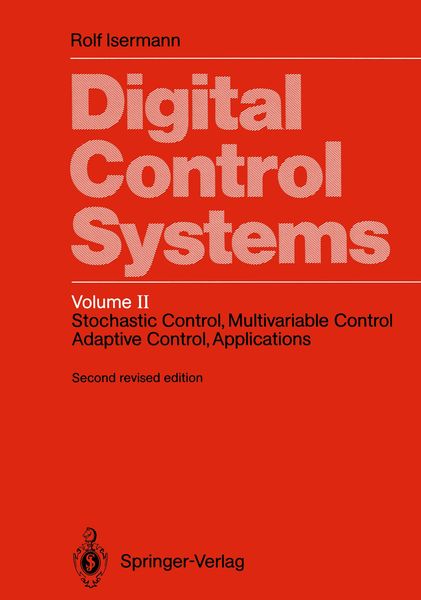
  • Produktbild: Digital Control Systems
  • Produktbild: Digital Control Systems
- 11%

Digital Control Systems Volume 2: Stochastic Control, Multivariable Control, Adaptive Control, Applications

11% sparen

77,99 € UVP 87,99 €

inkl. gesetzl. MwSt., Versandkostenfrei


Beschreibung

Produktdetails

Einband

Taschenbuch

Erscheinungsdatum

25.11.2012

Verlag

Springer Berlin

Seitenzahl

325

Maße (L/B/H)

24,4/17/2 cm

Gewicht

607 g

Auflage

Second Edition 1991

Sprache

Englisch

ISBN

978-3-642-86422-3

Beschreibung

Produktdetails

Einband

Taschenbuch

Erscheinungsdatum

25.11.2012

Verlag

Springer Berlin

Seitenzahl

325

Maße (L/B/H)

24,4/17/2 cm

Gewicht

607 g

Auflage

Second Edition 1991

Sprache

Englisch

ISBN

978-3-642-86422-3

Herstelleradresse

Springer-Verlag KG
Sachsenplatz 4-6
1201 Wien
AT

Email: ProductSafety@springernature.com

Kundinnen und Kunden meinen

0 Bewertungen

Informationen zu Bewertungen

Zur Abgabe einer Bewertung ist eine Anmeldung im Konto notwendig. Die Authentizität der Bewertungen wird von uns nicht überprüft. Wir behalten uns vor, Bewertungstexte, die unseren Richtlinien widersprechen, entsprechend zu kürzen oder zu löschen.

Die Bewertungen sind nach Format, Anzahl Sterne und Datum sortiert.

Verfassen Sie die erste Bewertung zu diesem Artikel

Helfen Sie anderen Kund*innen durch Ihre Meinung

Kundinnen und Kunden meinen

0 Bewertungen filtern

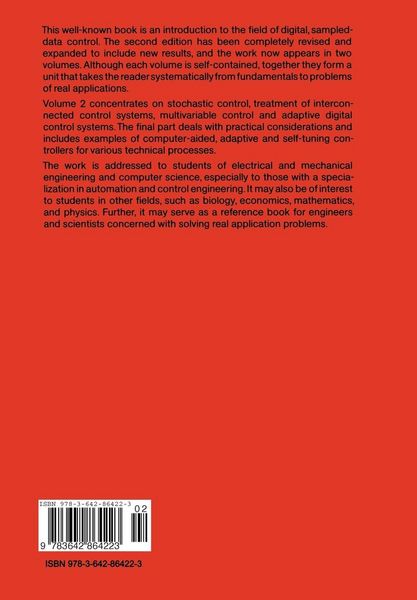
  • Produktbild: Digital Control Systems
  • Produktbild: Digital Control Systems
  • C Control Systems for Stochastic Disturbances.- 12 Stochastic Control Systems (Introduction).- 12.1 Preliminary Remarks.- 12.2 Mathematical Models of Stochastic Signal Processes.- 12.2.1 Basic Term.- 12.2.2 Markov Signal Processe.- 12.2.3 Scalar Stochastic Difference Equation.- 13 Parameter-optimized Controllers for Stochastic Disturbances.- 14 Minimum Variance Controllers for Stochastic Disturbances.- 14.1 Generalized Minimum Variance Controllers for Processes without Deadtime.- 14.2 Generalized Minimum Variance Controllers for Processes with Deadtime.- 14.3 Minimum Variance Controllers for Processes with Pure Deadtime.- 14.4 Minimum Variance Controllers without Offset.- 14.4.1 Additional Integral Acting Term.- 14.4.2 Minimization of the Control Error.- 14.5 Simulation Results with Minimum Variance Controllers.- 14.6 Comparison of Various Deterministic and Stochastic Controllers.- 15 State Controllers for Stochastic Disturbances.- 15.1 Optimal State Controllers for White Noise.- 15.2 Optimal State Controllers with State Estimation for White Noise.- 15.3 Optimal State Controllers with State Estimation for External Disturbances.- D Interconnected Control Systems.- 16 Cascade Control Systems.- 17 Feedforward Control.- 17.1 Cancellation Feedforward Control.- 17.2 Parameter-optimized Feedforward Control.- 17.2.1 Parameter-optimized Feedforward Control without a Prescribed Initial Manipulated Variable.- 17.2.2 Parameter-optimized Feedforward Control with Prescribed Initial Manipulated Variable.- 17.2.3 Cooperation of Feedforward and Feedback Control.- 17.3 State Variable Feedforward Control.- 17.4 Minimum Variance Feedforward Control.- E Multivariable Control Systems.- 18 Structures of Multivariable Processes.- 18.1 Structural Properties of Transfer Function Representations.- 18.1.1 Canonical Structures.- 18.1.2 The Characteristic Equation and Coupling Factor.- 18.1.3 The Influence of External Signals.- 18.1.4 Mutual Action of the Main Controllers.- 18.1.5 The Matrix Polynomial Representation.- 18.2 Structural Properties of the State Representation.- 19 Parameter-optimized Multivariable Control Systems.- 19.1 Parameter Optimization of Main Controllers without Coupling Controllers.- 19.1.1 Stability Regions.- 19.1.2 Optimization of the Controller Parameters and Tuning Rules for Twovariable Controllers.- 19.2 Decoupling by Coupling Controllers (Non-interaction).- 19.3 Parameter Optimization of the Main and Coupling Controller.- 20 Multivariable Matrix Polynomial Control Systems.- 20.1 The General Matrix Polynomial Controller.- 20.2 The Matrix Polynomial Deadbeat Controller.- 20.3 Matrix Polynomial Minimum Variance Controllers.- 21 Multivariable State Control Systems.- 21.1 Multivariable State Control Systems.- 21.2 Multivariable Matrix Riccati State Controllers.- 21.3 Multivariable Decoupling State Controllers.- 21.4 Multivariable Minimum Variance State Controllers.- 22 State Estimation.- 22.1 Vector Signal Processes and Assumptions.- 22.2 Weighted Averaging of Two Measurements.- 22.3 Recursive Estimation of Vector States (Kaiman Filter).- F Adaptive Control Systems.- 23 Adaptive Control Systems (A Short Review).- 23.1 Model Reference Adaptive Systems (MRAS).- 23.1.1 Local Parameter Optimization.- 23.1.2 Ljapunov Design.- 23.1.3 Hyperstability Design.- 23.2 Adaptive Controllers with Identification Model (MIAS).- 24 On-line Identification of Dynamical Processes and Stochastic Signals.- 24.1 Process and Signal Models.- 24.2 The Recursive Least Squares Method (RLS).- 24.2.1 Dynamical Processes.- 24.2.2 Stochastic Signals.- 24.3 The Recursive Extended Least Squares Method (RELS).- 24.4 The Recursive Instrumental Variables Method (RIV).- 24.5 A Unified Recursive Parameter Estimation Algorithm.- 24.6 Modifications to Recursive Parameter Estimation Algorithms.- 25 On-line Identification in Closed Loop.- 25.1 Parameter Estimation with Perturbations.- 25.1.1 Indirect Process Identification.- 25.1.2 Direct Process Identification.- 25.2 Parameter Estimation with Perturbations.- 25.3 Methods for Closed Loop Parameter Estimation.- 25.3.1 Indirect Process Identification without Perturbation.- 25.3.2 Direct Process Identification without Perturbation.- 25.3.3 Direct Process Identification with Perturbation.- 26 Parameter-adaptive Controllers.- 26.1 Design Principles.- 26.2 Suitable Control Algorithms.- 26.2.1 Deadbeat Control Algorithms.- 26.2.2 Minimum Variance Controllers.- 26.2.3 Parameter-optimized Controllers.- 26.2.4 General Linear Controller with Pole-assignment (LCPA).- 26.2.5 State Controller.- 26.3 Suitable Combinations.- 26.3.1 Ways of Combinations.- 26.3.2 Stability and Convergence.- 26.3.3 Choice of the Elements for Parameter-adaptive Controllers.- 26.4 Stochastic Parameter-adaptive Controllers.- 26.4.1 Adaptive Minimum Variance Controller (RLS/MV4).- 26.4.2 Adaptive Generalized Minimum Variance Controllers (RLS/MV3, RELS/MV3).- 26.5 Deterministic Parameter-adaptive Controllers.- 26.5.1 Adaptive Deadbeat Controller (RLS/DB).- 26.5.2 Adaptive State Controller (RLS/SC).- 26.5.3 Adaptive PID-Controllers.- 26.6 Simulation examples.- 26.6.1 Stochastic and Deterministic Adaptive Controllers.- 26.6.2 Various Processes.- 26.7 Start of Parameter-adaptive Controllers and Choice of Free Design Parameters.- 26.7.1 Preidentification.- 26.7.2 Choice of Design Parameters.- 26.7.3 Starting Methods.- 26.8 Supervision and Coordination of Adaptive Controllers.- 26.8.1 Supervision of Adaptive Controllers.- 26.8.2 Coordination of Adaptive Controllers.- 26.9 Parameter-adaptive Feedforward Control.- 26.10 Parameter-adaptive Multivariable Controllers.- 26.11 Application of Parameter-adaptive Control Algorithms.- G Digital Control with Process Computers and Microcomputers.- 27 The Influence of Amplitude Quantization for Digital Control.- 27.1 Reasons for Quantization Effects.- 27.2 Various Quantization Effects.- 27.2.1 Quantization Effects of Variables.- 27.2.2 Quantization Effects of Coefficients.- 27.2.3 Quantization Effects of Intermediate Results.- 28 Filtering of Disturbances.- 28.1 Noise Sources and Noise Spectra.- 28.2 Analog Filtering.- 28.3 Digital Filtering.- 28.3.1 Low-pass Filters.- 28.3.2 High-pass Filters.- 28.3.3 Special Filters.- 29 Combining Control Algorithms and Actuators.- 30 Computer-aided Control Algorithm Design.- 30.1 Program Packages.- 30.1.1 Modelling through Theoretical Modelling or Identification.- 30.1.2 Program Packages for Process Identification.- 30.1.3 Program Packages for Control Algorithm Design.- 30.2 Case Studies.- 30.2.1 Digital Control of a Superheater.- 30.2.2 Digital Control of a Heat Exchanger.- 30.2.3 Digital Control of a Rotary Dryer.- 31 Adaptive and Selftuning Control Systems Using Microcomputers and Process Computers.- 31.1 Microcomputers for Adaptive Control Systems.- 31.2 Examples.- 31.2.1 Adaptive Control of a Superheater (Simulation).- 31.2.2 Adaptive Control of Air Conditioning Units.- 31.2.3 Adaptive Control of the pH-value.- References.