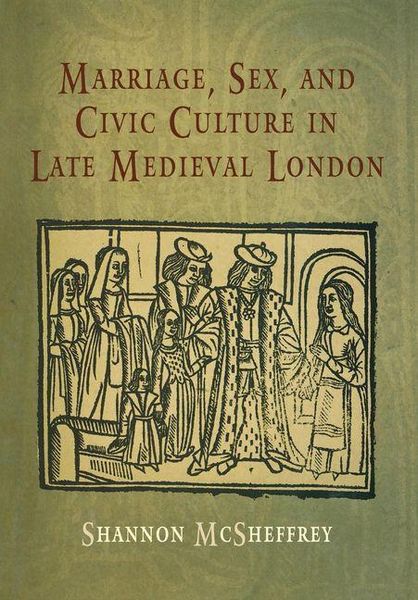
Marriage, Sex, and Civic Culture in Late Medieval London
72,00 €
inkl. gesetzl. MwSt.Beschreibung
Produktdetails
Format
ePUB
Kopierschutz
Ja
Family Sharing
Nein
Text-to-Speech
Ja
Erscheinungsdatum
23.04.2013
Verlag
Nyu PressSeitenzahl
304 (Printausgabe)
Dateigröße
984 KB
Sprache
Englisch
EAN
9780812203974
Awarded honorable mention for the 2007 Wallace K. Ferguson Prize sponsored by the Canadian Historical Association How were marital and sexual relationships woven into the fabric of late medieval society, and what form did these relationships take? Using extensive documentary evidence from both the ecclesiastical court system and the records of city and royal government, as well as advice manuals, chronicles, moral tales, and liturgical texts, Shannon McSheffrey focuses her study on England's largest city in the second half of the fifteenth century. Marriage was a religious union-one of the seven sacraments of the Catholic Church and imbued with deep spiritual significance-but the marital unit of husband and wife was also the fundamental domestic, social, political, and economic unit of medieval society. As such, marriage created political alliances at all levels, from the arena of international politics to local neighborhoods. Sexual relationships outside marriage were even more complicated. McSheffrey notes that medieval Londoners saw them as variously attributable to female seduction or to male lustfulness, as irrelevant or deeply damaging to society and to the body politic, as economically productive or wasteful of resources. Yet, like marriage, sexual relationships were also subject to control and influence from parents, relatives, neighbors, civic officials, parish priests, and ecclesiastical judges. Although by medieval canon law a marriage was irrevocable from the moment a man and a woman exchanged vows of consent before two witnesses, in practice marriage was usually a socially complicated process involving many people. McSheffrey looks more broadly at sex, governance, and civic morality to show how medieval patriarchy extended a far wider reach than a father's governance over his biological offspring. By focusing on a particular time and place, she not only elucidates the culture of England's metropolitan center but also contributes generally to our understanding of the social mechanisms through which premodern European people negotiated their lives.
Noch keine Bewertungen vorhanden
Verfassen Sie die erste Bewertung zu diesem Artikel
Helfen Sie anderen Kundinnen und Kunden durch Ihre Meinung.
Kurze Frage zu unserer Seite
Vielen Dank für Ihr Feedback
Wir nutzen Ihr Feedback, um unsere Produktseiten zu verbessern. Bitte haben Sie Verständnis, dass wir Ihnen keine Rückmeldung geben können. Falls Sie Kontakt mit uns aufnehmen möchten, können Sie sich aber gerne an unseren Kund*innenservice wenden.
zum Kundenservice