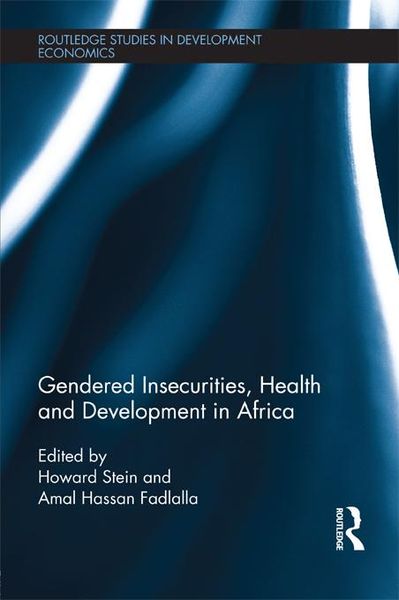
Gendered Insecurities, Health and Development in Africa
-
- Hardcover
- Taschenbuch
- eBook ausgewählt
-
Form:Einzelkauf Download
-
Sprache:Englisch
-
eBook Format:PDF
- ePUB 3 84,80 €
- PDF 84,80 € ausgewählt
84,80 €
inkl. gesetzl. MwSt.Beschreibung
Produktdetails
Format
Kopierschutz
Ja
Family Sharing
Nein
Text-to-Speech
Nein
Erscheinungsdatum
21.08.2012
Herausgeber
Howard Stein + weitereVerlag
Taylor & Francis eBooksSeitenzahl
224 (Printausgabe)
Dateigröße
2630 KB
Sprache
Englisch
EAN
9781136285370
The concept of security has often narrowly focused on issues surrounding the protection of national borders from outside threats. However, a richer idea of human security has become increasingly important in the past decade or so. The aim is to incorporate various dimensions of the downside risks affecting the generalized well-being or dignity of people. Despite this rising prominence, the discourses surrounding human security have neglected to address the topic of gender, particularly how issues of poverty and underdevelopment impact women's and men's experiences and strategies differently.
Since its introduction in the 1994 UNDP Human Development report, the idea of human security has become increasingly influential among academics and international development practitioners. However, gendered dimensions of human security have not attracted enough attention, despite their vital importance. Women are disproportionately more vulnerable to disease and other forms of human insecurity due to differences in entitlement, empowerment and an array of other ecological and socio-economic factors. These gendered insecurities are inextricably linked to poverty, and as a result, the feminization of poverty is a growing phenomenon worldwide. The contributors to this volume rely on a gender-focused analysis to consider a number of issues central to human security and development in Africa, including food security, environmental health risks, discrimination within judicial and legal systems, gendered aspects of HIV/AIDS transmission and treatment technologies, neoliberalism and poverty alleviation strategies, and conflict and women's political activism.
The gender focus of this volume points to the importance of power relationships and policy variability underlying human insecurities in the African context. The insights of this book offer the potential for an improved human security framework, one that embraces a more complex and context-specific analysis of the issues of risk and vulnerability, therefore expanding the capacities of the human security framework to safeguard the livelihoods of the most vulnerable populations.
Noch keine Bewertungen vorhanden
Verfassen Sie die erste Bewertung zu diesem Artikel
Helfen Sie anderen Kundinnen und Kunden durch Ihre Meinung.
Kurze Frage zu unserer Seite
Vielen Dank für Ihr Feedback
Wir nutzen Ihr Feedback, um unsere Produktseiten zu verbessern. Bitte haben Sie Verständnis, dass wir Ihnen keine Rückmeldung geben können. Falls Sie Kontakt mit uns aufnehmen möchten, können Sie sich aber gerne an unseren Kund*innenservice wenden.
zum Kundenservice