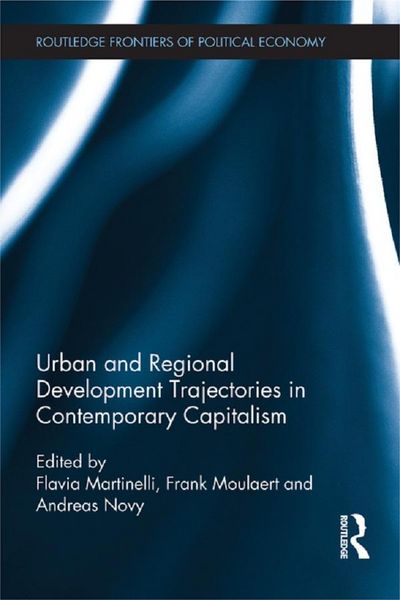
Urban and Regional Development Trajectories in Contemporary Capitalism
-
- Hardcover
- Taschenbuch
- eBook ausgewählt
-
Form:Einzelkauf Download
-
Sprache:Englisch
-
eBook Format:PDF
- PDF 85,90 € ausgewählt
- ePUB 86,40 €
85,90 €
inkl. gesetzl. MwSt.Beschreibung
Produktdetails
Format
Kopierschutz
Ja
Family Sharing
Nein
Text-to-Speech
Nein
Erscheinungsdatum
22.03.2013
Verlag
Taylor & Francis eBooksSeitenzahl
360 (Printausgabe)
Dateigröße
3822 KB
Sprache
Englisch
EAN
9781135119591
This book re-evaluates a rich scientific heritage of space- and history-sensitive development theories and produces an integrated methodology for the comparative analysis of urban and regional trajectories within a globalized world. The main argument put forward is that current mainstream analyses of urban and regional development have forgotten this rich heritage and fail to address the connections between different dimensions of development, the role of history and the importance of place and scale relations.
The proposed methodology integrates elements from different theories - radical economic geography, regulation approach, cultural political economy, old and new institutionalism - that all share a strong concern with time and space dynamics. They are recombined into an interdisciplinary (meta)theoretical framework, capable of articulating the overall problem of socio-economic development and providing methodological anchors for comparative case-study analysis, while recognizing context specificities. The analytical methodology focuses on key dynamics and relations, such as strategic agency and collective action, institutions and structures, culture and discourse, as well as the tension between path-dependency and path-shaping.
The methodology is then applied to eight urban and regional cases, mostly from Western Europe, but also from the United States and China. The case studies confirm the relevance of time- and space-sensitive analysis, not only for understanding development trajectories, but also for policy making. They ultimately highlight that, while post-war institutions were able to address systemic contradictions and foster a relatively inclusive development model, the neoliberal turn has led to reductionist policies that not only have resulted in an increase in social and spatial inequalities, but have also undermined growth and democracy.
Noch keine Bewertungen vorhanden
Verfassen Sie die erste Bewertung zu diesem Artikel
Helfen Sie anderen Kundinnen und Kunden durch Ihre Meinung.
Kurze Frage zu unserer Seite
Vielen Dank für Ihr Feedback
Wir nutzen Ihr Feedback, um unsere Produktseiten zu verbessern. Bitte haben Sie Verständnis, dass wir Ihnen keine Rückmeldung geben können. Falls Sie Kontakt mit uns aufnehmen möchten, können Sie sich aber gerne an unseren Kund*innenservice wenden.
zum Kundenservice