KI-Beratung Beta

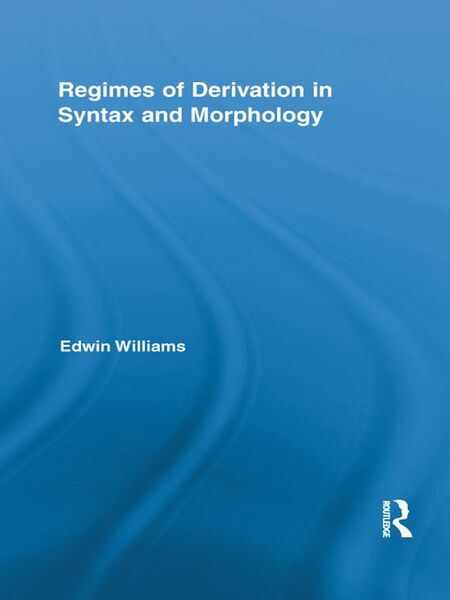
Produktbild: Regimes of Derivation in Syntax and Morphology

Regimes of Derivation in Syntax and Morphology

85,90 €

inkl. gesetzl. MwSt.

Beschreibung

Regimes of Derivation in Syntax and Morphology presents a theory of the architecture of the human linguistic system that differs from all current theories on four key points. First, the theory rests on a modular separation of word syntax from phrasal syntax, where word syntax corresponds roughly to what...

Beschreibung

Regimes of Derivation in Syntax and Morphology presents a theory of the architecture of the human linguistic system that differs from all current theories on four key points. First, the theory rests on a modular separation of word syntax from phrasal syntax, where word syntax corresponds roughly to what has been called derivational morphology. Second, morphosyntax (corresponding to what is traditionally called "e;inflectional morphology"e;) is the immediate spellout of the syntactic merge operation, and so there is no separate morphosyntactic component. There is no LF (logical form) derived; that is, there is no structure which 'mirrors' semantic interpretation ("e;LF"e;); instead, semantics interprets the derivation itself. And fourth, syntactic islands are derived purely as a consequence of the formal mechanics of syntactic derivation, and so there are no bounding nodes, no phases, no subjacency, and in fact no absolute islands. Lacking a morphosyntactic component and an LF representation are positive benefits as these provide temptations for theoretical mischief. The theory is a descendant of the author's "e;Representation Theory"e; and so inherits its other benefits as well, including explanations for properties of reconstruction, remnant movement, improper movement, and scrambling/scope interactions, and the different embedding regimes for clauses and DPs. Syntactic islands are added to this list as special cases of improper movement.

Produktdetails

Format

ePUB

Kopierschutz

Ja

Family Sharing

Nein

Text-to-Speech

Ja

Produktdetails

Format

ePUB

Format

eBooks im ePUB-Format erlauben eine dynamische Anpassung des Inhalts an die jeweilige Display-Größe des Lesegeräts. Das Format eignet sich daher besonders für das Lesen auf mobilen Geräten, wie z.B. Ihrem tolino, Tablets oder Smartphones.

Kopierschutz

Ja

Kopierschutz

Zum Lesen dieses eBooks auf Geräten der tolino Familie sowie auf sonstigen eReadern und am PC benötigen Sie eine Adobe ID. Weitere Hinweise zum Lesen von kopiergeschützten eBooks finden Sie unter Hilfe/Downloads.

Family Sharing

Nein

Family Sharing

Mit Family Sharing können Sie eBooks innerhalb Ihrer Familie (max. sechs Mitglieder im gleichen Haushalt) teilen. Sie entscheiden selbst, welches Buch Sie mit welchem Familienmitglied teilen möchten. Auch das parallele Lesen durch verschiedene Familienmitglieder ist durch Family Sharing möglich. Um eBooks zu teilen oder geteilt zu bekommen, muss jedes Familienmitglied ein Konto bei Thalia oder einem anderen tolino-Buchhändler haben. Weitere Informationen finden Sie unter Hilfe/Family-Sharing.

Text-to-Speech

Ja

Text-to-Speech

Bedeutet Ihnen Stimme mehr als Text? Mit der Funktion Text-to-Speech können Sie sich im tolino webReader und in der aktuellen Thalia – Lesen & Hören App das eBook vorlesen lassen. Weitere Informationen finden Sie unter Hilfe/Text-to-Speech.

Erscheinungsdatum

25.02.2011

Verlag Taylor & Francis
Seitenzahl

196 (Printausgabe)

Dateigröße

999 KB

Sprache

Englisch

EAN

9781136824814

Noch keine Bewertungen vorhanden

Verfassen Sie die erste Bewertung zu diesem Artikel

Helfen Sie anderen Kundinnen und Kunden durch Ihre Meinung.

Kundinnen und Kunden meinen

Bewertungen (0)

Weitere Artikel finden Sie in

Die Leseprobe wird geladen.
  • Produktbild: Regimes of Derivation in Syntax and Morphology