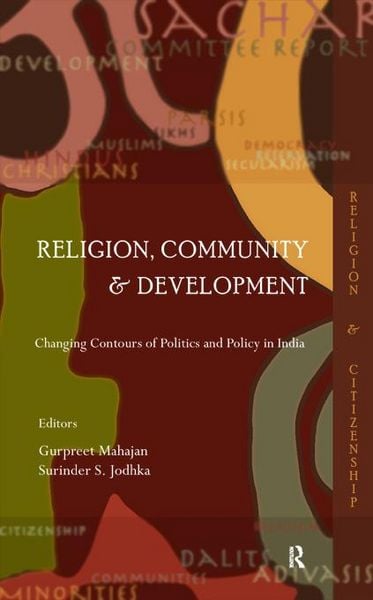
Religion, Community and Development Changing Contours of Politics and Policy in India
-
- Hardcover
- Taschenbuch
- eBook ausgewählt
-
Form:Einzelkauf Download
-
Sprache:Englisch
-
eBook Format:PDF
- PDF 76,60 € ausgewählt
- ePUB 76,60 €
76,60 €
inkl. gesetzl. MwSt.Beschreibung
Produktdetails
Format
Kopierschutz
Ja
Family Sharing
Nein
Text-to-Speech
Nein
Erscheinungsdatum
02.06.2010
Herausgeber
Gurpreet Mahajan + weitereVerlag
Taylor & Francis eBooksSeitenzahl
348 (Printausgabe)
Dateigröße
1372 KB
Auflage
1. Auflage
Sprache
Englisch
EAN
9781136704567
By making religious community a relevant category for discussing development deficit, the Sachar Committee Report (that was submitted to the Prime Minister of India in 2007) initiated a new political discourse in India. While the liberal secular framework privileged the individual over the community and was more inclined to use the category of class rather than the identity of religion, the Sachar Committee differentiated citizens on the basis of their religious identity. Its conclusions reinforced the necessity of approaching issues of development through the optic of religious community.
This volume focuses on this shift in public policy. The articles in this collection examine the nature and implications of this new approach to the Indian social reality. Taking a close look at the findings of the Sachar Committee Report (SCR) they highlight the challenges posed by inter-community comparisons. At another level the articles supplement the debate initiated by the SCR by constructing a profile of religious communities in India so as to factor in their concerns of development into the present discourse and to nuance and modify the simple indicators to which development is often reduced. As most religious communities are themselves engaged in development-related activities the volume also examines some of these initiatives in order to see what development connotes to the members themselves and what receives attention by the community.
Students of social sciences and development studies as well as those dealing with issues of marginalization will find this collection an invaluable resource for understanding contemporary India and for undertaking further theoretical and empirical research.
Noch keine Bewertungen vorhanden
Verfassen Sie die erste Bewertung zu diesem Artikel
Helfen Sie anderen Kundinnen und Kunden durch Ihre Meinung.
Kurze Frage zu unserer Seite
Vielen Dank für Ihr Feedback
Wir nutzen Ihr Feedback, um unsere Produktseiten zu verbessern. Bitte haben Sie Verständnis, dass wir Ihnen keine Rückmeldung geben können. Falls Sie Kontakt mit uns aufnehmen möchten, können Sie sich aber gerne an unseren Kund*innenservice wenden.
zum Kundenservice