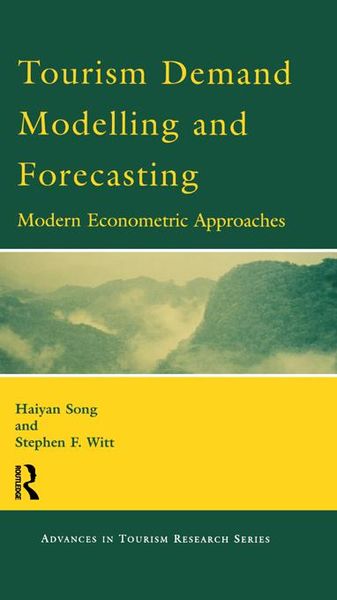
Tourism Demand Modelling and Forecasting
-
- Einzelkauf Download ausgewählt
-
Sprache:Englisch
-
eBook Format:ePUB 3
- ePUB 3 81,20 € ausgewählt
- PDF 81,20 €
81,20 €
inkl. gesetzl. MwSt.Beschreibung
Produktdetails
Format
ePUB 3
Kopierschutz
Ja
Family Sharing
Nein
Text-to-Speech
Ja
Erscheinungsdatum
21.08.2012
Herausgeber
Haiyan Song + weitereVerlag
Taylor & Francis eBooksSeitenzahl
186 (Printausgabe)
Dateigröße
4033 KB
Sprache
Englisch
EAN
9781136353550
The phenomenal growth of both the world-wide tourism industry and academic interest in tourism over the last thirty years has generated great interest in tourism demand modelling and forecasting from both sectors. However, the tendency for researchers and practitioners engaged in quantitative causal tourism modelling and forecasting to run many regression equations and try to choose the 'best' model based on various parametric and non-parametric criteria has been widely criticised as failing to provide credible results. The aim of this book is to present the recent advances in econometric modelling methodology within the context of tourism demand analysis at a level that is accessible to non-specialists, and to illustrate these new developments with actual tourism applications. The book begins with an introduction to the fundamentals of tourism demand analysis, before addressing the problems of traditional tourism demand modelling and forecasting, i.e. data mining and spurious regression due to common trends in the time series. Three chapters explore the general-to-specific approach to tourism demand modelling and forecasting, including the use of autoregressive distributed lag processes, cointegration analysis and error correction models. The time varying parameter model together with the use of the Kalman filter as an estimation method is a useful tool for examining the effects of regime shifts on tourism demand elasticities: this is explored next. The panel data approach is introduced as a way of overcoming the problem of estimation and forecasting biases caused by insufficient time series data. The book concludes by evaluating the empirical forecasting performance of the various models and putting forward some general conclusions.
Noch keine Bewertungen vorhanden
Verfassen Sie die erste Bewertung zu diesem Artikel
Helfen Sie anderen Kundinnen und Kunden durch Ihre Meinung.
Kurze Frage zu unserer Seite
Vielen Dank für Ihr Feedback
Wir nutzen Ihr Feedback, um unsere Produktseiten zu verbessern. Bitte haben Sie Verständnis, dass wir Ihnen keine Rückmeldung geben können. Falls Sie Kontakt mit uns aufnehmen möchten, können Sie sich aber gerne an unseren Kund*innenservice wenden.
zum Kundenservice