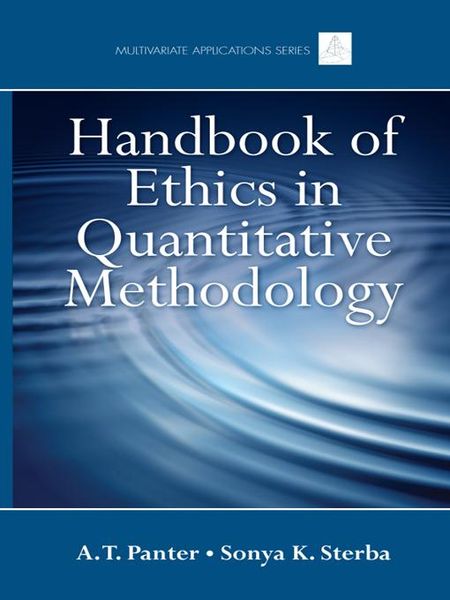
Handbook of Ethics in Quantitative Methodology
-
- Hardcover
- Taschenbuch
- eBook ausgewählt
-
Form:Einzelkauf Download
-
Sprache:Englisch
-
eBook Format:ePUB 3
- ePUB 3 115,20 € ausgewählt
- PDF 115,20 €
115,20 €
inkl. gesetzl. MwSt.Beschreibung
Produktdetails
Format
ePUB 3
Kopierschutz
Ja
Family Sharing
Nein
Text-to-Speech
Ja
Erscheinungsdatum
01.03.2011
Herausgeber
A. T. PanterVerlag
Taylor & Francis eBooksSeitenzahl
540 (Printausgabe)
Dateigröße
5127 KB
Sprache
Englisch
EAN
9781136888724
This comprehensive Handbook is the first to provide a practical, interdisciplinary review of ethical issues as they relate to quantitative methodology including how to present evidence for reliability and validity, what comprises an adequate tested population, and what constitutes scientific knowledge for eliminating biases. The book uses an ethical framework that emphasizes the human cost of quantitative decision making to help researchers understand the specific implications of their choices. The order of the Handbook chapters parallels the chronology of the research process: determining the research design and data collection; data analysis; and communicating findings. Each chapter:
- Explores the ethics of a particular topic
- Identifies prevailing methodological issues
- Reviews strategies and approaches for handling such issues and their ethical implications
- Provides one or more case examples
- Outlines plausible approaches to the issue including best-practice solutions.
Part 1 presents ethical frameworks that cross-cut design, analysis, and modeling in the behavioral sciences. Part 2 focuses on ideas for disseminating ethical training in statistics courses. Part 3 considers the ethical aspects of selecting measurement instruments and sample size planning and explores issues related to high stakes testing, the defensibility of experimental vs. quasi-experimental research designs, and ethics in program evaluation. Decision points that shape a researchers' approach to data analysis are examined in Part 4 - when and why analysts need to account for how the sample was selected, how to evaluate tradeoffs of hypothesis-testing vs. estimation, and how to handle missing data. Ethical issues that arise when using techniques such as factor analysis or multilevel modeling and when making causal inferences are also explored. The book concludes with ethical aspects of reporting meta-analyses, of cross-disciplinary statistical reform, and of the publication process.
This Handbook appeals to researchers and practitioners in psychology, human development, family studies, health, education, sociology, social work, political science, and business/marketing. This book is also a valuable supplement for quantitative methods courses required of all graduate students in these fields.
Noch keine Bewertungen vorhanden
Verfassen Sie die erste Bewertung zu diesem Artikel
Helfen Sie anderen Kundinnen und Kunden durch Ihre Meinung.
Kurze Frage zu unserer Seite
Vielen Dank für Ihr Feedback
Wir nutzen Ihr Feedback, um unsere Produktseiten zu verbessern. Bitte haben Sie Verständnis, dass wir Ihnen keine Rückmeldung geben können. Falls Sie Kontakt mit uns aufnehmen möchten, können Sie sich aber gerne an unseren Kund*innenservice wenden.
zum Kundenservice