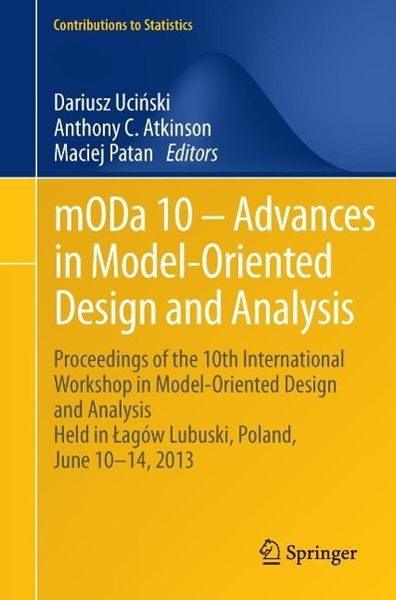
Produktbild: MODa 10 - Advances in Model-Oriented Design and Analysis

MODa 10 - Advances in Model-Oriented Design and Analysis Proceedings of the 10th International Workshop in Model-Oriented Design and Analysis Held in Lagów Lubuski, Poland, June 10-14, 2013

153,99 €

inkl. gesetzl. MwSt.

Beschreibung

Produktdetails

Format

PDF

Kopierschutz

Nein

Family Sharing

Nein

Text-to-Speech

Nein

Erscheinungsdatum

21.03.2013

Herausgeber

Dariusz Ucinski + weitere

Verlag

Springer Nature Switzerland

Seitenzahl

249 (Printausgabe)

Dateigröße

3212 KB

Sprache

Englisch

EAN

9783319002187

Beschreibung

Portrait

Dariusz Ucinski is a Professor of Automatic Control and Robotics at the University of Zielona Góra, Poland. His major research areas include measurement optimization for spatio-temporal systems, optimum experimental design for dynamic systems, algorithmic optimal control, probabilistic robotics and parallel computing. He is the author of Optimal Measurement Methods for Distributed Parameter System Identification. Anthony C. Atkinson is an Emeritus Professor of Statistics at the London School of Economics. He has published extensively on robust statistical methods, generalized linear models, clinical trials, optimum experimental design, simulation and regression diagnostics. He has served as Editor of the Journal of the Royal Statistical Society, Series B. He is the author of Plots, Transformations, and Regression and co-author of Optimum Experimental Designs, Robust Diagnostic Regression Analysis and Exploring Multivariate Data with the Forward Search. Maciej Patan is a Reader in Electrical Engineering at the University of Zielona Góra, Poland. His research focuses on sensor scheduling for the optimal observation of spatio-temporal systems, optimum experimental design, clinical trials, scientific computing and mobile robotics. He is the author of Optimal Sensor Networks Scheduling in Identification of Distributed Parameter Systems.

Produktdetails

Format

PDF

eBooks im PDF-Format haben eine festgelegte Seitengröße und eignen sich daher nur bedingt zum Lesen auf einem tolino eReader oder Smartphone. Für den vollen Lesegenuss empfehlen wir Ihnen bei PDF-eBooks die Verwendung eines Tablets oder Computers.

Kopierschutz

Nein

Dieses eBook können Sie uneingeschränkt auf allen Geräten der tolino Familie, allen sonstigen eReadern und am PC lesen. Das eBook ist nicht kopiergeschützt und kann ein personalisiertes Wasserzeichen enthalten. Weitere Hinweise zum Lesen von eBooks mit einem personalisierten Wasserzeichen finden Sie unter Hilfe/Downloads.

Family Sharing

Nein

Mit Family Sharing können Sie eBooks innerhalb Ihrer Familie (max. sechs Mitglieder im gleichen Haushalt) teilen. Sie entscheiden selbst, welches Buch Sie mit welchem Familienmitglied teilen möchten. Auch das parallele Lesen durch verschiedene Familienmitglieder ist durch Family Sharing möglich. Um eBooks zu teilen oder geteilt zu bekommen, muss jedes Familienmitglied ein Konto bei Thalia oder einem anderen tolino-Buchhändler haben. Weitere Informationen finden Sie unter Hilfe/Family-Sharing.

Text-to-Speech

Nein

Bedeutet Ihnen Stimme mehr als Text? Mit der Funktion Text-to-Speech können Sie sich im tolino webReader und in der aktuellen Thalia – Lesen & Hören App das eBook vorlesen lassen. Weitere Informationen finden Sie unter Hilfe/Text-to-Speech.

Barrierefreiheit

  • keine Information zur Barrierefreiheit bekannt

Erscheinungsdatum

21.03.2013

Herausgeber

Verlag

Springer Nature Switzerland

Seitenzahl

249 (Printausgabe)

Dateigröße

3212 KB

Sprache

Englisch

EAN

9783319002187

Noch keine Bewertungen vorhanden

Verfassen Sie die erste Bewertung zu diesem Artikel

Helfen Sie anderen Kundinnen und Kunden durch Ihre Meinung.

Kundinnen und Kunden meinen

Bewertungen (0)

Weitere Artikel finden Sie in

  • Produktbild: MODa 10 - Advances in Model-Oriented Design and Analysis
  • A Convergent Algorithm for Finding KL-Optimum Designs and Related Properties.- Robust Experimental Design for Choosing Between Models of Enzyme Inhibition.- Checking Linear Regression Models Taking Time into Account.- Optimal Sample Proportion for a Two-Treatment Clinical Trial in the Presence of Surrogate Endpoints.- Estimating and Quantifying Uncertainties on Level Sets Using the Vorobev Expectation and Deviation with Gaussian Process Models.- Optimal Designs for Multiple-Mixture by Process Variable Experiments.- Optimal Design of Experiments for Delayed Responses in Clinical Trials.- Construction of Minimax Designs for the Trinomial Spike Model in Contingent Valuation Experiments.- Maximum Entropy Design in High Dimensions by Composite Likelihood Modelling.- Randomization Based Inference for the Drop-The-Loser Rule.- Adaptive Bayesian Design with Penalty Based on Toxicity-Efficacy Response.- Randomly Reinforced Urn Designs Whose Allocation Proportions Converge to Arbitrary Prespecified Values.- Kernels and Designs for Modelling Invariant Functions: From Group Invariance to Additivity.- Optimal Design for Count Data with Binary Predictors in Item Response Theory.- Differences between Analytic and Algorithmic Choice Designs for Pairs of Partial Profiles.- Approximate Bayesian Computation Design (ABCD), An Introduction.- Approximation of the Fisher Information Matrix for Nonlinear Mixed Effects Models in Population Pk/Pd Studies.- c-Optimal Designs for the Bivariate Emax Model.- On the Functional Approach to Locally D-Optimum Design for Multiresponse Models.- Sample Size Calculation for Diagnostic Tests in Generalized Linear Mixed Models.- D-Optimal Designs for Lifetime Experiments with Exponential Distribution and Censoring.- Convergence of An Algorithm for Constructing Minimax Designs.- Extended Optimality Criteria for Optimum Design in Nonlinear Regression.- Optimal Design for Multivariate Models with Correlated Observations.- Optimal Designs for the Prediction of Individual Effects in Random Coefficient Regression.- D-Optimum Input Signals for Systems with Spatio-Temporal Dynamics.- Random Projections in Model Selection and Related Experimental Design Problems.- Optimal Design for the Bounded Log-Linear Regression Model.