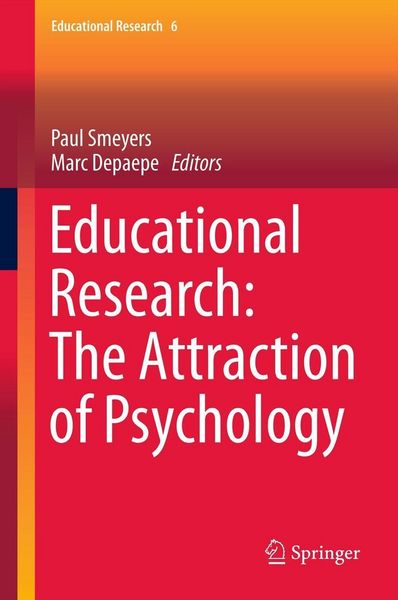
Produktbild: Educational Research: The Attraction of Psychology
Band 6

Educational Research: The Attraction of Psychology

Aus der Reihe Educational Research

98,99 €

inkl. gesetzl. MwSt.

Beschreibung

Produktdetails

Format

PDF

Kopierschutz

Nein

Family Sharing

Nein

Text-to-Speech

Nein

Erscheinungsdatum

23.10.2012

Herausgeber

Marc Depaepe

Verlag

Springer Netherlands

Seitenzahl

184 (Printausgabe)

Dateigröße

1509 KB

Sprache

Englisch

EAN

9789400750388

Beschreibung

Rezension

For some years both governments and Educational research associations such as AERA have subscribed to a view of the relationship between educational research and educational practices as needing to be linear and causal. The emphasis on RCTs and research informed decision-making and practice was going to shape educational rationally hence making it more effective. Central to this drive has been the psychology of education with its emphasis on transforming our understanding of brains and minds into sets of technologies. Increasingly it witnesses the superimposition of the neurological on the psychological. Such moves pay little attention to an inescapable and conditioning feature of education – that it is always a normative practice shaped everywhere by the kinds of things a society thinks or determines that it wants. While psychological and other forms of quantitative research are likely to offer important insight into the practices of education they will successfully do so only to the extent that they take seriously the contextual and related normative conditions of educational practices. In this edited volume Smeyers and Depaepe and their colleagues offer a timely intervention subjecting to serious interrogation the current passion to see particular, often aetiolated, impulses to reduce educational scholarship to a series of causal regularities immune to the complexities of actual lived educational encounters and practices. They argue carefully for the reinstatement of the central actor in education- the student as a complex, subtle, context located being whose education depends on more than statistical generalisations. Lest this volume be considered, in its turn, a collection of rhetorically freighted abstractions the essays here give considerable concrete expression to the concerns about the emergence of particular kinds of psychology and its attractiveness to the ‘modern’ mind. From Depaepe’s paper on the historical attractiveness of psychology, and its need for its grand theories to be modified by an attentiveness to everyday life, to Kraft’s challenge to educational theory, which has allowed the language of neuroscience to dominate it rather easily, the essays in this volume offer careful and consider attention to one of the most important issues in contemporary education. Anyone who wants to think seriously about some of the most pressing issues in educational research and practice will welcome this important and insightful collection. Smeyers and Depaepe are to be thanked for brining together this timely contribution.

James C Conroy, University of Glasgow, United Kingdom

The attraction of psychology surpasses both in scope and in time the short and limited history of the science of education. Already during the 17th century – long before Pädagogik became an academic ‘scientific’ discipline – the approach of the child bears the mark of religious expectations cherishing ‘the treasures of her soul’. What covertly preceded or could precede, i.e., the turning of the soul towards the grace of God, shall impose itself in a normative sense on education. Modern educational discourses expect from psychology infallible absolute directions for and justifications of education and childrearing. In as far as contemporary educational science embraces the architecture of such a concept of education it sides with a theological cultural legacy and speaks the theological language of education. It is this language and its architecture that is critically discussed in this interesting collection.

Fritz Osterwalder, Universität Bern, Switzerland

Produktdetails

Format

PDF

eBooks im PDF-Format haben eine festgelegte Seitengröße und eignen sich daher nur bedingt zum Lesen auf einem tolino eReader oder Smartphone. Für den vollen Lesegenuss empfehlen wir Ihnen bei PDF-eBooks die Verwendung eines Tablets oder Computers.

Kopierschutz

Nein

Dieses eBook können Sie uneingeschränkt auf allen Geräten der tolino Familie, allen sonstigen eReadern und am PC lesen. Das eBook ist nicht kopiergeschützt und kann ein personalisiertes Wasserzeichen enthalten. Weitere Hinweise zum Lesen von eBooks mit einem personalisierten Wasserzeichen finden Sie unter Hilfe/Downloads.

Family Sharing

Nein

Mit Family Sharing können Sie eBooks innerhalb Ihrer Familie (max. sechs Mitglieder im gleichen Haushalt) teilen. Sie entscheiden selbst, welches Buch Sie mit welchem Familienmitglied teilen möchten. Auch das parallele Lesen durch verschiedene Familienmitglieder ist durch Family Sharing möglich. Um eBooks zu teilen oder geteilt zu bekommen, muss jedes Familienmitglied ein Konto bei Thalia oder einem anderen tolino-Buchhändler haben. Weitere Informationen finden Sie unter Hilfe/Family-Sharing.

Text-to-Speech

Nein

Bedeutet Ihnen Stimme mehr als Text? Mit der Funktion Text-to-Speech können Sie sich im tolino webReader und in der aktuellen Thalia – Lesen & Hören App das eBook vorlesen lassen. Weitere Informationen finden Sie unter Hilfe/Text-to-Speech.

Barrierefreiheit

  • keine Information zur Barrierefreiheit bekannt

Erscheinungsdatum

23.10.2012

Herausgeber

Marc Depaepe

Verlag

Springer Netherlands

Seitenzahl

184 (Printausgabe)

Dateigröße

1509 KB

Sprache

Englisch

EAN

9789400750388

Noch keine Bewertungen vorhanden

Verfassen Sie die erste Bewertung zu diesem Artikel

Helfen Sie anderen Kundinnen und Kunden durch Ihre Meinung.

Kundinnen und Kunden meinen

Bewertungen (0)

Weitere Artikel finden Sie in

  • Produktbild: Educational Research: The Attraction of Psychology
  • 1. Making sense of the attraction of psychology: On the strengths and weaknesses for education and educational research; Paul Smeyers and Marc Depaepe.- 2. Struggling with the historical attractiveness of psychology for educational research illustrated by the case of Nazi-Germany; Marc Depaepe.- 3. On the fatal attractiveness of psychology: Racism of intelligence in education; Jean-Claude Croizet.- 4. Psychology in teacher education: Efficacy, professionalization, management, and habit; Lynn Fendler.- 5. The fatal attraction of the language of developmental psychology in child rearing; Stefan Ramaekers and Judith Suissa.- 6. Mirror neuron, mirror neuron in the brain, who's the cleverest in your reign? From the attraction of psychology to the discovery of the social; Kathleen Coessens, Karen François and Jean Paul van Bendegem.- 7. The vocabulary of acts: Neuroscience, phenomenology, and the mirror-neuron; Paul Standish.- 8. The attraction of neuropsychological findings in contemporary educational thinking, or: Feeling, emotion and relationship as blind spots in educational theory; Volker Kraft.- 9. In defence of the humanities against the exaggerated pretensions of 'scientific' psychology; David Bridges.- 10. The theology of education to come; Richard Smith.- 11. Learning is not education; Nicholas C. Burbules.- 12. Attention, commitment and imagination in educational research. Open the universe a little more!; Stijn Mus.- About the Authors.- Author Index.- Subject index.