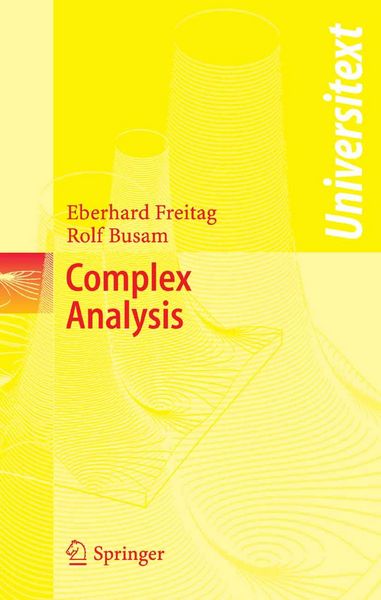
Complex Analysis
Aus der Reihe
Universitext
-
- Taschenbuch
- eBook ausgewählt
-
Form:Einzelkauf Download
-
Sprache:Englisch
48,31 €
inkl. gesetzl. MwSt.Beschreibung
Produktdetails
Format
Kopierschutz
Nein
Family Sharing
Nein
Text-to-Speech
Nein
Erscheinungsdatum
17.01.2006
Verlag
SpringerSeitenzahl
552 (Printausgabe)
Dateigröße
4552 KB
Sprache
Englisch
EAN
9783540308232
This book is a translation of the forthcoming fourth edition of our German A book "Funktionentheorie I" (Springer 2005). The translation and the LT X E ?les have been produced by Dan Fulea. He also made a lot of suggestions for improvement which in?uenced the English version of the book. It is a pleasure for us to express to him our thanks. We also want to thank our colleagues Diarmuid Crowley, Winfried Kohnen and J¿ org Sixt for useful suggestions c- cerning the translation. Over the years, a great number of students, friends, and colleagues have c- tributed many suggestions and have helped to detect errors and to clear the text. The many new applications and exercises were completed in the last decade to also allow a partial parallel approach using computer algebra systems and graphictools,whichmayhaveafruitful,powerfulimpactespeciallyincomplex analysis. Last but not least, we are indebted to Clemens Heine (Springer, Heidelberg), who revived our translation project initially started by Springer, New York, and brought it to its ?nal stage.
Noch keine Bewertungen vorhanden
Verfassen Sie die erste Bewertung zu diesem Artikel
Helfen Sie anderen Kundinnen und Kunden durch Ihre Meinung.
Kurze Frage zu unserer Seite
Vielen Dank für Ihr Feedback
Wir nutzen Ihr Feedback, um unsere Produktseiten zu verbessern. Bitte haben Sie Verständnis, dass wir Ihnen keine Rückmeldung geben können. Falls Sie Kontakt mit uns aufnehmen möchten, können Sie sich aber gerne an unseren Kund*innenservice wenden.
zum Kundenservice