KI-Beratung Beta

Produktbild: Mathematical Physiology

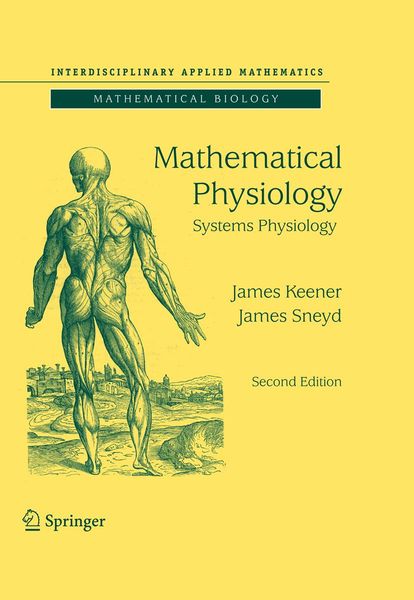
Mathematical Physiology II: Systems Physiology

98,99 €

inkl. gesetzl. MwSt.

Beschreibung

There has been a long history of interaction between mathematics and physiology. This book looks in detail at a wide selection of mathematical models in physiology, showing how physiological problems can be formulated and studied mathematically, and how such models give rise to interesting and challenging...

Beschreibung

There has been a long history of interaction between mathematics and physiology. This book looks in detail at a wide selection of mathematical models in physiology, showing how physiological problems can be formulated and studied mathematically, and how such models give rise to interesting and challenging mathematical questions. With its coverage of many recent models it gives an overview of the field, while many older models are also discussed, to put the modern work in context.

In this second edition the coverage of basic principles has been expanded to include such topics as stochastic differential equations, Markov models and Gibbs free energy, and the selection of models has also been expanded to include some of the basic models of fluid transport, respiration/perfusion, blood diseases, molecular motors, smooth muscle, neuroendrocine cells, the baroreceptor loop, turboglomerular oscillations, blood clotting and the retina.

Owing to this extensive coverage, the seond edition is published in two volumes. This first volume deals with the fundamental principles of cell physiology and the second with the physiology of systems.

The book includes detailed illustrations and numerous excercises with selected solutions. The emphasis throughout is on the applications; because of this interdisciplinary approach, this book will be of interest to students and researchers, not only in mathematics, but also in bioengineering, physics, chemistry, biology, statistics and medicine.

James Keener is a Distinguished Professor of Mathematics at the University of Utah.

James Sneyd is the Professor of Applied Mathematics at the University of Auckland, New Zealand. He is best known for his work on the dynamics of intracellular calcium.

Reviews of the first edition:

...probably the best book ever written on the interdisciplinary field of mathematical physiology. Mathematical Reviews, 2000

In addition to being good reading, excellent pedagogy, and appealing science, the exposition is lucid and clear, and there are many good problem sets to choose from... Highly recommended. Mathematical Biosciences, 1999

Both authors are seasoned experts in the field of mathematical physiology and particularly in the field of excitability, calcium dynamics and spiral waves. It directs students to become not merely skilled technicians in biological research but masters of the science. SIAM, 2004

The first edition was the winner of the prize for The Best Mathematics book of 1998 from the American Association of Publishers.

Rezension

From the reviews:

"Probably the best book ever written on the subject of mathematical physiology … It contains numerous exercises, enough to keep even the most diligent student busy, and a comprehensive list of approximately 600 references … highly recommended to anybody interested in mathematical or theoretical physiology." Mathematical Reviews

"In addition to being good reading, excellent pedagogy, and appealing science, the exposition is lucid and clear, and there are many good problem sets to choose from … Highly recommended." Journal of the Society of Mathematical Biology

From the reviews of the second edition:

"This massive new edition … offers an introduction to mathematical physiology that emphasizes work conducted by Keener (Univ. of Utah), Sneyd (Univ. of Auckland, New Zealand), and others over the past 20 years. It is designed as a course resource for beginning graduate students who have … some mathematical background. … Keener and Sneyd have made very reasonable choices in their subject selections. This work is an admirable resource for students with the appropriate prerequisites. Chapters include exercises … . Summing Up: Recommended. Graduate students." (P. Cull, Choice, Vol. 46 (10), June, 2009)

"The texts provide a comprehensive summary of the important concepts in mathematical physiology. … For those actively working in the field of mathematical physiology … is a must have. The new edition includes updated descriptions, new models, and new figures adding to the breadth of the first edition. One of the most beneficial aspects … is the addition of about a decade’s worth of work and references (over 350!). … more advanced questions were added giving more flexibility when used as a course textbook." (Joe Latulippe, The Mathematical Association of America, July, 2009)

“This second edition of Mathematical physiology, ten years after the first one … provides information on recent works in mathematical physiology. … It is a very interesting book dealing with the interdisciplinary field of mathematical physiology. … Mathematical physiology, with the consequent number of exercises given at the end of each chapter, could be used in particular for a full-year course in mathematical physiology. It is also suitable for researchers and graduate students in applied mathematics, bioengineering and physiology.” (Fabien Crauste, Mathematical Reviews, Issue 2010 b)

Produktdetails

Format

PDF

Kopierschutz

Nein

Family Sharing

Nein

Text-to-Speech

Nein

Produktdetails

Format

PDF

Format

eBooks im PDF-Format haben eine festgelegte Seitengröße und eignen sich daher nur bedingt zum Lesen auf einem tolino eReader oder Smartphone. Für den vollen Lesegenuss empfehlen wir Ihnen bei PDF-eBooks die Verwendung eines Tablets oder Computers.

Kopierschutz

Nein

Kopierschutz

Dieses eBook können Sie uneingeschränkt auf allen Geräten der tolino Familie, allen sonstigen eReadern und am PC lesen. Das eBook ist nicht kopiergeschützt und kann ein personalisiertes Wasserzeichen enthalten. Weitere Hinweise zum Lesen von eBooks mit einem personalisierten Wasserzeichen finden Sie unter Hilfe/Downloads.

Family Sharing

Nein

Family Sharing

Mit Family Sharing können Sie eBooks innerhalb Ihrer Familie (max. sechs Mitglieder im gleichen Haushalt) teilen. Sie entscheiden selbst, welches Buch Sie mit welchem Familienmitglied teilen möchten. Auch das parallele Lesen durch verschiedene Familienmitglieder ist durch Family Sharing möglich. Um eBooks zu teilen oder geteilt zu bekommen, muss jedes Familienmitglied ein Konto bei Thalia oder einem anderen tolino-Buchhändler haben. Weitere Informationen finden Sie unter Hilfe/Family-Sharing.

Text-to-Speech

Nein

Text-to-Speech

Bedeutet Ihnen Stimme mehr als Text? Mit der Funktion Text-to-Speech können Sie sich im tolino webReader und in der aktuellen Thalia – Lesen & Hören App das eBook vorlesen lassen. Weitere Informationen finden Sie unter Hilfe/Text-to-Speech.

Erscheinungsdatum

06.01.2009

Verlag Springer Us
Seitenzahl

549 (Printausgabe)

Dateigröße

13934 KB

Auflage

2nd ed. 2009

Sprache

Englisch

EAN

9780387793887

Barrierefreiheit
  • keine Information zur Barrierefreiheit bekannt

Noch keine Bewertungen vorhanden

Verfassen Sie die erste Bewertung zu diesem Artikel

Helfen Sie anderen Kundinnen und Kunden durch Ihre Meinung.

Kundinnen und Kunden meinen

Bewertungen (0)

Weitere Artikel finden Sie in

  • Produktbild: Mathematical Physiology