KI-Beratung Beta

Produktbild: Understanding Industrial Transformation
Band 44

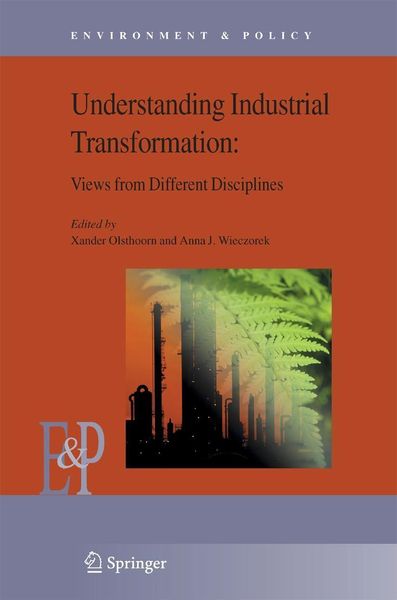
Understanding Industrial Transformation Views from Different Disciplines

Aus der Reihe Environment & Policy

98,99 €

inkl. gesetzl. MwSt.

Beschreibung

'A system is just like truth's tail, but the truth is like a lizard. It will leave the tail in your hand and escape; it knows that it will soon grow another one.' [Ivan Sergeevich Turgenev (1818-1883), Letter, Paris, January 3, 1857, to Count Lev Nikolaevich Tolstoy. Turgenev: Letters, ed. David]

...a...

Beschreibung

'A system is just like truth's tail, but the truth is like a lizard. It will leave the tail in your hand and escape; it knows that it will soon grow another one.' [Ivan Sergeevich Turgenev (1818-1883), Letter, Paris, January 3, 1857, to Count Lev Nikolaevich Tolstoy. Turgenev: Letters, ed. David]

...a scientist can only come to a partial understanding of industrial transformation processes. This is so not only because of the vastness of the topic, but because of the inherent limitations of each scientific discipline. The common ground, which scientists of different disciplines may endeavour to find when approaching some problem, is often slight.

A scientist entering such grounds runs the risk of getting lost, losing understanding and only catching the loose tail mentioned above. Secondly, sciences, to make a difference, must impress their importance upon the public and convince scientific and policy institutions in order to obtain the means to carryout their mission.

The editors consider that there has been progress, and that this book is a sign of such progress, and hope that it provides a further contribution to such advancement. Their hope is that this book will also foster co-operation among those approaching this area from dissimilar disciplines and scientific traditions, and that it will stimulate progress for all scientists advancing on the international road to global sustainability.

Produktdetails

Format

PDF

Kopierschutz

Nein

Family Sharing

Nein

Text-to-Speech

Nein

Produktdetails

Format

PDF

Format

eBooks im PDF-Format haben eine festgelegte Seitengröße und eignen sich daher nur bedingt zum Lesen auf einem tolino eReader oder Smartphone. Für den vollen Lesegenuss empfehlen wir Ihnen bei PDF-eBooks die Verwendung eines Tablets oder Computers.

Kopierschutz

Nein

Kopierschutz

Dieses eBook können Sie uneingeschränkt auf allen Geräten der tolino Familie, allen sonstigen eReadern und am PC lesen. Das eBook ist nicht kopiergeschützt und kann ein personalisiertes Wasserzeichen enthalten. Weitere Hinweise zum Lesen von eBooks mit einem personalisierten Wasserzeichen finden Sie unter Hilfe/Downloads.

Family Sharing

Nein

Family Sharing

Mit Family Sharing können Sie eBooks innerhalb Ihrer Familie (max. sechs Mitglieder im gleichen Haushalt) teilen. Sie entscheiden selbst, welches Buch Sie mit welchem Familienmitglied teilen möchten. Auch das parallele Lesen durch verschiedene Familienmitglieder ist durch Family Sharing möglich. Um eBooks zu teilen oder geteilt zu bekommen, muss jedes Familienmitglied ein Konto bei Thalia oder einem anderen tolino-Buchhändler haben. Weitere Informationen finden Sie unter Hilfe/Family-Sharing.

Text-to-Speech

Nein

Text-to-Speech

Bedeutet Ihnen Stimme mehr als Text? Mit der Funktion Text-to-Speech können Sie sich im tolino webReader und in der aktuellen Thalia – Lesen & Hören App das eBook vorlesen lassen. Weitere Informationen finden Sie unter Hilfe/Text-to-Speech.

Erscheinungsdatum

21.02.2006

Herausgeber
Verlag Springer Netherlands
Seitenzahl

226 (Printausgabe)

Dateigröße

1881 KB

Sprache

Englisch

EAN

9781402044182

Barrierefreiheit
  • keine Information zur Barrierefreiheit bekannt

Noch keine Bewertungen vorhanden

Verfassen Sie die erste Bewertung zu diesem Artikel

Helfen Sie anderen Kundinnen und Kunden durch Ihre Meinung.

Kundinnen und Kunden meinen

Bewertungen (0)

Weitere Artikel finden Sie in

  • Produktbild: Understanding Industrial Transformation
  • About the Authors. Preface. 1. INTRODUCTION, Xander Olsthoorn & Anna J. Wieczorek. 1.1.What is industrial transformation? 1.2. About this book. Acknowledgements. References. 2. A PSYCHOLOGICAL VIEW ON INDUSTRIAL TRANSFORMATION AND BEHAVIOUR, Joop de Boer. 2.1. Introduction. 2.2. On the causes of behaviour. 2.3. The role of values. 2.4. The impacts of awareness. 2.5. Final remarks. Acknowledgements. References. 3. SOCIOLOGICAL PERSPECTIVES FOR INDUSTRIAL TRANSFORMATION, Arthur P.J. Mol & Gert Spaargaren. 3.1. Introduction. 3.2. General and theoretical sociology. 3.3. Environmental sociology. 3.4. Environmental sociology and industrial production. 3.5. Sociology and sustainable consumption. 3.6. Epilogue. References. 4. INDUSTRIAL TRANSFORMATION AND INTERNATIONAL LAW, Joyeeta Gupta. 4.1. Introduction. 4.2. The incremental model. 4.3. Structural model of law making. 4.4. Regulatory competition and law: international economic law. 4.5. Conclusions. Acknowledgements. References. 5. CONTRIBUTIONS TO TRANSFORMATION RESEARCH FROM POLITICAL SCIENCE, Klaus Jacob, Frank Biermann, Marleen van de Kerkhof & Anna J. Wieczorek. 5.1. Introduction. 5.2. The international dimension of industrial transformation. 5.3. New actors: stakeholder involvement in transformation processes. 5.4. New instruments and strategies for environmental policies. 5.5. Conclusions: strategies for industrial transformation. Acknowledgements. References. 6. ECOLOGICAL ECONOMICS AND INDUSTRIAL TRANSFORMATION, Xander Olsthoorn & Onno Kuik. 6.1. Introduction. 6.2. The analysis by ecological economics. 6.3. Indicators. 6.4. Ecological economics as a criticism of 'mainstream' economics. 6.5. Conclusions. References. 7. AN EVOLUTIONARY ECONOMICS PERSPECTIVE ONINDUSTRIAL TRANSFORMATION, Jeroen C.J.M. van den Bergh, Marjan W. Hofkes & Frans H. Oosterhuis. 7.1. Introduction. 7.2. Concepts in evolutionary thinking. 7.3. Essential contributions to evolutionary Economics. 7.4. Environmental applications of evolutionary economics. 7.5. An application to the energy system. 7.6. Evolutionary policies for industrial transformation. Acknowledgements. References. 8. A NEO-CLASSICAL ECONOMICS VIEW ON TECHNOLOGICAL TRANSITIONS, Frank A.G. den Butter & Marjan W. Hofkes. 8.1. Introduction. 8.2. Neo-classical economics and the environment. 8.3. Technological change. 8.4. Technological lock-ins. 8.5. Transitions and government intervention. 8.6. Transition to wind energy: an example. 8.7. Conclusion. References. 9. MULTI-LEVEL PERSPECTIVE ON SYSTEM INNOVATION: RELEVANCE FOR INDUSTRIAL TRANSFORMATION, Frank W. Geels. 9.1. Introduction. 9.2. Some disciplinary building blocks. 9.3. A multi-level perspective on system innovations. 9.4. Policy suggestions. 9.5. Topics for further research. Acknowledgements. References. 10. MANAGING TRANSITIONS FOR SUSTAINABLE DEVELOPMENT, Derk Loorbach & Jan Rotmans. 10.1. Introduction. 10.2. Scientific perspective. 10.3. The water transition 10.4. Possibilities for managing transitions. 10.5. Conclusions. References. 11. DISCUSSION & CONCLUSIONS, Xander Olsthoorn, Adrian Smith & Anna J. Wieczorek. 11.1. Introduction. 11.2. Analysis and Conclusions. 11.3. The management of change: Some challenges ahead. References. Epilogue.