KI-Beratung Beta

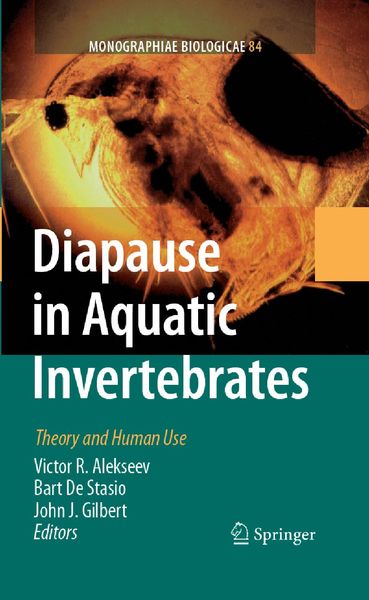
Produktbild: Diapause in Aquatic Invertebrates
Band 84

Diapause in Aquatic Invertebrates Theory and Human Use

Aus der Reihe Monographiae Biologicae

153,99 €

inkl. gesetzl. MwSt.

Nein, App installieren Ja, App öffnen

Beschreibung

Dormancy is a suspension of the vital functions in an organism to overcome harsh environmental conditions, and sometimes can last for centuries. It is a widespread adaptation in many phyla, ranging from bacteria to vertebrates, and may exert a great influence on aquatic communities.

Contributors to this...

Beschreibung

Dormancy is a suspension of the vital functions in an organism to overcome harsh environmental conditions, and sometimes can last for centuries. It is a widespread adaptation in many phyla, ranging from bacteria to vertebrates, and may exert a great influence on aquatic communities.

Contributors to this new book are leaders in the field of diapause studies, and many authors were participants at a recent workshop on diapause in aquatic invertebrates (Pallanza, Italy 2003). The book consists of two major parts, as indicated in its title: Phenomenology of diapause and significance of this adaptation in scientific and practical uses. Application to newly developing areas such as cultivation of live food, like rotifers or Artemia, in modern aquaculture is covered, as are aspects of diapause that promote the colonization of new environments by facilitating the passive transport of resting stages of invasive species. Creation of artificial ecosystems outside of the Earth's biosphere using dormant propagules becomes an actual possibility as humankind develops plans to colonize our nearest planets. Also, studies on the vertical distribution of resting stages in undisturbed sediment cores yield important ecological and evolutionary information useful in investigations of past environments.

Throughout the book properties of diapause and individual peculiarities of this ancient and well-developed adaptive phenomenon are regarded in evolutionarily distant groups such as Rotifers, Crustaceans and Insects.

Rezension

From the reviews:

"The best-defined types of dormancy are diapause and quiescence. These two remarkable abilities are discussed in the new book Diapause in Aquatic Invertebrates … . The book written by 20 authors, examines the current state of knowledge over 14 chapters and two major parts. … All in all, the book is the best available on the phenomenon of diapause. … This interesting volume … has something to say about the nature of life." (Ralph Schill, Lab Times, Issue 2, 2008)

Portrait

Victor R. Alekseev, Research Professor, Head of Taxonomy department, Zoological Institute of The Russain Academy of Sciences, the author of the first monograph on diapause in Crustaceans (1990, Nauka Academic Publishers, Moscow), the organiser of the First International Symposium on Diapause in Crustaceans (September 1994, St. Petersburg, Russia) and Workshop on Diapause in Aquatic Animals (October 2003, Palanza, Italy, together with professor Oscar Ravera and Dr. Riccardo diBernardi).
Bart De Stasio, Associated Professor, Department of Biology, Lawrence University, USA, a well known specialist in Crustaceans's diapause, the first who applied the very productive idea of seed bank (egg-bank) to aquatic ecosystems. John J. Gilbert, Professor of ecology, Department of Biological Sciences, Dartmouth College, Hanover, New Hampshire USA a world known specialist in diapause and signal chemicals in the Rotifers.

Produktdetails

Format

PDF

Kopierschutz

Nein

Family Sharing

Nein

Text-to-Speech

Nein

Produktdetails

Format

PDF

Format

eBooks im PDF-Format haben eine festgelegte Seitengröße und eignen sich daher nur bedingt zum Lesen auf einem tolino eReader oder Smartphone. Für den vollen Lesegenuss empfehlen wir Ihnen bei PDF-eBooks die Verwendung eines Tablets oder Computers.

Kopierschutz

Nein

Kopierschutz

Dieses eBook können Sie uneingeschränkt auf allen Geräten der tolino Familie, allen sonstigen eReadern und am PC lesen. Das eBook ist nicht kopiergeschützt und kann ein personalisiertes Wasserzeichen enthalten. Weitere Hinweise zum Lesen von eBooks mit einem personalisierten Wasserzeichen finden Sie unter Hilfe/Downloads.

Family Sharing

Nein

Family Sharing

Mit Family Sharing können Sie eBooks innerhalb Ihrer Familie (max. sechs Mitglieder im gleichen Haushalt) teilen. Sie entscheiden selbst, welches Buch Sie mit welchem Familienmitglied teilen möchten. Auch das parallele Lesen durch verschiedene Familienmitglieder ist durch Family Sharing möglich. Um eBooks zu teilen oder geteilt zu bekommen, muss jedes Familienmitglied ein Konto bei Thalia oder einem anderen tolino-Buchhändler haben. Weitere Informationen finden Sie unter Hilfe/Family-Sharing.

Text-to-Speech

Nein

Text-to-Speech

Bedeutet Ihnen Stimme mehr als Text? Mit der Funktion Text-to-Speech können Sie sich im tolino webReader und in der aktuellen Thalia – Lesen & Hören App das eBook vorlesen lassen. Weitere Informationen finden Sie unter Hilfe/Text-to-Speech.

Erscheinungsdatum

03.04.2007

Herausgeber
Verlag Springer Netherlands
Seitenzahl

260 (Printausgabe)

Dateigröße

5178 KB

Sprache

Englisch

EAN

9781402056802

Barrierefreiheit
  • keine Information zur Barrierefreiheit bekannt

Noch keine Bewertungen vorhanden

Verfassen Sie die erste Bewertung zu diesem Artikel

Helfen Sie anderen Kundinnen und Kunden durch Ihre Meinung.

Kundinnen und Kunden meinen

Bewertungen (0)

Weitere Artikel finden Sie in

  • Produktbild: Diapause in Aquatic Invertebrates
  • PART I: Strategies and Mechanisms of Diapause in Aquatic Invertebrates 1. INTRODUCTION TO DIAPAUSE, Victor R. Alekseev, Oscar Ravera & Bart T. De Stasio 1. Diagnosis of diapause, 1.2 Ecological causes of diapause in aquatic organisms, 1.3 Terminology on dormancy
    2. TIMING OF DIAPAUSE IN MONOGONONT ROTIFERS: MECHANISMS AND STRATEGIES, John J. Gilbert 2.1 Introduction, 2.2 Female types and the fertilized resting egg, 2.3 The timing of sex: environmental controls, 2.4 The Timing of sex: endogenous controls, 2.5 General mechanistic models for the control of mixis, 2.6 Theoretical models for maximizing resting-egg production, 2.7 Diapausing parthenogenetic eggs, 2.8 Acknowledgments 3. DIAPAUSE IN CRUSTACEANS: Peculiarities of Induction, Victor R. Alekseev 3.1 Introduction, 3.2 Diapause in crustacean life cycles, 3.3 Presence of diapause among crustaceans, 3.4 Evolution of points of view on inducing factors, 3.5 Diapause as a photoperiodic response, 3.6 Light as the source of information about the season, 3.7 Role of temperature and photoperiod in diapause induction, 3.8 Population density and manifestations of photoperiodic reactions, 3.9 Food quality and diapause induction in Crustacea, 3.10 Population polymorphism and inheritance of photoperiodic responses, 3.11 Heredity of photoperiodic responses, 3.12 Acknowledgments 4. REACTIVATION OF DIAPAUSING CRUSTACEANS, Victor R. Alekseev
    4.1 Introduction, 4.2 Patterns of reactivation processes for different types of diapause, 4.3 Endogenous phase of diapause, 4.4 Reactivation action of oxygen, 4.5 Participation of carbon dioxide in reactivation, 4.6 Hormonal basis of diapause, 4.7 Acknowledgments 5. DIAPAUSE IN AQUATIC INSECTS, WITH EMPHASIS ON MOSQUITOES, Elena B. Vinogradova 5.1 Introduction, 5.2 Mosquitoes (Culicidae), 5.3 Other groups of aquatic insects, 5.4 Acknowledgments 6. A BRIEF PERSPECTIVE ON MOLECULAR MECHANISMS OF DIAPAUSE IN AQUATIC INVERTEBRATES, Victor R. Alekseev 6.1 Introduction, 6.2. Molecular mechanism of diapause in nematode Caenorhabditis elegans, 6.3 Acknowledgments PART 2: The Role of Diapause in Science and Human Uses 7. EGG BANK FORMATION BY AQUATIC INVERTEBRATES: A BRIDGE ACROSS DISCIPLINARY BOUNDARIES, Bart T. De Stasio 7.1 Introduction, 7.2 Dormancy processes, 7.3 Egg bank size and dynamics, 7.4 Creating an egg bank, 7.5 Conclusion, 7.6 Acknowledgements 8. USE OF CLADOCERAN RESTING EGGS TO TRACE CLIMATE-DRIVEN AND ANTHROPOGENIC CHANGES IN AQUATIC ECOSYSTEMS, Susanne L. Amsinck, Erik Jeppesen & Dirk Verschuren 8.1 Introduction, 8.2 Tracing acidification, 8.3 Tracing eutrophication, 8.4 Tracing fish introductions and biomanipulation, 8.5 Tracing heavy metal pollution, 8.6 Tracing climate change, 8.7 Discussion and conclusion: limitations, concerns and future potentials, 8.8 Acknowledgements 9. RECONSTRUCTING MICRO-EVOLUTIONARY DYNAMICS FROM LAYERED EGG BANKS, Luc De Meester, Joachim Mergeay, Helen Michels & Ellen Decaestecker
    9.1 Introduction: dormant stages and the study of micro-evolution, 9.2 A short survey of recent success stories, 9.3 Pitfalls, 9.4 Conclusion and future directions, 9.5 Acknowledgments
    10. DOES TIMING OF EMERGENCE WITHIN A SEASON AFFECT THE EVOLUTION OF POST-DIAPAUSE TRAITS? Post-diapause and directly developing phenotypes of Daphnia, Kestutis Arbaciauskas
    10.1 Introduction, 10.2 Daphnia life cycle, 10.3 Neonates: biochemical quality and body size, 10.4 Physiology: respiration and starvation resistance, 10.5 Life-history: growth, allocation and relative fitness, 10.6 Descendents of post-diapause and directly developing females, 10.7 Conclusion, 10.8 Acknowledgments 11. DIAPAUSE AND ITS CONSEQUENCES IN DAPHNIA GALEATA - CUCULLATA - HYALINA SPECIES COMPLEX, Piet Spaak & Barbara Keller 11.1 Introduction, 11.2 Hybridization in Daphnia, 11.3. Genetic markers to identify parental and hybrid taxa within the D. galeata - cucullata - hyalina complex, 11.4 Factors that determine sexual reproduction of parental Daphnia species, 11.5 Are hybrids still produced?, 11.6 Taxon distribution of asexual and sexual Daphnids as well as from their offspring, 11.7 Can the sediment tell us something about past hybridization events?, 11.8 Conclusion, 11.9 Acknowledgments 12. ROLE OF DIAPAUSE IN DISPERSAL OF AQUATIC INVERTEBRATES, Vadim E. Panov & Carla Caceres 12.1 Introduction, 12.2 Mechanisms and vectors of dispersal of diapausing invertebrates, 12.3 Conclusion: generalized model of dispersal of aquatic invertebrates with prolonged diapause, 12.4 Acknowledgments 13. THE ROLE OF WITHIN TROPHIC LEVEL CHEMICAL INTERACTIONS IN DIAPAUSE INDUCTION: BASIC AND APPLIED ASPECT, Egor S. Zadereev 13.1 Introduction, 13.2 The effect of chemical interactions on diapause induction at the individual level, 13.3 The effect of chemical interactions on the diapause induction at population and ecosystem levels, 13.4 Biotechnological applications, 13.5 Conclusion, 13.6 Acknowledgments 14. STUDYING THE PHENOMENON OF DORMANCY: Why It Is Important for Space Exploration, Victor R. Alekseev, Vladimir N. Sychev & Natalia D. Novikova
    14.1 Introduction, 14.2. Study of dormancy from the prospective of its integration into ecological life support systems, 14.3 Planetary and interplanetary quarantine, 14.4 Microbiological safety of space flight, 14.5 Diapause and adaptation of higher vertebrates to extended body metabolism, 14.6 Search for extraterrestrial life, 14.7 The first results and perspectives, 14.8 Conclusion, 14.9 Acknowledgments
    References Taxonomic index