KI-Beratung Beta

Produktbild: The Pendulum

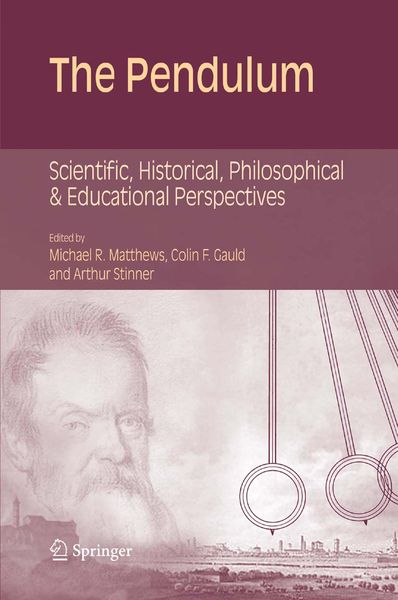
The Pendulum Scientific, Historical, Philosophical and Educational Perspectives

219,99 €

inkl. gesetzl. MwSt.

Beschreibung

The pendulum is a universal topic in primary and secondary schools, but its full potential for learning about physics, the nature of science, and the relationships between science, mathematics, technology, society and culture is seldom realised.

Contributions to this 32-chapter anthology deal with the...

Beschreibung

The pendulum is a universal topic in primary and secondary schools, but its full potential for learning about physics, the nature of science, and the relationships between science, mathematics, technology, society and culture is seldom realised.

Contributions to this 32-chapter anthology deal with the science, history, methodology and pedagogy of pendulum motion. There is ample material for the richer and more cross-disciplinary treatment of the pendulum from elementary school to high school, and through to advanced university classes.

Scientists will value the studies on the physics of the pendulum; historians will appreciate the detailed treatment of Galileo, Huygens, Newton and Foucault's pendulum investigations; psychologists and educators will learn from the papers on Piaget; teachers will welcome the many contributions to pendulum pedagogy.

All readers will come away with a new awareness of the importance of the pendulum in the foundation and development of modern science; and for its centrality in so many facets of society and culture.

Portrait

Michael Matthews is an associate professor in the School of Education at the University of New South Wales. He has degrees in science, philosophy, psychology, history and philosophy of science, and education. He publishes in the fields of science education, history and philosophy of science, and philosophy of education. He is the author of five books, the editor of six anthologies, and the Foundation Editor of the journal Science & Education. Colin Gauld is a Visiting Fellow at the University of New South Wales. After taking a PhD in physics, he taught high school physics, lectured in physics education, and was senior examiner of physics in the state of New South Wales. He researches the role of history and philosophy of science in science teaching, and the relationship between religion and science. Arthur Stinner is a professor of science education in the Faculty of Education, University of Manitoba. He holds undergraduate degrees in physics, modern languages and education, an MSc in physics, and a PhD in science education. His research interests are focused on relating the history and philosophy of science to science teaching, and the development of large context problems in physics.

Produktdetails

Format

PDF

Kopierschutz

Nein

Family Sharing

Nein

Text-to-Speech

Nein

Produktdetails

Format

PDF

Format

eBooks im PDF-Format haben eine festgelegte Seitengröße und eignen sich daher nur bedingt zum Lesen auf einem tolino eReader oder Smartphone. Für den vollen Lesegenuss empfehlen wir Ihnen bei PDF-eBooks die Verwendung eines Tablets oder Computers.

Kopierschutz

Nein

Kopierschutz

Dieses eBook können Sie uneingeschränkt auf allen Geräten der tolino Familie, allen sonstigen eReadern und am PC lesen. Das eBook ist nicht kopiergeschützt und kann ein personalisiertes Wasserzeichen enthalten. Weitere Hinweise zum Lesen von eBooks mit einem personalisierten Wasserzeichen finden Sie unter Hilfe/Downloads.

Family Sharing

Nein

Family Sharing

Mit Family Sharing können Sie eBooks innerhalb Ihrer Familie (max. sechs Mitglieder im gleichen Haushalt) teilen. Sie entscheiden selbst, welches Buch Sie mit welchem Familienmitglied teilen möchten. Auch das parallele Lesen durch verschiedene Familienmitglieder ist durch Family Sharing möglich. Um eBooks zu teilen oder geteilt zu bekommen, muss jedes Familienmitglied ein Konto bei Thalia oder einem anderen tolino-Buchhändler haben. Weitere Informationen finden Sie unter Hilfe/Family-Sharing.

Text-to-Speech

Nein

Text-to-Speech

Bedeutet Ihnen Stimme mehr als Text? Mit der Funktion Text-to-Speech können Sie sich im tolino webReader und in der aktuellen Thalia – Lesen & Hören App das eBook vorlesen lassen. Weitere Informationen finden Sie unter Hilfe/Text-to-Speech.

Erscheinungsdatum

19.01.2006

Herausgeber
Verlag Springer Netherlands
Seitenzahl

542 (Printausgabe)

Dateigröße

19666 KB

Sprache

Englisch

EAN

9781402035265

Barrierefreiheit
  • keine Information zur Barrierefreiheit bekannt

Noch keine Bewertungen vorhanden

Verfassen Sie die erste Bewertung zu diesem Artikel

Helfen Sie anderen Kundinnen und Kunden durch Ihre Meinung.

Kundinnen und Kunden meinen

Bewertungen (0)

Weitere Artikel finden Sie in

  • Produktbild: The Pendulum
  • MICHAEL R. MATTHEWS, COLIN GAULD & ARTHUR STINNER / The Pendulum: Its Place in Science, Culture and Pedagogy Scientific Perspectives:
    RANDALL D. PETERS / The Pendulum in the 21st Century-Relic or Trendsetter. RONALD NEWBURGH / The Pendulum: A Paradigm for the Linear Oscillator. KLAUS WELTHER, ANTONIO SERGIO C. ESPERIDIAO, ROBERTO ANDRADE & PAULO MIRANDA / Introduction to the Treatment of Non-Linear Effects Using a Gravitational Pendulum. CESAR MEDINA, SANDRA VELAZCO & JULIA SALINAS / Experimental Control of a Simple Pendulum Model. RANDALL D. PETERS / Soup-can Pendulum. NORMAN PHILLIPS / What Makes the Foucault Pendulum Move Among the Stars?- Historical Perspectives: PETER MACHAMER & BRIAN HEPBURN / Galileo and the Pendulum: Latching on to Time. COLIN GAULD / The Treatment of Cycloidal Pendulum Motion in Newton's Principia. ZVI BIENER & CHRISTOPER SMEENK: Pendulums, Pedagogy, and Matter: Lessons from the Editing of Newton's Principia. COLIN GAULD / The Treatment of the Motion of a Simple Pendulum in some Early 18th Century Newtonian Textbooks. PIERRE J. BOULOS / Newton's Path to Universal Gravitation: The Role of the Pendulum. AMIR D. ACZEL / Leon Foucault: His Life, Times and Achievements. FABIO BEVILACQUA, LIDIA FALOMO, LUCIO FREGONESE, ENRICO GIANNETTO & FRANCO GIUDICE / Interpreting the Pendulum: From Constrained Fall to Potential Energy.-
    Philosophical Perspectives: MICHAEL R. MATTHEWS / Idealisation and Galileo's Pendulum Discoveries: Historical, Philosophical and Pedagogical Considerations. ROBERT NOLA/ Pendula, Models, Constructivism and Reality. LOUIS B. ROSENBLATT / The Poet and the Pendulum. AGUSTIN ADURIZ-BRAVO / Methodology and Politics: A Proposal to Teach the Structuring Ideas of the Philosophy of Science through the Pendulum. DENNIS LOMAS / Degree of Influence on Perception of Belief and Social Setting: Its Relevance toUnderstanding Pendulum Phenomena.-
    Educational Perspectives: TREVOR G. BOND / Piaget and the Pendulum. ERIN STAFFORD / What the Pendulum Can Tell Educators about Children's Scientific Reasoning. PAUL ZACHOS / Pendulum Phenomena and the Assessment of Scientific Inquiry Capabilities. YONG-JU KWON, JIN-SU JEONG, YUN-BOK PARK / Children's Generating Hypotheses on a Pendulum Task : Roles of Abductive Reasoning Skills and Prior Knowledge. ROBERT J. WHITAKER / Types of Two-Dimensional Pendulums and Their Uses in Education.MARIANNE B. BARNES, JAMES GARNER & DAVID REID / The Pendulum as a Vehicle for Transitioning from Classical to Quantum Physics: History, Quantum Concepts, and Educational Challenges. CATHY MARIOTTI EZRAILSON, G. DONALD ALLEN & CATHLEEN C. LOVING / Analyzing Dynamic Pendulum Motion in an Interactive Online Environment Using Flash. IGAL GALILI & DAVID SELA / Pendulum Activities in the Israeli Physics Curriculum: Used and Missed Opportunities. DEMETRIS KOLIOPOULOS AND COSTAS CONSTANTINOU / An Analysis of the Treatment of the Simple Pendulum in Greek and Cypriot Science Curricula. MANABU SUMIDA / The Public Understanding of Pendulum Motion: From 5 to 88 Years Old. MICHAEL FOWLER/ Using Excel to Simulate Pendulum Motion and Maybe Understand Calculus a Little Better. ROBERT N. CARSON / Teaching Cultural History from Primary Events. COLIN GAULD / Pendulums in the Physics Education Literature: A Bibliography. Book Notes.-
    NAME INDEX.- SUBJECT INDEX.- CONTRIBUTORS.- COUNTRIES PRESENTED: AUSTRALIA, USA, CANADA, BRAZIL, ARGENTINA, NEW ZEALAND, JAPAN, KOREA, ISRAEL, GREECE, ITALY, SPAIN.