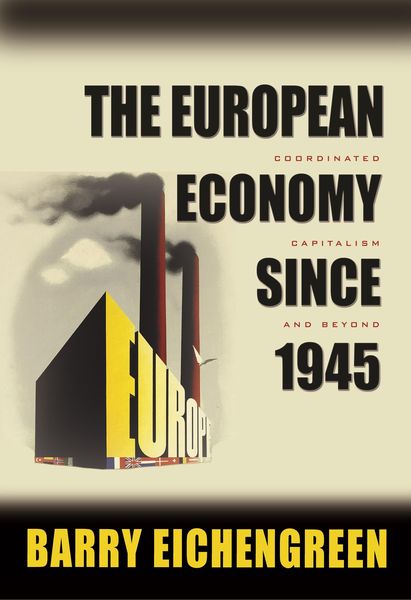
European Economy since 1945 Coordinated Capitalism and Beyond
-
- Taschenbuch
- eBook ausgewählt
-
Form:Einzelkauf Download
-
Sprache:Englisch
38,10 €
inkl. gesetzl. MwSt.Beschreibung
Produktdetails
Format
Kopierschutz
Ja
Family Sharing
Ja
Text-to-Speech
Nein
Erscheinungsdatum
01.07.2008
Verlag
Princeton University PressSeitenzahl
520 (Printausgabe)
Dateigröße
3557 KB
Sprache
Englisch
EAN
9781400829545
In 1945, many Europeans still heated with coal, cooled their food with ice, and lacked indoor plumbing. Today, things could hardly be more different. Over the second half of the twentieth century, the average European's buying power tripled, while working hours fell by a third. The European Economy since 1945 is a broad, accessible, forthright account of the extraordinary development of Europe's economy since the end of World War II. Barry Eichengreen argues that the continent's history has been critical to its economic performance, and that it will continue to be so going forward.
Challenging standard views that basic economic forces were behind postwar Europe's success, Eichengreen shows how Western Europe in particular inherited a set of institutions singularly well suited to the economic circumstances that reigned for almost three decades. Economic growth was facilitated by solidarity-centered trade unions, cohesive employers' associations, and growth-minded governments--all legacies of Europe's earlier history. For example, these institutions worked together to mobilize savings, finance investment, and stabilize wages.
However, this inheritance of economic and social institutions that was the solution until around 1973--when Europe had to switch from growth based on brute-force investment and the acquisition of known technologies to growth based on increased efficiency and innovation--then became the problem.
Thus, the key questions for the future are whether Europe and its constituent nations can now adapt their institutions to the needs of a globalized knowledge economy, and whether in doing so, the continent's distinctive history will be an obstacle or an asset.
Noch keine Bewertungen vorhanden
Verfassen Sie die erste Bewertung zu diesem Artikel
Helfen Sie anderen Kundinnen und Kunden durch Ihre Meinung.
Kurze Frage zu unserer Seite
Vielen Dank für Ihr Feedback
Wir nutzen Ihr Feedback, um unsere Produktseiten zu verbessern. Bitte haben Sie Verständnis, dass wir Ihnen keine Rückmeldung geben können. Falls Sie Kontakt mit uns aufnehmen möchten, können Sie sich aber gerne an unseren Kund*innenservice wenden.
zum Kundenservice