KI-Beratung Beta

Produktbild: Economic Evolution and Equilibrium
Band 591

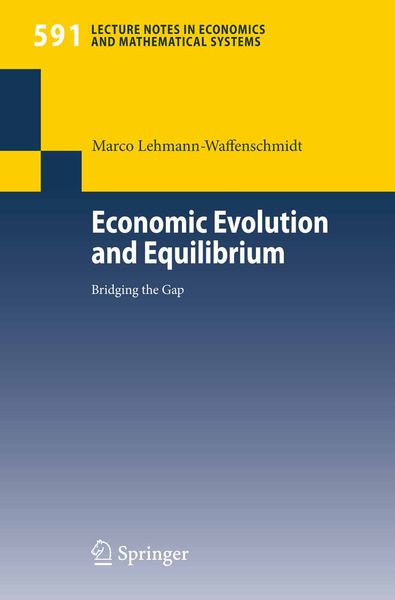
Economic Evolution and Equilibrium Bridging the Gap

  • Form:Einzelkauf Download
  • Sprache:Englisch

54,99 €

inkl. gesetzl. MwSt.

Beschreibung

theory,whichformalizesa dynamiceconomicsystemasa systemofdi?erence, or di?erential, equations. There equilibria mean 'equilibrium trajectories' of the whole evolution that, in a certain sense, are optimal. A particularly un- tisfactory feature of this conceptualization of an equilibrium, however, is...

Beschreibung

theory,whichformalizesa dynamiceconomicsystemasa systemofdi?erence, or di?erential, equations. There equilibria mean 'equilibrium trajectories' of the whole evolution that, in a certain sense, are optimal. A particularly un- tisfactory feature of this conceptualization of an equilibrium, however, is the factthattheintertemporaloptimizingapproachcompletelypredeterminesthe whole future of the economic system. This "closed loop" approach gives rise to the common reproach that economic theory is predominantly concerned with the question of 'how the economic system ought to behave' rather than with the question of 'how does it behave actually'. This is the point at which the new branch of evolutionary economics has made its entrance. In contrast to growth or business cycle theory, evolutionary economics perceives the evolution of the economic system as essentially "open" to true novelties that are unforeseeable by their very nature. This view clearly makes obsolete any conception of equilibrium that resorts to the idea of a ?nal state of rest, or to the idea of an intertemporally optimizing trajectory which is prespeci?ed ab initio by a system of di?erential equations and initial con- tions. To be sure, there have been attempts to reconceptualize the notion of equilibrium from the evolutionary viewpoint. However, these proposals also appear, in one way or another, to hinge on the ideas of rest. This parti- larly applies to the branch of nonlinear dynamics and deterministic chaotic motion.

Produktdetails

Format

PDF

Kopierschutz

Nein

Family Sharing

Nein

Text-to-Speech

Nein

Produktdetails

Format

PDF

Format

eBooks im PDF-Format haben eine festgelegte Seitengröße und eignen sich daher nur bedingt zum Lesen auf einem tolino eReader oder Smartphone. Für den vollen Lesegenuss empfehlen wir Ihnen bei PDF-eBooks die Verwendung eines Tablets oder Computers.

Kopierschutz

Nein

Kopierschutz

Dieses eBook können Sie uneingeschränkt auf allen Geräten der tolino Familie, allen sonstigen eReadern und am PC lesen. Das eBook ist nicht kopiergeschützt und kann ein personalisiertes Wasserzeichen enthalten. Weitere Hinweise zum Lesen von eBooks mit einem personalisierten Wasserzeichen finden Sie unter Hilfe/Downloads.

Family Sharing

Nein

Family Sharing

Mit Family Sharing können Sie eBooks innerhalb Ihrer Familie (max. sechs Mitglieder im gleichen Haushalt) teilen. Sie entscheiden selbst, welches Buch Sie mit welchem Familienmitglied teilen möchten. Auch das parallele Lesen durch verschiedene Familienmitglieder ist durch Family Sharing möglich. Um eBooks zu teilen oder geteilt zu bekommen, muss jedes Familienmitglied ein Konto bei Thalia oder einem anderen tolino-Buchhändler haben. Weitere Informationen finden Sie unter Hilfe/Family-Sharing.

Text-to-Speech

Nein

Text-to-Speech

Bedeutet Ihnen Stimme mehr als Text? Mit der Funktion Text-to-Speech können Sie sich im tolino webReader und in der aktuellen Thalia – Lesen & Hören App das eBook vorlesen lassen. Weitere Informationen finden Sie unter Hilfe/Text-to-Speech.

Erscheinungsdatum

10.06.2007

Verlag Springer
Seitenzahl

272 (Printausgabe)

Dateigröße

3190 KB

Sprache

Englisch

EAN

9783540686644

Barrierefreiheit
  • keine Information zur Barrierefreiheit bekannt

Noch keine Bewertungen vorhanden

Verfassen Sie die erste Bewertung zu diesem Artikel

Helfen Sie anderen Kundinnen und Kunden durch Ihre Meinung.

Kundinnen und Kunden meinen

Bewertungen (0)

Weitere Artikel finden Sie in

  • Produktbild: Economic Evolution and Equilibrium
  • General Introduction.- General Introduction.- Notations and Mathematical Preliminaries.- Notations and Mathematical Preliminaries.- Conceptualization and Definition of Evolutions of Economies in Four General Equilibrium Frameworks.- to Part I.- Evolutions in the Traditional Walrasian Exchange Equilibrium Framework.- Evolutions in an Exchange Equilibrium Framework Without Walras' Law and Homogeneity.- Evolutions in a General Equilibrium Framework With Production, Taxes, and Subsidies.- Evolutions in the Temporary Fixprice Equilibrium Framework.- Conclusions.- Formal Analysis.- to Part II.- Near-Equilibrium Paths.- Equilibrium Paths.- Economic Refinements of the Notion of an Evolution of Economies.- The Structure of the Equilibrium Price Set of an Evolution of Exchange Economies.- Comparison With Related Results in the Literature.- Conclusions.- Economic Analysis.- to Part III.- Applications of the Analytical Results From Part II in the Economist's Laboratory.- The Method of Kinetic Analysis of Evolving Economies in Historical Time.- Evolving Economies in Historical Time.- Conclusions.- General Conclusions and Outlook.- General Conclusions and Outlook.