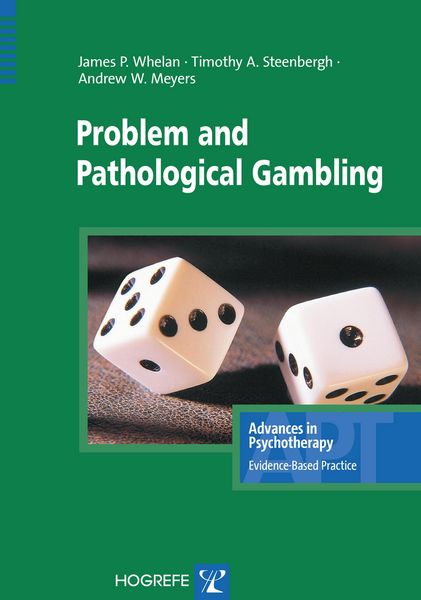
Produktbild: Problem and Pathological Gambling
Band 8

Problem and Pathological Gambling

21,99 €

inkl. gesetzl. MwSt.

Beschreibung

Produktdetails

Format

PDF

Kopierschutz

Nein

Family Sharing

Ja

Text-to-Speech

Nein

Erscheinungsdatum

01.01.2007

Verlag

Hogrefe Publishing

Seitenzahl

123 (Printausgabe)

Dateigröße

1612 KB

Auflage

1

Sprache

Englisch

EAN

9781616763121

Beschreibung

Zitat

"Beginning with a concise background of the disorder, its prevalence, risk factor, and comorbidities, and finishing with an illustrative case vignette, this brief but fulfilling handbook delivers - It is a quick read with no wasted space and provides a highly valuable and concise introduction to both problem and pathological gambling - This volume successfully distils a complicated topic into an easily readable primer, making it a first-line reference for gambling treatment." Carrie H. Kennedy in PsycCRITIQUES, 2008, Vol. 53 "This excellent publication provides a thorough coverage of the nature of this problem - I highly recommend this manual for all readers who are interested in learning more about gambling problems and effective treatment methods: It's a good bet!" G. Alan Marlatt, PhD, Professor and Director, Addictive Behaviors Research Center, University of Washington "A succinct review of a youthful field that is sure to please clinicians. [The authors] get right to the point and cover a range of important topics. Clinicians who treat gambling problems will be sure to find that this useful primer deserves a place on their bookshelves." Howard J. Shaffer, PhD, Editor of Psychology of Addictive Behaviors; Associate Professor, Harvard Medical School and Director, Division on Addictions, The Cambridge Health Alliance

Produktdetails

Format

PDF

eBooks im PDF-Format haben eine festgelegte Seitengröße und eignen sich daher nur bedingt zum Lesen auf einem tolino eReader oder Smartphone. Für den vollen Lesegenuss empfehlen wir Ihnen bei PDF-eBooks die Verwendung eines Tablets oder Computers.

Kopierschutz

Nein

Dieses eBook können Sie uneingeschränkt auf allen Geräten der tolino Familie, allen sonstigen eReadern und am PC lesen. Das eBook ist nicht kopiergeschützt und kann ein personalisiertes Wasserzeichen enthalten. Weitere Hinweise zum Lesen von eBooks mit einem personalisierten Wasserzeichen finden Sie unter Hilfe/Downloads.

Family Sharing

Ja

Mit Family Sharing können Sie eBooks innerhalb Ihrer Familie (max. sechs Mitglieder im gleichen Haushalt) teilen. Sie entscheiden selbst, welches Buch Sie mit welchem Familienmitglied teilen möchten. Auch das parallele Lesen durch verschiedene Familienmitglieder ist durch Family Sharing möglich. Um eBooks zu teilen oder geteilt zu bekommen, muss jedes Familienmitglied ein Konto bei Thalia oder einem anderen tolino-Buchhändler haben. Weitere Informationen finden Sie unter Hilfe/Family-Sharing.

Text-to-Speech

Nein

Bedeutet Ihnen Stimme mehr als Text? Mit der Funktion Text-to-Speech können Sie sich im tolino webReader und in der aktuellen Thalia – Lesen & Hören App das eBook vorlesen lassen. Weitere Informationen finden Sie unter Hilfe/Text-to-Speech.

Barrierefreiheit

  • keine Information zur Barrierefreiheit bekannt

Erscheinungsdatum

01.01.2007

Verlag

Hogrefe Publishing

Seitenzahl

123 (Printausgabe)

Dateigröße

1612 KB

Auflage

1

Sprache

Englisch

EAN

9781616763121

Noch keine Bewertungen vorhanden

Verfassen Sie die erste Bewertung zu diesem Artikel

Helfen Sie anderen Kundinnen und Kunden durch Ihre Meinung.

Kundinnen und Kunden meinen

Bewertungen (0)

Weitere Artikel finden Sie in

Die Leseprobe wird geladen.
  • Produktbild: Problem and Pathological Gambling
  • Preface... v Acknowledgments ... vi Dedication... vii 1 Description of Problem and Pathological Gambling... 1 1.1 Terminology... 1 1.1.1 Gambling as Recreation ... 1 1.1.2 Continuum of Gambling-Related Harm... 2 1.2 Definitions... 4 1.2.1 Pathological Gambling ... 4 1.2.2 Problem Gambling... 6 1.3 Epidemiology... 7 1.3.1 Vulnerable Populations... 7 1.3.2 Types of Gambling and Gambling Problems... 9 1.3.3 Impact of Gambling Availability... 9 1.3.4 Demographic Correlates... 10 1.4 Course and Prognosis ... 11 1.4.1 Negative Effects ... 12 1.4.2 Natural Recovery ... 12 1.5 Differential Diagnosis... 13 1.6 Comorbidity... 13 1.6.1 Substance Use Disorders... 13 1.6.2 Mood Disorders... 14 1.6.3 Anxiety Disorders... 15 1.6.4 Axis II Disorders... 15 1.7 Diagnostic Procedures and Documentation ... 15 1.7.1 Diagnostic Interview for Gambling Severity (DIGS)... 15 1.7.2 South Oaks Gambling Screen (SOGS)... 16 1.7.3 Lie/Bet Questionnaire... 16 1.7.4 Gambling Timeline Follow-Back (G-TLFB) ... 16 1.7.5 Addiction Severity Index - Gambling Subscale (ASI-G)... 17 1.7.6 Gamblers Belief Questionnaire (GBQ)... 18 1.7.7 Gamblers Self-Efficacy Questionnaire (GSEQ)... 18 2 Theories and Models... 20 2.1 Gambling as an Addictive Behavior... 20 2.2 Learning Theories ... 22 2.3 Cognitive Theories ... 24 2.4 Biological Theories... 27 2.4.1 Family and Genetic Studies... 27 2.4.2 Neurotransmitter and Neuroanatomical Theories... 28 2.5 Disease Model... 29 2.6 An Integrated Model of Problem Gambling... 30 2.7 Guided Self-Change ... 31 Advances in Psychotherapy: Problem and Pathological Gambling 2.7.1 Harm Reduction ... 32 2.7.2 Rapid Change Response... 32 2.7.3 Self-Change... 33 2.7.4 Motivational Approach... 34 3 Diagnosis and Treatment Indications... 35 3.1 Diagnostic Assessment ... 35 3.2 Treatment Indications ... 35 3.3 Clinical Assessment... 36 3.3.1 Gambling Behavior ... 37 3.3.2 Assessment of Possible Treatment Mediators... 37 3.3.3 Systemic Factors... 39 3.3.4 Comorbid Psychopathology ... 40 3.4 Treatments ... 41 4 Treatment... 43 4.1 Method of Treatment... 43 4.1.1 Basic Principles ... 43 4.1.2 Phase 1: Running Start Assessment ... 47 4.1.3 Phase 2: Motivational Feedback ... 49 4.1.4 Phase 3: Triggers and Consequences ... 52 4.1.5 Phase 4: Options and Action Plan ... 53 4.1.6 Phase 5: Relapse Prevention ... 55 4.1.7 Follow-Up ... 56 4.2 Mechanisms of Action... 57 4.3 Efficacy and Diagnosis... 58 4.4 Variations and Combination Methods... 59 4.5 Problems in Carrying Out Treatment ... 61 4.6 Multicultural Issues... 62 5 Case Vignette... 64 5.1 Phase 1: Running Start Assessment ... 64 5.2 Phase 2: Motivation and Feedback... 68 5.3 Phase 3: Functional Analysis of Gambling... 76 5.4 Phase 4: Implementation of Alternative Behaviors... 78 5.5 Phase 5: Relapse Prevention... 79 5.6 Six Month Follow-up ... 80 6 Further Reading... 82 7 References... 83 8 Appendices: Tools and Resources ... 91