Gutscheinbedingungen

**Gültig bis 19.07.2026 auf tolino Accessoires online auf thalia.at und in der Thalia App. Einzelne Artikel können ausgeschlossen sein. Ausgenommen sind tolino stylus schwarz (4016621130282) und weiß (4016621131463). Pro Einkauf einmal einlösbar. Click & Collect nur bei Onlinevorabzahlung möglich. Keine Barauszahlung. Nicht kombinierbar mit anderen Aktionen und Gutscheinen. Nicht gültig für Geschenkkarten, Versandkosten und Services. Nur solange der Vorrat reicht.

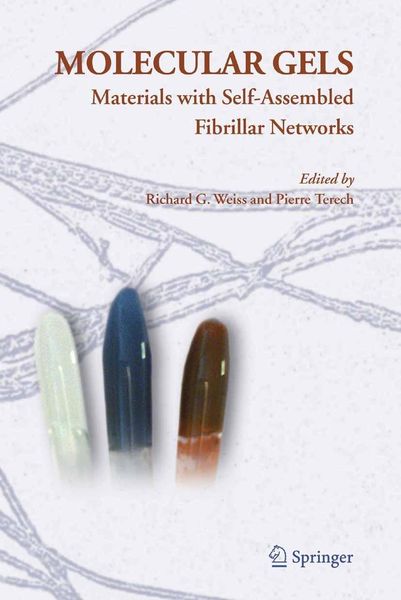
Produktbild: Molecular Gels

Molecular Gels Materials with Self-Assembled Fibrillar Networks

Aus der Reihe Molecular Gels

219,99 €

inkl. gesetzl. MwSt.

Beschreibung

Produktdetails

Format

PDF

Kopierschutz

Nein

Family Sharing

Nein

Text-to-Speech

Nein

Erscheinungsdatum

30.06.2006

Herausgeber

Richard G. Weiss + weitere

Verlag

Springer Netherlands

Seitenzahl

978 (Printausgabe)

Dateigröße

21224 KB

Sprache

Englisch

EAN

9781402036897

Beschreibung

Portrait

Richard G. Weiss is Professor of Chemistry, Department of Chemistry, Georgetown University, Washington, DC, USA. Pierre Terech is Research Director, CNRS - Atomic Energy Center - Grenoble University, Grenoble, France.

Produktdetails

Format

PDF

eBooks im PDF-Format haben eine festgelegte Seitengröße und eignen sich daher nur bedingt zum Lesen auf einem tolino eReader oder Smartphone. Für den vollen Lesegenuss empfehlen wir Ihnen bei PDF-eBooks die Verwendung eines Tablets oder Computers.

Kopierschutz

Nein

Dieses eBook können Sie uneingeschränkt auf allen Geräten der tolino Familie, allen sonstigen eReadern und am PC lesen. Das eBook ist nicht kopiergeschützt und kann ein personalisiertes Wasserzeichen enthalten. Weitere Hinweise zum Lesen von eBooks mit einem personalisierten Wasserzeichen finden Sie unter Hilfe/Downloads.

Family Sharing

Nein

Mit Family Sharing können Sie eBooks innerhalb Ihrer Familie (max. sechs Mitglieder im gleichen Haushalt) teilen. Sie entscheiden selbst, welches Buch Sie mit welchem Familienmitglied teilen möchten. Auch das parallele Lesen durch verschiedene Familienmitglieder ist durch Family Sharing möglich. Um eBooks zu teilen oder geteilt zu bekommen, muss jedes Familienmitglied ein Konto bei Thalia oder einem anderen tolino-Buchhändler haben. Weitere Informationen finden Sie unter Hilfe/Family-Sharing.

Text-to-Speech

Nein

Bedeutet Ihnen Stimme mehr als Text? Mit der Funktion Text-to-Speech können Sie sich im tolino webReader und in der aktuellen Thalia – Lesen & Hören App das eBook vorlesen lassen. Weitere Informationen finden Sie unter Hilfe/Text-to-Speech.

Barrierefreiheit

  • keine Information zur Barrierefreiheit bekannt

Erscheinungsdatum

30.06.2006

Herausgeber

Verlag

Springer Netherlands

Seitenzahl

978 (Printausgabe)

Dateigröße

21224 KB

Sprache

Englisch

EAN

9781402036897

Noch keine Bewertungen vorhanden

Verfassen Sie die erste Bewertung zu diesem Artikel

Helfen Sie anderen Kundinnen und Kunden durch Ihre Meinung.

Kundinnen und Kunden meinen

Bewertungen (0)

Weitere Artikel finden Sie in

  • Produktbild: Molecular Gels
  • Introduction.- Theory: Theory Of Molecular Association And Thermoreversible Gelation: Thermodynamic theory of network-forming liquid mixtures. Some important examples of non-gelling associating mixtures. Gelling solutions and mixtures. Summary.-
    Growth And Chirality Amplification In Helical Supramolecular Polymers: Introduction. Helical aggregation. Discotics. Linear self-assembly. A two-state model. Aggregate ends. Chirality amplification. Sergeants and soldiers. Conclusions and outlook.- Self Assembling Peptide Gels: Theoretical model of self-assembling chiral rod-like units. Experiments illustrating predictions of the model. Stabilization by twist. Nematic fluids and gels. Properties for new materials.- Kinetics Of Nucleation, Aggregation And Aging: Introduction. Some basic thermodynamic concepts. Basic concepts of the theory of nucleation and cluster growth. Spinodal decomposition. Secondary aggregation, coarsening and aging. Discussion.- Soft Glassy Rheology: Introduction. Rheology. The SGR model. Rheological aging: imposed strain. Rheological aging: imposed stress. Discussion and conclusion.-
    Rheological Chaos In Wormlike Micelles And Nematic Hydronamic: Deterministic Chaos in viscoelastic materials in shear flow. Spatiotemporal rheological oscillations and chaotic dynamics.- Wetting of Fibres: Introduction. The Rayleigh-Plateau instability. Drop shapes. Heterogeneous fibers. Invasion of a network of fibers. Conclusion.- Techniques: Gel Formation: Phase Diagrams Using Tabletop Rheology And Calorimetry: Introduction. Detecting the sol-gel transition by tabletop theology. Thermodynamics of gelation: sol-gel transition by calorimetry. Conclusions and perspectives.- Direct-Imaging And Freeze-Fracture Cryo-Transmission Electron Microscopy Of Molecular Gels: Introduction. Cryo-TEM. Cryo-Tem Investigations of Molecular Gels. Future Developments.- Molecular Gels And Small-Angle Scattering: Foreword. Introduction. Basic principles. Form-factors of rod-like scatterers. Semi-rigid fibers. Fibers with anisometric sections. Tubes. Helices. Scattering by the junction zones in the networks. Structure factor peak in poorly organized fibrillar scatterers. Oriented fibers. Real space data. Kinetic studies. Useful hints for a standard SANS investigation of molecular gels. Conclusion.- X-Ray Diffraction Of Poorly Organized Systems And Molecular Gels: Introduction Long range ordering. Single crystal diffraction. X-rays and neutrons. Applications of diffraction.- Optical Spectroscopic Methods As A Tool To Investigate Gel Structures: Introduction. Electronic absorption and emission spectroscopy. Ifrared spectroscopy.-
    Circular Dichroism For Studying Gel-Like Phases: Introduction. Technique. Applications to the study of gel-like phases. Perspectives.- Systems - Organogels: Low Molecular Mass Organo-Gelators: Analyses of the natures of gelators and liquids for efficient gelation: Introduction. Classification of low molecular-mass organo-gelators (lmogs). The role of liquid in gelation by lmogs. Future directions.- Design And Functions Of Low Molecular Weight Gelators Bearing Sugars And Steroids In Their Backbone: Introduction. Steroid derivatives for gelating organic liquids. Sugar derivatives for gelating liquids. Other related lmogs. Outlook.- Safin Gels With Amphiphilic Molecules: Introduction. Amphiphilic molecules. Gels with amphiphilic molecules. Gemini amphiphilic molecules. Conclusions.- Hydrogels: Advances In Molecular Hydrogels: Introduction. Historical perspective. Amino acid derivatives and oligopeptide based hydrogelators- b -Peptides as hydrogelators.Carbohydrate based hydrogelator