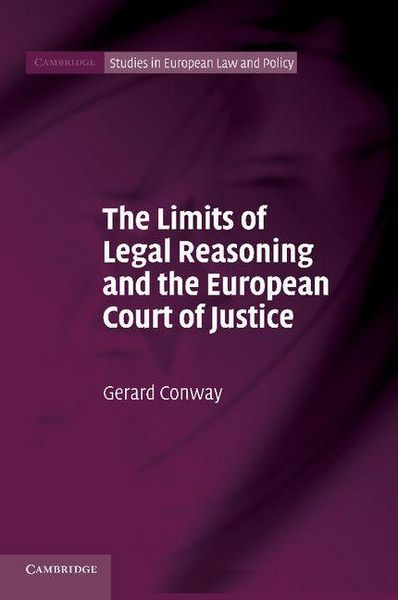
The Limits of Legal Reasoning and the European Court of Justice
-
- Hardcover
- Taschenbuch ausgewählt
- eBook
-
Sprache:Englisch
59,99 €
inkl. gesetzl. MwSt.,
Beschreibung
Produktdetails
Einband
Taschenbuch
Erscheinungsdatum
10.07.2013
Verlag
Cambridge AcademicSeitenzahl
346
Maße (L/B/H)
22,9/15,2/1,9 cm
Gewicht
460 g
Sprache
Englisch
ISBN
978-1-107-66035-9
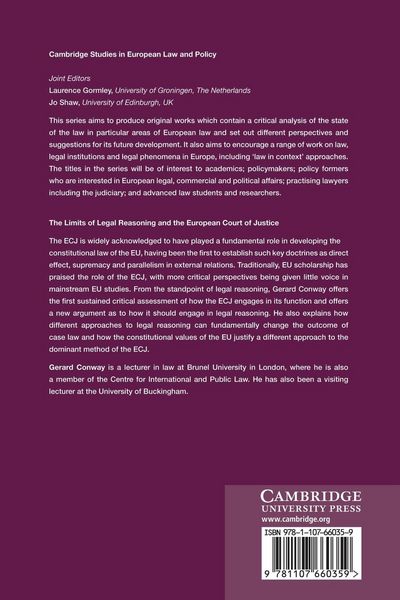
The European Court of Justice is widely acknowledged to have played a fundamental role in developing the constitutional law of the EU, having been the first to establish such key doctrines as direct effect, supremacy and parallelism in external relations. Traditionally, EU scholarship has praised the role of the ECJ, with more critical perspectives being given little voice in mainstream EU studies. From the standpoint of legal reasoning, Gerard Conway offers the first sustained critical assessment of how the ECJ engages in its function and offers a new argument as to how it should engage in legal reasoning. He also explains how different approaches to legal reasoning can fundamentally change the outcome of case law and how the constitutional values of the EU justify a different approach to the dominant method of the ECJ.
Noch keine Bewertungen vorhanden
Verfassen Sie die erste Bewertung zu diesem Artikel
Helfen Sie anderen Kundinnen und Kunden durch Ihre Meinung.
Kurze Frage zu unserer Seite
Vielen Dank für Ihr Feedback
Wir nutzen Ihr Feedback, um unsere Produktseiten zu verbessern. Bitte haben Sie Verständnis, dass wir Ihnen keine Rückmeldung geben können. Falls Sie Kontakt mit uns aufnehmen möchten, können Sie sich aber gerne an unseren Kund*innenservice wenden.
zum Kundenservice