KI-Beratung Beta

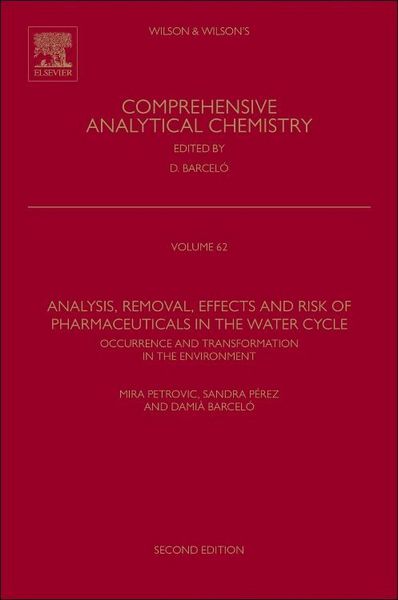
Produktbild: Analysis, Removal, Effects and Risk of Pharmaceuticals in the Water Cycle
Band 62

Analysis, Removal, Effects and Risk of Pharmaceuticals in the Water Cycle Occurrence and Transformation in the Environment Volume 62

187,99 €

inkl. gesetzl. MwSt., Versandkostenfrei


Beschreibung

Produktdetails

Einband

Gebundene Ausgabe

Erscheinungsdatum

26.11.2013

Herausgeber

Mira Petrovic + weitere

Verlag

Elsevier Science & Technology

Seitenzahl

600

Maße (L/B/H)

23,8/15,6/3,8 cm

Gewicht

1349 g

Auflage

2nd Revised edition

Sprache

Englisch

ISBN

978-0-444-62657-8

Beschreibung

Portrait

Dr. Sandra Pérez Solsona, (80 publications and 17 book chapters; H-index=27), Barcelona (Spain). Since May 2005, research associate at the Institute of Environmental Assessment and Water Research IDÆA-CSIC in Barcelona (Spain). She has a Ph.D. in Chemistry from the University of Barcelona (2003). Postdoctoral researcher at the State University of New York at Buffalo (2003-2005). Her work is focused on studying the occurrence, distribution and degradation of pollutants in the aquatic environment. Use of advanced mass spectrometry techniques such as the hybrid techniques UPLC-QToF-MS and UPLC-QExactive-MS, for the structural elucidation of novel transformation products and metabolites of organic pollutants. She uses suspect screening and non-target approaches based on high resolution MS for the detection of polar emerging contaminants and for assessing their elimination and transformation in both natural processes and engineered systems. She has been involved in different EU projects (EMCO, SANDRINE and GLOBAQUA), NSF projects in EEUU and Spanish national projects (CEMAGUA and SCARCE). Principal investigator of CSI-Environment (Marie Curie Actions ITN CSI:Environment PITN-GA-2010-264329).Prof. dr. Barcelo Damia, Director of the Catalan Institute for Water Research (ICRA) and Professor at the Institute of Environmental Assessment and Water Research (IDAEA), Barcelona, Spain. His expertise is in water quality assessment and management, fate, risk and removal of emerging contaminants in wastewater treatment plants and analysis, fate and risk of emerging contaminants and nanomaterials in the aquatic environment. He published over 900 papers, 200 book chapters and has h index 91. He was a coordinator of several national and EU projects and at the moment he coordinates two EU projects: GLOBAQUA , on multiple stressors in the aquatic environment and SEA-on-a-CHIP, on the development of sensor technolgies for emerging contamaints in marine aquaculture. He is CoEditor in Chief of the journal Science of Total Environment and the book series Comprehensive Analytical Chemistry, both form Elsevier..

Produktdetails

Einband

Gebundene Ausgabe

Erscheinungsdatum

26.11.2013

Herausgeber

Verlag

Elsevier Science & Technology

Seitenzahl

600

Maße (L/B/H)

23,8/15,6/3,8 cm

Gewicht

1349 g

Auflage

2nd Revised edition

Sprache

Englisch

ISBN

978-0-444-62657-8

EU-Ansprechpartner

Elsevier B.V.
Radarweg 29
1043 NX Amsterdam
NL
productsafety@elsevier.com

Herstelleradresse

Elsevier Science & Technology
London Wall 125
EC2Y 5AS London
GB
tradeorders@elsevier.com

Noch keine Bewertungen vorhanden

Verfassen Sie die erste Bewertung zu diesem Artikel

Helfen Sie anderen Kundinnen und Kunden durch Ihre Meinung.

Kundinnen und Kunden meinen

Bewertungen (0)

Die Leseprobe wird geladen.
  • Produktbild: Analysis, Removal, Effects and Risk of Pharmaceuticals in the Water Cycle
  • Introduction: Pharmaceuticals in the environment1. General introduction on pharmaceuticals, Peter Eichhorn2. Pharmaceuticals in the environment: Sources and their management, Christian DaughtonAnalysis of pharmaceuticals in the environment3. Prioritization: selection of contaminants to be monitored, Antoni Ginebreda4. Analysis of PhACs in aqueous samples (wastewater, surface water, groundwater, drinking water), Imma Ferrer5. Analysis of PhACs in solid environmental samples (soil, sediment, sludge), Sandra Babic6. Analysis of PhACs in biota, Sara Rodriguez7. Application of bioassays/biosensors for the analysis of pharmaceuticals in environmental samples, Roger GalveRemoval of pharmaceuticals in wastewater and drinking water treatment8. Removal of pharmaceuticals in wastewater treatment plants (conventional technology - CAS), Paola Verlicchi9. Removal of pharmaceuticals by membrane bioreactor technology (MBR), Rubén Reif López10. Removal of pharmaceuticals by UF, NF, RO, Davor Dolar11. Removal of pharmaceuticals by ozonation and advanced oxidation processes (AOP), Despo Fatta-Kassinos12. Removal by natural treatments (constructed wetlands), Victor Matamoros13. Removal of pharmaceuticals bank filtration and artificial recharge, Sung Kyu MaengFate and occurrence of pharmaceuticals in the environment14. Fate and occurrence of pharmaceuticals in the aquatic environment (surface water, sediment), Guang-Guo Ying15. Fate and occurrence of PhACs in the terrestrial environment, Silvia Diaz-Cruz16. Methods for elucidation of abiotic and biotic transformation pathways, Sandra PérezEffects and risk assessment17. Ecotoxicity of pharmaceuticals, Demetrio Raldua18. The effect of PhACs on biological communities in rivers: field studies, Lorenzo Proia19. Effect of antibiotics on microbial resistance, Jose Luis Balcazar20. Data evaluation for risks assessment purposes, Christina Ruden21. Conclusions and Needs for Future Research, Mira Petrovic