Gutscheinbedingungen

**Gültig bis 06.07.2026 auf fremdsprachige Bücher online auf thalia.at, in der Thalia App ab einem Mindestbestellwert von 30€ und in allen Thalia Buchhandlungen in Österreich. In den Buchhandlungen nur gültig auf lagernde Ware. Einzelne Artikel können ausgeschlossen sein. Ausgenommen sind preisgebundene Artikel & eBooks. Pro Einkauf einmal einlösbar. Nur gültig gegen Vorlage oder im Onlineshop hinterlegter Bonuscard. Infos zur Einlösung in der Buchhandlung sind auf der Bonuscard-Vorteilspreisseite zu finden. Click & Collect nur bei Onlinevorabzahlung möglich. Keine Einlösung bei Scan & Go-Bezahlung. Keine Barauszahlung. Nicht kombinierbar mit anderen Aktionen und Gutscheinen. Gutschein wird auf max. 500€ Bestellwert angerechnet. Nicht gültig für Versandkosten und Services.

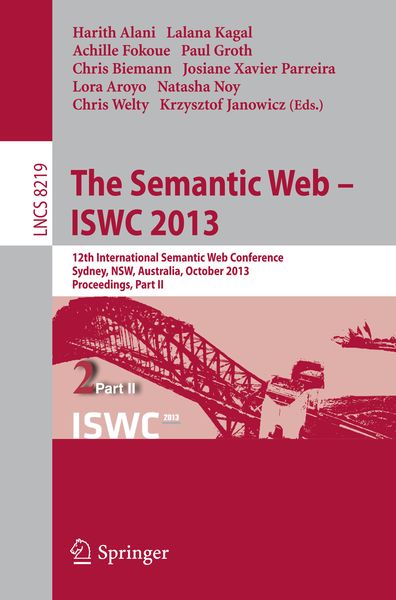
  • Produktbild: The Semantic Web - ISWC 2013
  • Produktbild: The Semantic Web - ISWC 2013
Band 8218

The Semantic Web - ISWC 2013 12th International Semantic Web Conference, Sydney, NSW, Australia, October 21-25, 2013, Proceedings, Part II

49,99 €

inkl. gesetzl. MwSt., Versandkostenfrei


Beschreibung

Produktdetails

Einband

Taschenbuch

Erscheinungsdatum

26.09.2013

Abbildungen

XXXII, 135 illus., schwarz-weiss Illustrationen

Herausgeber

Harith Alani + weitere

Verlag

Springer Berlin

Seitenzahl

468

Maße (L/B/H)

23,5/15,5/2,7 cm

Gewicht

751 g

Auflage

2013

Sprache

Englisch

ISBN

978-3-642-41337-7

Beschreibung

Produktdetails

Einband

Taschenbuch

Erscheinungsdatum

26.09.2013

Abbildungen

XXXII, 135 illus., schwarz-weiss Illustrationen

Herausgeber

Verlag

Springer Berlin

Seitenzahl

468

Maße (L/B/H)

23,5/15,5/2,7 cm

Gewicht

751 g

Auflage

2013

Sprache

Englisch

ISBN

978-3-642-41337-7

Herstelleradresse

Springer-Verlag KG
Sachsenplatz 4-6
1201 Wien
AT

Email: GPSR Kontakt

Noch keine Bewertungen vorhanden

Verfassen Sie die erste Bewertung zu diesem Artikel

Helfen Sie anderen Kundinnen und Kunden durch Ihre Meinung.

Kundinnen und Kunden meinen

Bewertungen (0)

  • Produktbild: The Semantic Web - ISWC 2013
  • Produktbild: The Semantic Web - ISWC 2013
  • Social Listening of City Scale Events Using the Streaming Linked Data.- Deployment of RDFa, Microdata, and Microformats on the Web – A Quantitative Analysis.- Entity Recommendations in Web.- The Energy Management Adviser at EDF.- Incorporating Commercial and Private Data into an Open Linked Data Platform for Drug Discovery.- When History Matters - Assessing Reliability for the Reuse of Scientific Workflows.- Integrating NLP Using Linked Data.- A Linked-Data-Driven and Semantically-Enabled Journal Portal for Scientometrics.- Cross-Language Semantic Retrieval and Linking of E-Gov.- Using the Past to Explain the Present: Interlinking Current Affairs with Archives via the Semantic Web.- Publishing the Norwegian Petroleum Directorate’s FactPages as Semantic Web Data.- Real-Time Urban Monitoring in Dublin Using Semantic and Stream Technologies.- Using Semantic Web in ICD-11: Three Years Down the Road.- Semantic Data and Models Sharing in Systems Biology: The Just Enough Results Model and the SEEK Platform.- Reasoning on Crowd-Sourced Semantic Annotations to Facilitate Cataloguing of 3D Artefacts in the Cultural Heritage Domain.- Using Linked Data to Evaluate the Impact of Research and Development in Europe: A Structural Equation Model.- Crowdsourcing Linked Data Quality Assessment.- SPARQL Web-Querying Infrastructure: Ready for Action.- String Similarity Metrics for Ontology Alignment.- NoSQL Databases for RDF: An Empirical Evaluation.- On Correctness in RDF Stream Processor Benchmarking.- Geographica: A Benchmark for Geospatial RDF Stores.- Introducing Statistical Design of Experiments to SPARQL Endpoint Evaluation.- Towards a Systematic Benchmarking of Ontology-Based Query Rewriting Systems.- Evaluation Measures for Ontology Matchers in Supervised Matching Scenarios.- Evaluating and Benchmarking SPARQL Query Containment Solvers.- Assessing Content Value for Digital Publishing through Relevance and Provenance-Based Trust.- The Effects of Licensing on Open Data: Computing a Measure of Health for Our Scholarly Record.- Utilising Provenance to Enhance Social Computation.- Crowdsourcing Ontology Verification.- Interactive Pay as You Go Relational-to-Ontology Mapping.