Gutscheinbedingungen

**Gültig bis 06.07.2026 auf fremdsprachige Bücher online auf thalia.at, in der Thalia App ab einem Mindestbestellwert von 30€ und in allen Thalia Buchhandlungen in Österreich. In den Buchhandlungen nur gültig auf lagernde Ware. Einzelne Artikel können ausgeschlossen sein. Ausgenommen sind preisgebundene Artikel & eBooks. Pro Einkauf einmal einlösbar. Nur gültig gegen Vorlage oder im Onlineshop hinterlegter Bonuscard. Infos zur Einlösung in der Buchhandlung sind auf der Bonuscard-Vorteilspreisseite zu finden. Click & Collect nur bei Onlinevorabzahlung möglich. Keine Einlösung bei Scan & Go-Bezahlung. Keine Barauszahlung. Nicht kombinierbar mit anderen Aktionen und Gutscheinen. Gutschein wird auf max. 500€ Bestellwert angerechnet. Nicht gültig für Versandkosten und Services.

  • Produktbild: Philosophy Comes to Dinner
  • Produktbild: Philosophy Comes to Dinner

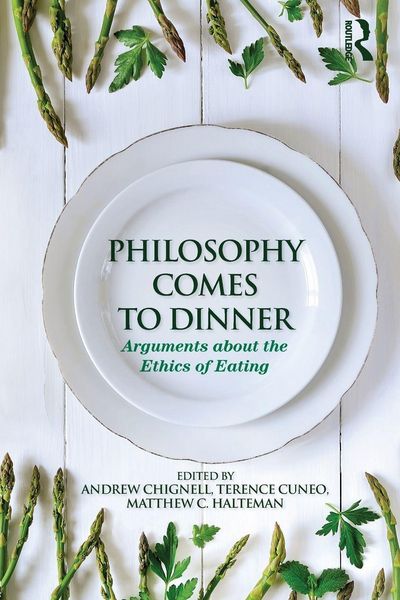
Philosophy Comes to Dinner Arguments About the Ethics of Eating

53,99 €

inkl. gesetzl. MwSt., Versandkostenfrei


Beschreibung

Produktdetails

Einband

Taschenbuch

Erscheinungsdatum

23.10.2015

Herausgeber

Andrew Chignell + weitere

Verlag

Taylor & Francis

Seitenzahl

320

Maße (L/B/H)

22,9/15,2/1,7 cm

Gewicht

460 g

Sprache

Englisch

ISBN

978-0-415-80683-1

Beschreibung

Rezension

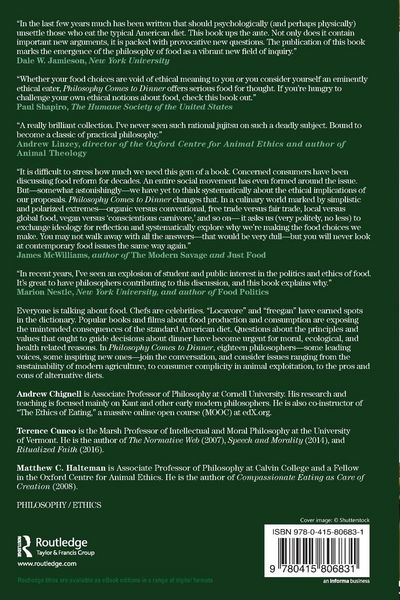
"Whether your food choices are void of ethical meaning to you or you consider yourself an eminently ethical eater, Philosophy Comes to Dinner offers serious food for thought. If you're hungry to challenge your own ethical notions about food, check this book out."

Paul Shapiro, The Humane Society of the United States

"The act of eating involves ethical decisions, and yet most of us eat without contemplation-we exclude philosophy from our thought process, and instead make our dietary choices almost exclusively based on price and taste. Philosophy Comes to Dinner: Arguments about the Ethics of Eating aims to change that, and it does so with a diverse collection of essays that attacks the moral question of what to eat from a wide and intriguing range of perspectives. This important book should be read by everyone who eats."

Bruce G. Friedrich, Farm Sanctuary

"A really brilliant collection. I've never seen such rational jujitsu on such a deadly subject. Bound to become a classic of practical philosophy."

Andrew Linzey, director of the Oxford Centre for Animal Ethics and author of Animal Theology

"It is difficult to stress how much we need this gem of a book. Concerned consumers have been discussing food reform for decades. An entire social movement has even formed around the issue. But-somewhat astonishingly-we have yet to think systematically about the ethical implications of our proposals. Philosophy Comes to Dinner changes that. In a culinary world marked by simplistic and polarized extremes-organic versus conventional, free trade versus fair trade, local versus global food, vegan versus "conscientious carnivore," and so on- it asks us (very politely, no less) to exchange ideology for reflection and systematically explore why we're making the food choices we make. You may not walk away with all the answers--that would be very dull-- but you will never look at the contemporary food issues the same way again."

James McWilliams, author of The Modern Savage and Just Food

"The essays collected in this timely volume tackle a wide range of important ethical questions about our food system in a manner that is both argumentatively rigorous and accessible - both the scholar and the non-specialist will find much to chew on here."

Kate Nolfi, University of Vermont, USA

"In recent years, I've seen an explosion of student and public interest in the politics and ethics of food. It's great to have philosophers contributing to this discussion, and this book explains why."

Marion Nestle, New York University, USA, and author of Food Politics

Produktdetails

Einband

Taschenbuch

Erscheinungsdatum

23.10.2015

Herausgeber

Verlag

Taylor & Francis

Seitenzahl

320

Maße (L/B/H)

22,9/15,2/1,7 cm

Gewicht

460 g

Sprache

Englisch

ISBN

978-0-415-80683-1

Noch keine Bewertungen vorhanden

Verfassen Sie die erste Bewertung zu diesem Artikel

Helfen Sie anderen Kundinnen und Kunden durch Ihre Meinung.

Kundinnen und Kunden meinen

Bewertungen (0)

Die Leseprobe wird geladen.
  • Produktbild: Philosophy Comes to Dinner
  • Produktbild: Philosophy Comes to Dinner
  • 0. Matthew C. Halteman, Terence Cuneo, Andrew Chignell, "Introduction". I. Dietary Ideals. 1. Terence Cuneo, "Conscientious Omnivorism". 2. Christina Van Dyke, "Manly Meat and Gendered Eating: Correcting Imbalance and Seeking Virtue". 3. Benjamin J. Bruxvoort Lipscomb, "’Eat Responsibly:’ Agrarianism and Meat". 4. Tristram McPherson, "Why I Am a Vegan (and You Should Be One Too)". 5. Dan Hooley and Nathan Nobis, "A Moral Argument for Veganism". 6. Tyler Doggett and Andy Egan, "Non-Ideal Food Choices". 7. Matthew C. Halteman and Megan Halteman Zwart, "Philosophy as Therapy for Recovering (Unrestrained) Omnivores". II. Puzzling Questions. 8. Ted A.Warfield, "Eating Dead Animals: Meat Eating, Meat Purchasing, and Proving Too Much". 9. Mark Budolfson, "Consumer Ethics, Harm Footprints, and the Empirical Dimensions of Food Choices". 10. Andrew Chignell, "Can We Really Vote with Our Forks? Opportunism and the Threshold Chicken". 11. Adrienne M. Martin, "Factory Farming and Consumer Complicity". 12. Elizabeth Harman, "Eating Meat as a Morally Permissible Moral Mistake". 13. Anne Barnhill, "Does Locavorism Keep It Too Simple?". 14. David M. Kaplan, "What’s Wrong with Artificial Ingredients?". 15. Jeff McMahan, "The Moral Problem of Predation"