KI-Beratung Beta

Gutscheinbedingungen

**Gültig bis 30.11.2026 auf Spielzeug, Schreibwaren, Filme, Geschenke & Trends, Musik, tolino eReader & Zubehör, Hörbücher und Hörbuch-Downloads, nicht preisgebundene Bücher und Kalender online auf thalia.at und in der Thalia App. Einzelne Artikel können ausgeschlossen sein. Aufgrund der Buchpreisbindung sind deutschsprachige Bücher und eBooks ausgenommen. Zusätzlich ausgenommen sind Abos & Flatrates, Games, Geschenkkarten/-boxen, Shelfies, Software, Zeitschriften sowie einzelne Artikel von tonies®. Pro Einkauf einmal einlösbar. Nur gültig mit im Onlineshop hinterlegter Bonuscard. Click & Collect nur bei Onlinevorabzahlung möglich. Keine Barauszahlung. Nicht kombinierbar mit anderen Aktionen und Gutscheinen. Gutschein wird auf max. 500€ Bestellwert angerechnet. Nicht gültig für Versandkosten und Services.

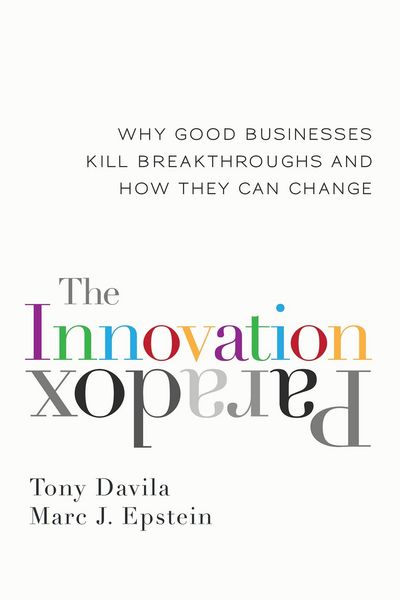
Produktbild: The Innovation Paradox

The Innovation Paradox Why Good Businesses Kill Breakthroughs and How They Can Change

29,99 €

inkl. gesetzl. MwSt., zzgl. Versandkosten


  • Kostenlose Lieferung ab 30 € Einkaufswert
  • Versandkostenfrei für Bonuscard-Kund*innen

Beschreibung

It's a paradox: as big companies get better at achieving operational excellence, actual breakthroughs seem to decrease. It's the scrappy little startups, with comparatively tiny budgets, that continue to be founts of innovation. Why is it that as industry leaders get better at what they do, they get...

Beschreibung

It's a paradox: as big companies get better at achieving operational excellence, actual breakthroughs seem to decrease. It's the scrappy little startups, with comparatively tiny budgets, that continue to be founts of innovation. Why is it that as industry leaders get better at what they do, they get worse at innovation?

By conducting deep research within companies as diverse as Apple, Google, Pfizer, General Motors, Nike, and Sony, the authors have found the answer: the very pursuit of operational excellence - that is, making one's existing business as efficient as it can be - blinds managers to the kinds of disruptive business model changes vital for innovation. These changes could threaten all that hard work. It's why Nokia famously killed its smart phone - the company was too invested in "dumb phones." Nothing less than a complete redesign and rethinking of the corporation - down to how accountants capture innovation costs and overhead - is necessary to get companies moving again. The authors' new model, "the startup corporation," marries the strengths of corporate scale to the nimbleness of entrepreneurs.

For a model of the new startup corporation, the authors return again and again to Apple, which doesn't have the usual corporate structure and accounting systems. Not every company can be an Apple, but all companies can learn to break the bonds of operational thinking if they'll take the authors' lessons to heart.

Produktdetails

Einband

Gebundene Ausgabe

Erscheinungsdatum

30.06.2014

Verlag Random House N.Y.
Seitenzahl

240

Produktdetails

Einband

Gebundene Ausgabe

Erscheinungsdatum

30.06.2014

Verlag Random House N.Y.
Seitenzahl

240

Maße (L/B/H)

24,1/15,9/2,7 cm

Gewicht

515 g

Sprache

Englisch

ISBN

978-1-60994-553-4

Herstelleradresse

Libri GmbH
Europaallee 1
36244 Bad Hersfeld
DE

Email: gpsr@libri.de

Noch keine Bewertungen vorhanden

Verfassen Sie die erste Bewertung zu diesem Artikel

Helfen Sie anderen Kundinnen und Kunden durch Ihre Meinung.

Kundinnen und Kunden meinen

Bewertungen (0)

  • Produktbild: The Innovation Paradox
  • Preface
    1. What is the Innovation Paradox?
    1.1 Incremental and Breakthrough Innovation
    1.2 Top-Down and Bottom-Up Innovation
    1.3 Managing for Strategic Discoveries
    1.4 The Startup Corporation
    1.5 The Truth About the Innovation Paradox
    2. The Benefits and Limits of the Business Unit
    2.1 The Benefits of Business Units
    2.2 The Limits of Business Units
    2.3 Business Units, Functional Structure, and Breakthrough Innovation
    3. The Success of Startups
    3.1 Copy and Combine from Others
    3.2 Learn as Quickly and as Cheaply as Possible
    3.3 Manage Risk Effectively
    3.4 Govern Transparently
    3.5 Execute
    3.6 Learning From the Activities of Startup Innovation
    3.7 Learning from the Creation of Science
    4. The Startup Corporation: The New Kid on the Block
    4.1 Beyond the Success of Startups
    4.2 Adopting the Strengths of Startups
    4.3 Stage One: Inspire
    4.4 Stage Two: Attract
    4.5 Stage Three: Combine
    4.6 Stage Four: Learn
    4.7 Stage Five: Leverage
    4.8 Stage Six: Integrate
    5. Implementing the Startup Corporation
    5.1 Solutions for Inspiring
    5.2 Solutions for Attracting
    5.3 Solutions for Combining
    5.4 Solutions for Learning
    5.5 Solutions for Leveraging
    5.6 Solutions for Integrating
    6. Overcoming the Innovation Paradox: Designing the Startup Corporation
    6.1 Managing Breakthrough Innovation Projects
    6.2 Inspiring the Startup Corporation
    6.3 Attracting Ideas into the Startup Corporation
    6.4 Combining the Pieces of the Startup Corporation
    6.5 Learning for Strategic Discoveries
    6.6 Leveraging Strategic Discoveries
    6.7 Integrating Strategic Discoveries
    7. Innovative Cultures
    7.1 Changing the Culture of an Organization
    7.2 Employee Abilities
    7.3 Supporting Innovation Activities
    7.4 Goals and Evaluation
    7.5. Role Models and Structures
    7.6 Resources, Culture, and Innovation
    8. Leading for Breakthrough Innovation
    8.1 The Innovation Strategist
    8.2 The Innovation Sponsor
    8.3 The Innovation Architect
    8.4 The Innovation Evangelist
    8.5 Personal Characteristics of Innovative leaders
    9. Hard Foundations: Strategy, Incentives, and Management Systems
    9.1 Strategies for Breakthrough Innovation
    9.2 Incentives for Breakthrough innovation
    9.3 Management Systems for Breakthrough innovation
    10. Wrapping up
    About the Authors
    Index