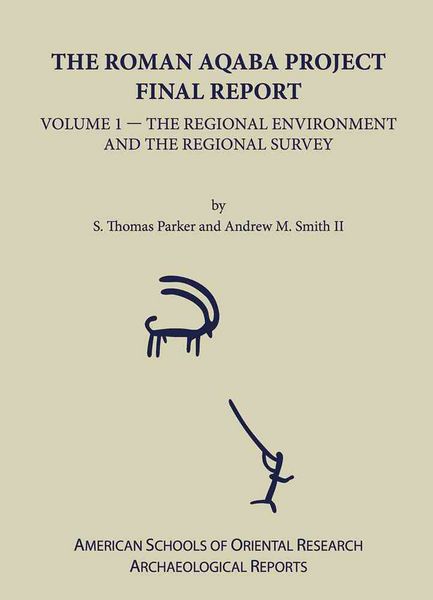
The Roman Aqaba Project Final Report, Volume 1 The Regional Environment and the Regional Survey
-
- Englisch ausgewählt
24,99 €
inkl. gesetzl. MwSt.,
- Kostenlose Lieferung ab 30 € Einkaufswert
- Versandkostenfrei für Bonuscard-Kund*innen
Beschreibung
Produktdetails
Einband
Gebundene Ausgabe
Erscheinungsdatum
03.03.2014
Verlag
American Society of Overseas ResearchSeitenzahl
400
Maße (L/B/H)
27,9/21,8/2,5 cm
Gewicht
1497 g
Sprache
Englisch
ISBN
978-0-89757-042-8
Recent scholarship on the Roman Empire has focused on the nature of its economy, including sites that served as nodules of commercial exchange. Aila was such a port city on the Red Sea on the southeastern frontier of the Empire, now within modern Aqaba in Jordan. The city of Aila emerged in the late 1st century BC within the Nabataean kingdom, a client state of the Roman Empire. The port continued to flourish into the early Islamic period, handling trade between the Empire and south Arabia, east Africa, and India. The Roman Aqaba Project aimed to reconstruct Aila's economy diachronically. The project research design included a regional archaeological and environmental survey, excavation of the ancient city, and analysis of material remains relevant to Aila's economy. Six field seasons were conducted between 1994 and 2002, providing a detailed picture of the economic history of the city. Excavation revealed major elements of the city, such as domestic quarters, industrial facilities, fortifications, and a monumental building interpreted as an early Christian church. This first of three projected volumes of the project's final report focuses on the regional environment and the regional survey. Analysis of the environment employs a wide range of evidence to analyze the physiography, geology, soils, seismic history, climate, and natural resources. Various lines of evidence are employed to reconstruct the paleoclimate, which seems to have remained essentially hyperarid since early historical times. The report also includes results of an intensive archaeological survey of Wadi Araba, the shallow valley extending north from Aqaba to the Dead Sea. The project surveyed the southeastern the valley, recording 334 archaeological sites, most previously unrecorded. These of these were small and unobtrusive and ranged in date from Paleolithic to Late Islamic, but especially common were sites of the Chalcolithic/Early Bronze Age and the Early Roman/Nabataean periods, suggesting more intensive occupation in these periods. The volume also includes chapters on artifacts collected by the survey, including chipped stone tools, pottery, and Nabataean inscriptions. Aila apparently lacked any significant agricultural hinterland. The city was largely dependent on imports from more distant sources.
Noch keine Bewertungen vorhanden
Verfassen Sie die erste Bewertung zu diesem Artikel
Helfen Sie anderen Kundinnen und Kunden durch Ihre Meinung.
Kurze Frage zu unserer Seite
Vielen Dank für Ihr Feedback
Wir nutzen Ihr Feedback, um unsere Produktseiten zu verbessern. Bitte haben Sie Verständnis, dass wir Ihnen keine Rückmeldung geben können. Falls Sie Kontakt mit uns aufnehmen möchten, können Sie sich aber gerne an unseren Kund*innenservice wenden.
zum Kundenservice