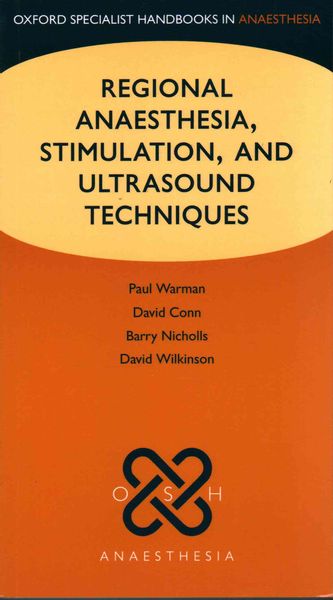
Produktbild: Regional Anaesthesia, Stimulation, and Ultrasound Techniques

Regional Anaesthesia, Stimulation, and Ultrasound Techniques

105,99 €

inkl. gesetzl. MwSt., Versandkostenfrei


Beschreibung

Produktdetails

Einband

Taschenbuch

Erscheinungsdatum

27.01.2015

Herausgeber

Warman Paul + weitere

Verlag

Oxford University Press

Seitenzahl

592

Maße (L/B/H)

18/10,3/3,2 cm

Gewicht

481 g

Sprache

Englisch

ISBN

978-0-19-955984-8

Beschreibung

Rezension

This textbook, although intended for anaesthesiologists, will be of interest to various surgeons, including urologists. Professor Paul Meria European Urology

Produktdetails

Einband

Taschenbuch

Erscheinungsdatum

27.01.2015

Herausgeber

Verlag

Oxford University Press

Seitenzahl

592

Maße (L/B/H)

18/10,3/3,2 cm

Gewicht

481 g

Sprache

Englisch

ISBN

978-0-19-955984-8

Herstelleradresse

Libri GmbH
Europaallee 1
36244 Bad Hersfeld
DE

Email: gpsr@libri.de

Noch keine Bewertungen vorhanden

Verfassen Sie die erste Bewertung zu diesem Artikel

Helfen Sie anderen Kundinnen und Kunden durch Ihre Meinung.

Kundinnen und Kunden meinen

Bewertungen (0)

Die Leseprobe wird geladen.
  • Produktbild: Regional Anaesthesia, Stimulation, and Ultrasound Techniques
    • Part 1 General considerations

    • 1: A brief history of regional anaesthesia

    • 2: The physiology of pain

    • 3: Local anaesthetics and additives

    • 4: Local anaesthetic toxicity

    • 5: Peripheral nerve location using nerve stimulators

    • 6: Basic physics of ultrasound

    • 7: Principles and practice of ultrasound guided regional anaesthesia

    • 8: Risks, benefits, and controversies of regional anaesthesia

    • 9: Regional anaesthesia in patients taking anticoagulant drugs

    • 10: Preparation and care of the awake patient during surgery

    • 11: Wound infiltration and catheters techniques

    • 12: Dermatomes and myotomes

    • 13: Paediatric regional anaesthesia techniques

    • 14: Peripheral nerve catheters

    • 15: Training and assessment in regional anaesthesia

    • Part 2 Head and neck

    • 16: Regional anaesthesia for ophthalmic surgery

    • 17: Maxillofacial blocks

    • 18: Cervical plexus blocks

    • 19: Stellate ganglion (cervical sympathetic trunk)

    • 20: Topical and regional anaesthesia of the upper airways

    • Part 3 Upper limb

    • 21: Interscalene brachial plexus block

    • 22: Suprascapular nerve block

    • 23: Supraclavicular brachial plexus block

    • 24: Infraclavicular brachial plexus block

    • 25: Axillary brachial plexus block

    • 26: Mid-humeral block

    • 27: Elbow and forearm blocks

    • 28: Wrist, hand, and finger blocks

    • 29: Intravenous regional anaesthesia (Bier's block)

    • Part 4 Trunk blocks

    • 30: Intercostal and interpleural blocks

    • 31: Paravertebral block

    • 32: Transversus abdominis plane (TAP) block

    • 33: Ilioinguinal and iliohypogastric nerve blocks

    • 34: Rectus sheath block

    • 35: Penile block

    • Part 5 Lower limb

    • 36: Lumbar plexus block

    • 37: Femoral nerve block

    • 38: Fascia ilica block

    • 39: Lateral cutaneous nerve of the thigh block

    • 40: Saphenous nerve block

    • 41: Obturator nerve block

    • 42: Parasacral approach to sacral plexus block

    • 43: Proximal sciatic nerve block

    • 44: Popliteal fossa sciatic nerve block

    • 45: Ankle block

    • 46: Foot blocks

    • Part 6

    • 47: General considerations for central neuraxial blocks

    • 48: Epidural anesthesia and analgesia

    • 49: Spinal anaesthesia, combined spinal epidural (CSE) and continuous spinal anaesthesia (CSA)