Gutscheinbedingungen

**Gültig bis 25.06.2026 auf fremdsprachige Bücher online auf thalia.at und in der Thalia App. Einzelne Artikel können ausgeschlossen sein. Ausgenommen sind preisgebundene Artikel & eBooks. Pro Einkauf einmal einlösbar. Click & Collect nur bei Onlinevorabzahlung möglich. Keine Barauszahlung. Nicht kombinierbar mit anderen Aktionen und Gutscheinen. Gutschein wird auf max. 500€ Bestellwert angerechnet. Nicht gültig für Geschenkkarten, Versandkosten und Services.

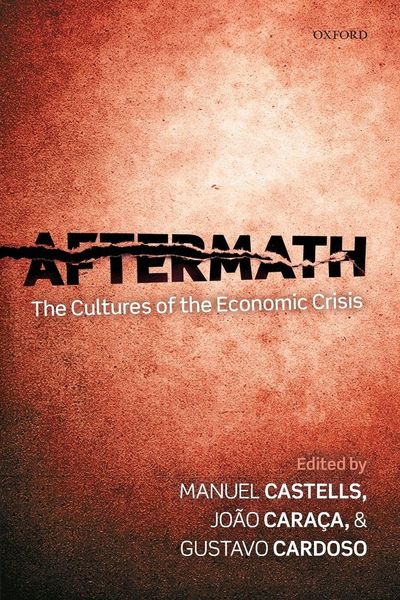
Produktbild: Aftermath

Aftermath The Cultures of the Economic Crisis

55,99 €

inkl. gesetzl. MwSt., Versandkostenfrei


Beschreibung

Produktdetails

Einband

Taschenbuch

Erscheinungsdatum

01.05.2014

Herausgeber

Manuel Castells + weitere

Verlag

Oxford University Press

Seitenzahl

330

Maße (L/B/H)

23,4/15,6/1,8 cm

Gewicht

494 g

Sprache

Englisch

ISBN

978-0-19-967738-2

Beschreibung

Rezension

The discussion of the crisis of global capitalism offered in this book marks a breakthrough. The work ranges far more widely than the usual crop of purely economic analyses and rightly so. Anthony Giddens, Former Director of the London School of Economics and Political Science

Zitat

Reviews from previous edition"Manuel Castells has shaped himself into the most prominent and influential theorist and analyst of the modern communications and network age. He is the Marshall McLuhan of our time."--John Lloyd, Financial Times"a challenging and intriguing work [in its] ambitions, scope and concepts."--Paschal Preston, Media, Culture & Society, Volume 32 (6), 2010"A sustained inquiry into the nature of political and economic power in the modern world."--Steven Livingston, Political Communicatoin (27)"Castells has done it again, a masterpiece of global perspective and enviable erudition. Moving beyond his trilogy on the information age, Castells focuses on how cultural, economic and particularly political power relationships are constituted and sustained through systematic communication flows. A new line of analysis draws on neuroscience and cognitive psychology to track the role of emotion in political communication. Case studies include global media deregulation, the politics of scandal, framing the war in Iraq, ecological social movements, the Obama presidential candidacy and a fascinating comparison of media control dynamics in Russia and China."-- W. Russell Neuman, Evans Professor of Media Technology, University of Michigan"How could Manuel Castells have predicted that now is the time of the perfect storm? I do not know. But I do know that his new book coincides with the largest downturn in global economies since the 1930s, with the most important American election since the 1960s, with a most radical transformation of world politics in many generations, and with the most profound reevaluation of the lives of modern citizens, from what they value to how they communicate. We have become used to Castells' careful scholarship and penetrating analyses but in this new book he cuts deeper into the heart of the matter. Sometimes he provides illuminating answers and where he cannot, he frames the questions that must

Produktdetails

Einband

Taschenbuch

Erscheinungsdatum

01.05.2014

Herausgeber

Verlag

Oxford University Press

Seitenzahl

330

Maße (L/B/H)

23,4/15,6/1,8 cm

Gewicht

494 g

Sprache

Englisch

ISBN

978-0-19-967738-2

Herstelleradresse

Libri GmbH
Europaallee 1
36244 Bad Hersfeld
DE

Email: gpsr@libri.de

Kundinnen und Kunden meinen

0 Bewertungen

Informationen zu Bewertungen

Zur Abgabe einer Bewertung ist eine Anmeldung im Konto notwendig. Die Authentizität der Bewertungen wird von uns nicht überprüft. Wir behalten uns vor, Bewertungstexte, die unseren Richtlinien widersprechen, entsprechend zu kürzen oder zu löschen.

Die Bewertungen sind nach Format, Anzahl Sterne und Datum sortiert.

Verfassen Sie die erste Bewertung zu diesem Artikel

Helfen Sie anderen Kund*innen durch Ihre Meinung

Kundinnen und Kunden meinen

0 Bewertungen filtern

  • Produktbild: Aftermath
    • 1: Manuel Castells, João Caraça and Gustavo Cardoso: The Cultures of the Economic Crisis: An Introduction

    • PRELUDE

    • 2: Rosalind Williams: The Rolling Apocalypse of Contemporary History

    • 3: João Caraça: The Separation of Cultures and the Decline of Modernity

    • WHICH CRISIS? WHOSE CRISIS?

    • 4: John B. Thompson: The Metamorphosis of a Crisis

    • 5: Michel Wieviorka: Financial Crisis or Societal Mutation?

    • DEALING WITH THE CRISIS

    • 6: Sarah Banet-Weiser: Branding the Crisis

    • 7: Terhi Rantanen: In Nationalism We Trust?

    • 8: Pekka Himanen: Crisis, Identity and the Welfare State

    • BEYOND THE CRISIS

    • 9: Gustavo Cardoso and Pedro Jacobetty: Surfing the Crisis: Cultures of Belonging and Networked Social Change

    • 10: Joana Conill, Manuel Castells, Amalia Cardenas and Lisa Servon: Beyond the Crisis: The Emergence of Alternative Economic Practises

    • THE NON-GLOBAL GLOBAL CRISIS

    • 11: You-tien Hsing: No Crisis in China? The Rise of China's Social Crisis

    • 12: Ernesto Ottone: A Non-Global Crisis? Challenging the Crisis in Latin America

    • AFTERMATH?